A solid cube is painted yellow on all its faces. The cube is then cut into 60 smaller but equal pieces by making the minimum number of cuts. Which of the following statements is/are correct? I. The minimum number of cuts is 9. II. The number of smaller pieces which are not painted on any face is 6. Select the correct answer using the code given below:

- AI only
- BII only
- CBoth I and IICorrect
- DNeither I nor II
Explanation
To solve this problem, we need to understand how cuts in a cube relate to the number of pieces formed.
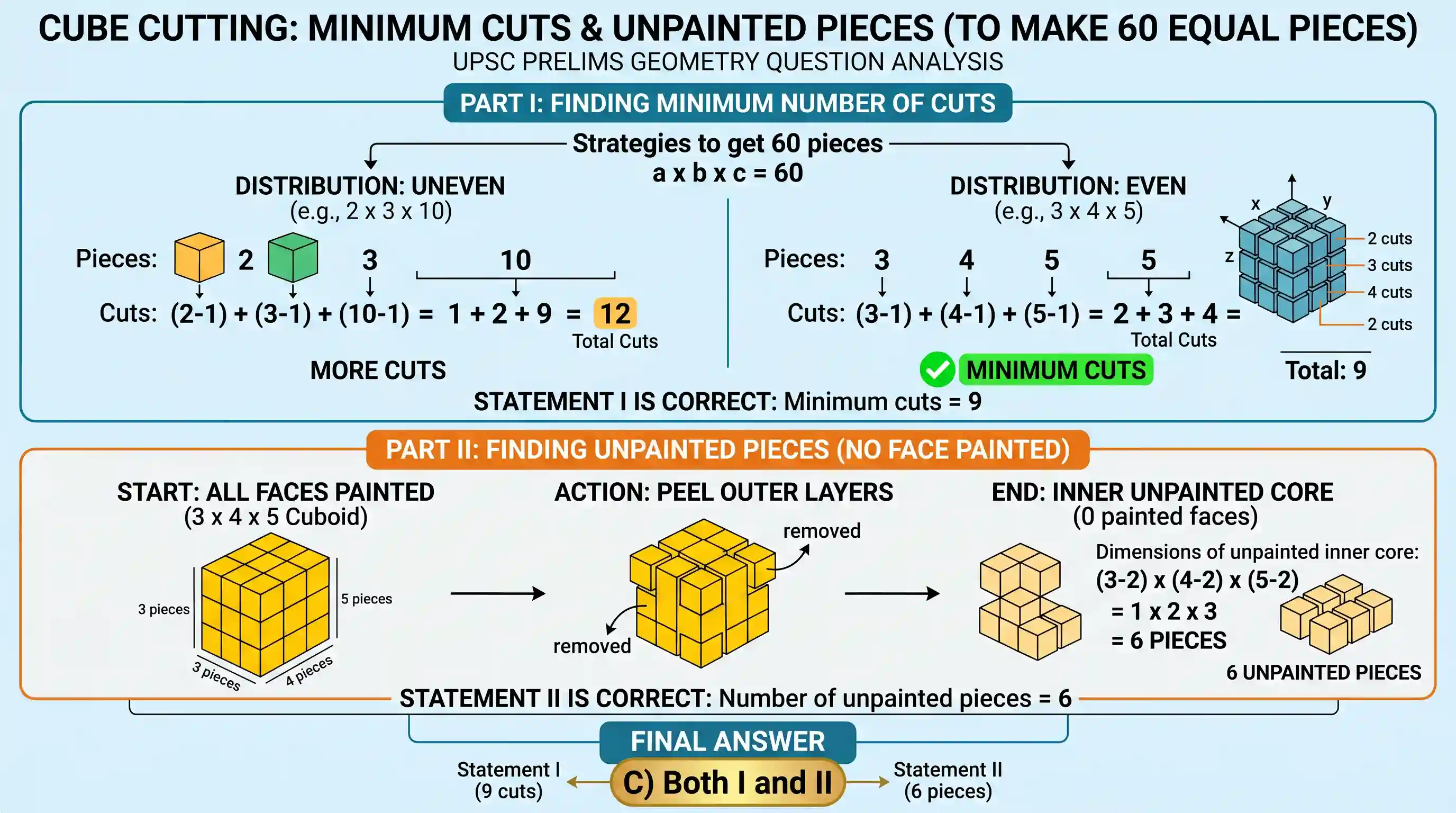
Statement I: The minimum number of cuts. To get 60 pieces with the minimum number of cuts, we divide the cuts among the three axes (x, y, and z) as evenly as possible. Let the number of pieces along the axes be a, b, and c. Then a times b times c equals 60. The number of cuts is (a-1) plus (b-1) plus (c-1). To minimize cuts, a, b, and c should be close to each other. For 60, the best combination is 3, 4, and 5. The cuts would be (3-1) + (4-1) + (5-1) which equals 2 + 3 + 4 = 9. Thus, Statement I is correct.
Statement II: Number of unpainted pieces. The pieces with no paint are those located in the inner core of the cube. If the cube is divided into a, b, and c pieces along the axes, the inner pieces are found by subtracting 2 from each dimension (to remove the painted outer layers). So, the unpainted pieces are (a-2) times (b-2) times (c-2). Using our dimensions 3, 4, and 5, we get (3-2) times (4-2) times (5-2), which is 1 times 2 times 3 = 6. Thus, Statement II is also correct.
Since both statements are correct, the correct answer is C.
Related questions
More UPSC Prelims practice from the same subject and topic.
- Prelims 2025CSATQuantitative Aptitude
A natural number N is such that it can be expressed as N = p + q + r , where p, q and r are distinct factors of N. How many numbers below 50 have this property?
- Prelims 2025CSATQuantitative Aptitude
Three prime numbers p, q and r, each less than 20, are such that p - q = q - r . How many distinct possible values can we get for (p + q + r) ?
- Prelims 2025CSATQuantitative Aptitude
How many possible values of (p + q + r) are there satisfying (1)/(p) + (1)/(q) + (1)/(r) = 1 , where p, q and r are natural numbers (not necessarily distinct)?
- Prelims 2025CSATQuantitative Aptitude
Team X scored a total of N runs in 20 overs. Team Y tied the score in 10% less overs. Had team Y's average run rate (runs per over) been 50% higher, the scores would have been tied in 12 overs. How ma…
- Prelims 2025CSATQuantitative Aptitude
The price (p) of a commodity is first increased by k% ; then decreased by k% ; again increased by k% ; and again decreased by k% . If the new price is q , then what is the relation between p and q ?
- Prelims 2025CSATQuantitative Aptitude
The petrol price shot up by 10% as a result of the hike in crude oil prices. The price of petrol before the hike was π 90 per litre. A person travels 2200km every month and his car gives a mileage of …