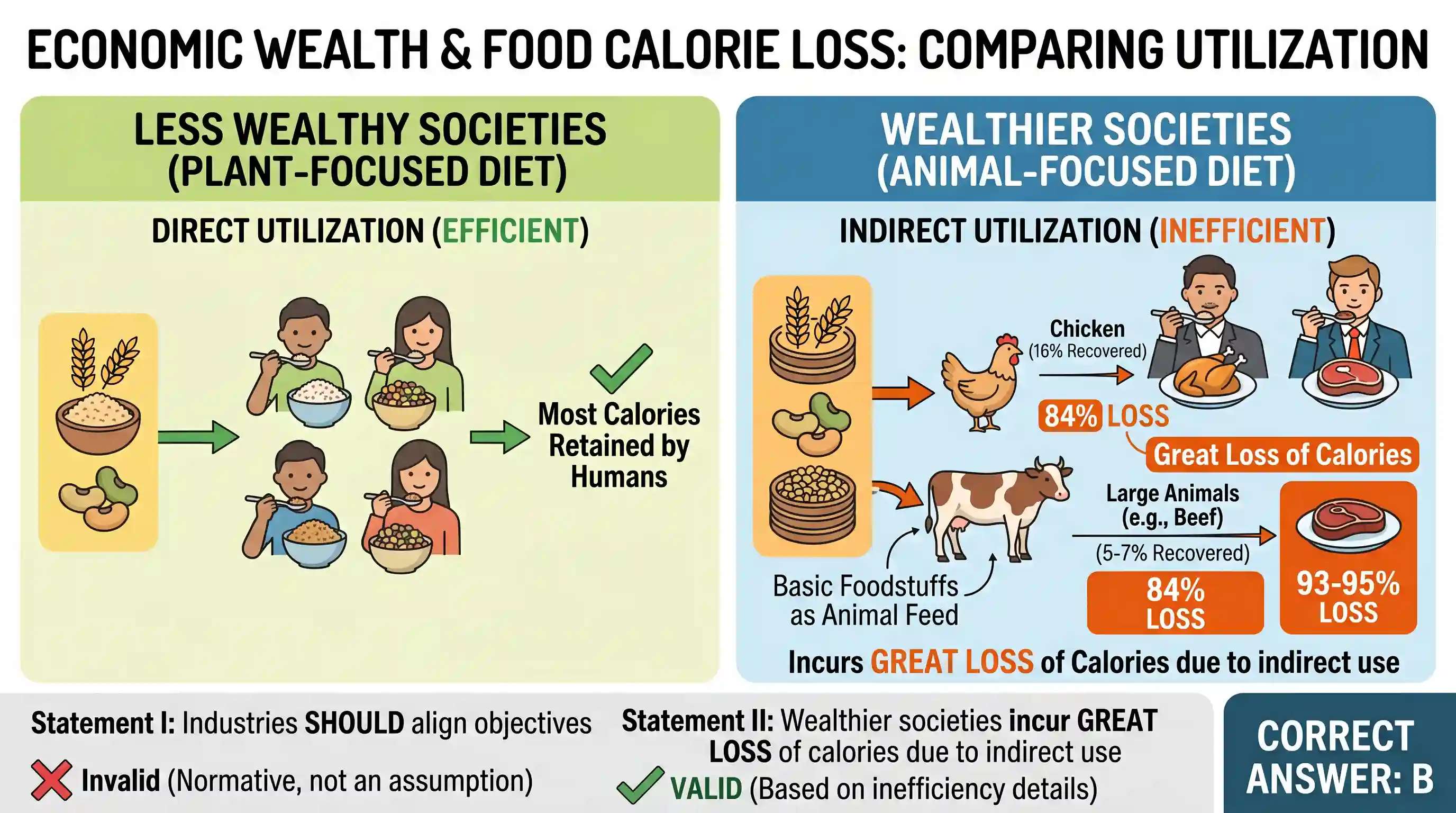
If there is inequality in the pattern of population growth, there is greater inequality in food production and utilization. As societies become wealthier, their consumption of animal products increases. This means that a greater proportion of such basic foodstuff as grains and legumes that could feed humans directly is instead being converted into feed for poultry and large farm animals. Yet this conversion of plant- based food into animal food for humans is far from efficient. Only 16% of the calories fed to chickens are recovered by us when we eat them. This conversion rate goes down to five to seven per cent in large animals that are fed grain to add fat and some protein before slaughter. With reference to the above passage, the following assumptions have been made: I. The food manufacturing and processing industries in every country should align their objectives and processes in accordance with the changing needs of the societies. II. Wealthier societies tend to incur great loss of calories of food materials due to indirect utilization of their agricultural produce. Which of the above assumptions is/are valid?

- AI only
- BII onlyCorrect
- CBoth I and II
- DNeither I nor II
Explanation
The passage describes how wealthier societies consume more animal products, leading to a greater proportion of grains and legumes being converted into animal feed. It then highlights the significant inefficiency of this conversion, stating that only a small percentage of calories fed to animals are recovered by humans.
Let's analyze each statement:
Statement I: "The food manufacturing and processing industries in every country should align their objectives and processes in accordance with the changing needs of the societies." The passage describes a situation and its consequences (calorie loss due to inefficient conversion). It does not offer solutions or prescribe what industries "should" do. This statement is a policy recommendation or a normative judgment, which is not an assumption made by the descriptive and analytical nature of the passage. The passage does not assume that industries should change, it merely points out a trend and its inefficiency.
Statement II: "Wealthier societies tend to incur great loss of calories of food materials due to indirect utilization of their agricultural produce." The passage explicitly states, "As societies become wealthier, their consumption of animal products increases." It then details how "a greater proportion of such basic foodstuff as grains and legumes... is instead being converted into feed for poultry and large farm animals," and that this conversion is "far from efficient," resulting in very low calorie recovery (16% for chickens, 5-7% for large animals). This directly supports the idea that wealthier societies, due to their consumption patterns, incur a significant loss of calories by indirectly utilizing their agricultural produce (feeding it to animals instead of humans directly). This is a direct conclusion and an underlying assumption based on the facts presented in the passage.
Therefore, only Statement II is a valid assumption based on the information provided in the passage.
The final answer is B.
Related questions
More UPSC Prelims practice from the same subject and topic.
- Prelims 2025CSATReading Comprehension
Maintaining an ecosystem just to conserve biodiversity will affect its commercial potential as well as the livelihoods dependent on the ecosystem. There is also a conflict between using an ecosystem o…
- Prelims 2025CSATReading Comprehension
Maintaining an ecosystem just to conserve biodiversity will affect its commercial potential as well as the livelihoods dependent on the ecosystem. There is also a conflict between using an ecosystem o…
- Prelims 2025CSATReading Comprehension
]The history of renewable energy suggests there is a steep learning curve, meaning that, as more is produced, costs fall rapidly because of economies of scale and learning by doing. The firms' green i…
- Prelims 2025CSATReading Comprehension
]The history of renewable energy suggests there is a steep learning curve, meaning that, as more is produced, costs fall rapidly because of economies of scale and learning by doing. The firms' green i…
- Prelims 2025CSATReading Comprehension
Each State in India faces a distinctive set of challenges regarding the impact of warming, but also offers its own set of opportunities for reducing emissions depending on its natural resources. For e…
- Prelims 2025CSATReading Comprehension
Each State in India faces a distinctive set of challenges regarding the impact of warming, but also offers its own set of opportunities for reducing emissions depending on its natural resources. For e…