A question is given followed by two Statements I and II. Consider the Question and the Statements and mark the correct option. How is Q related to P? Statement I: P has two sisters, R and S. Statement II: R's father is the brother of Q. Which one of the following is correct in respect of the above Question and the Statements?

- AThe Question can be answered by using one of the Statements alone, but cannot be answered using the other statement alone.
- BThe Question can be answered by using either Statement alone.
- CThe Question can be answered by using both the Statements together, but cannot be answered using either Statement alone.
- DThe Question cannot be answered even using any of the Statements.Correct
Explanation
The question asks "How is Q related to P?". We need to determine if a unique relationship can be established using the given statements.
-
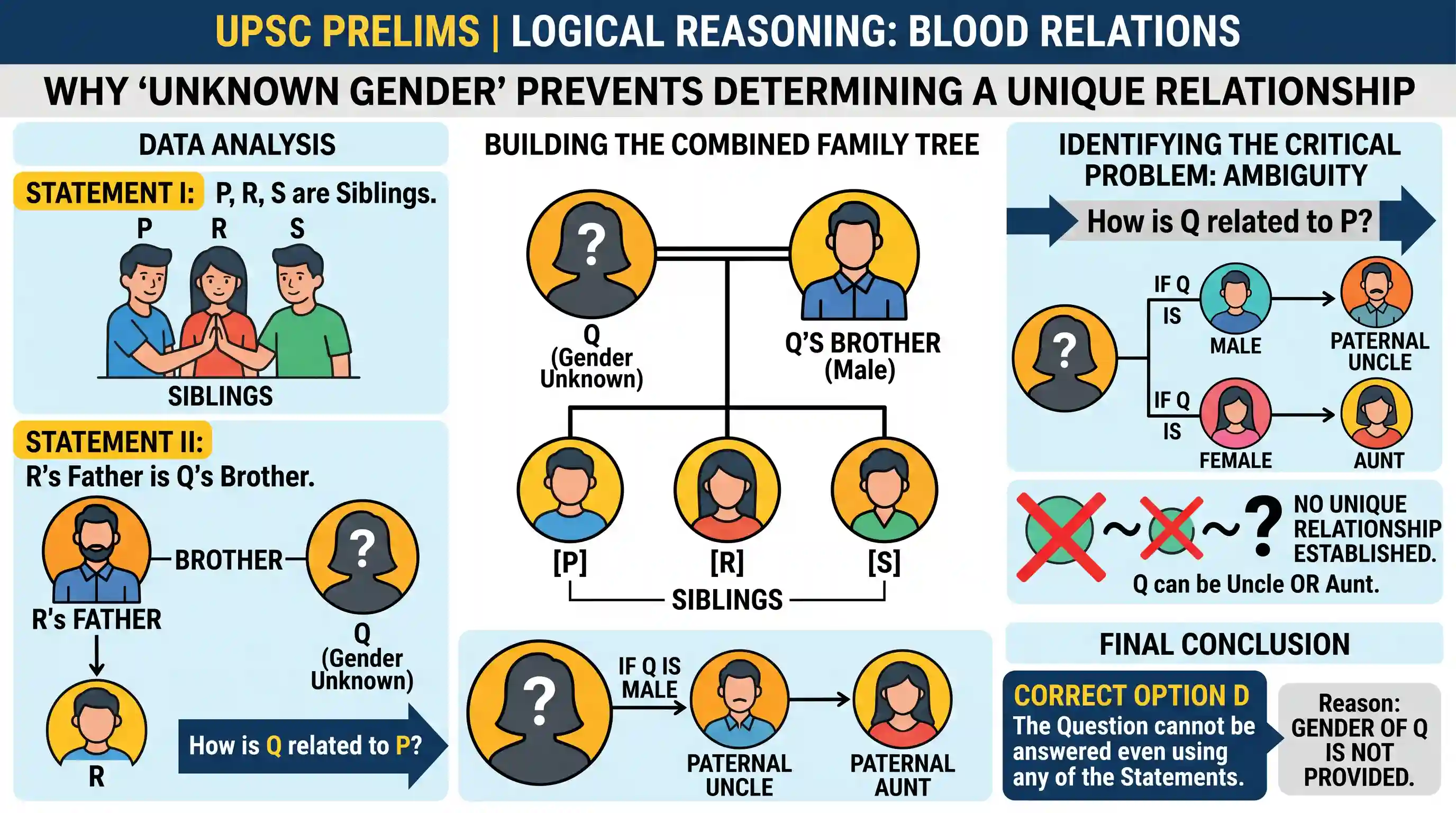
Analyze Statement I: "P has two sisters, R and S." This statement tells us that P, R, and S are siblings. It does not mention Q at all. Therefore, Statement I alone is insufficient to determine the relationship between Q and P.
-
Analyze Statement II: "R's father is the brother of Q." Let R's father be F. So, F is the brother of Q. This means Q is F's sibling. Therefore, Q is R's paternal uncle or paternal aunt (depending on Q's gender). This statement mentions R and Q, but not P. Therefore, Statement II alone is insufficient to determine the relationship between Q and P.
-
Analyze both Statements together: From Statement I, we know P and R are siblings. From Statement II, we know R's father (F) is Q's brother. Since P and R are siblings, R's father (F) is also P's father. So, P's father (F) is the brother of Q. This means Q is P's father's sibling. Therefore, Q is either P's paternal uncle (if Q is male) or P's paternal aunt (if Q is female).
The problem is that the gender of Q is not provided in either statement. Since the question asks "How is Q related to P?", it implies a specific, unambiguous relationship (e.g., uncle, aunt, brother, sister, etc.). Because Q's gender is unknown, we cannot definitively say whether Q is P's paternal uncle or paternal aunt. We can only state a disjunctive relationship ("uncle or aunt"). In such reasoning questions, if the exact, singular relationship cannot be determined due to missing gender information, the question is considered unanswered.
Conclusion: Even by combining both statements, we cannot determine a unique and specific relationship between Q and P because Q's gender is unknown.
Therefore, the Question cannot be answered even using any of the Statements.
The final answer is D.
Related questions
More UPSC Prelims practice from the same subject and topic.
- Prelims 2025CSATLogical Reasoning
P is the brother of Q and R. S is R's mother. T is P's father. How many of the following statements are definitely true? I. S and T are a couple. II. Q is T's son. III. T is Q's father. IV. S is P's m…
- Prelims 2025CSATLogical Reasoning
What comes at X and Y respectively in the following sequence? January, January, December, October, X, March, October, Y, September
- Prelims 2025CSATLogical Reasoning
If 7*24 = 25 and 12*16 = 20 , then what is 16*63 equal to?
- Prelims 2025CSATLogical Reasoning
Consider the following statements: I. If A≤ B > C E > F≥ G = H ; then B is always greater than E. II. If P > Q = R≥ S = T≤ U = V > W ; then S is always less than V. Which of the statements given above…
- Prelims 2025CSATLogical Reasoning
Consider the sequence AB_CC_A_BCCC_BBC_C that follows a certain pattern. Which one of the following completes the sequence?
- Prelims 2025CSATLogical Reasoning
What is X in the sequence 24, X, 12, 18, 36, 90 ?