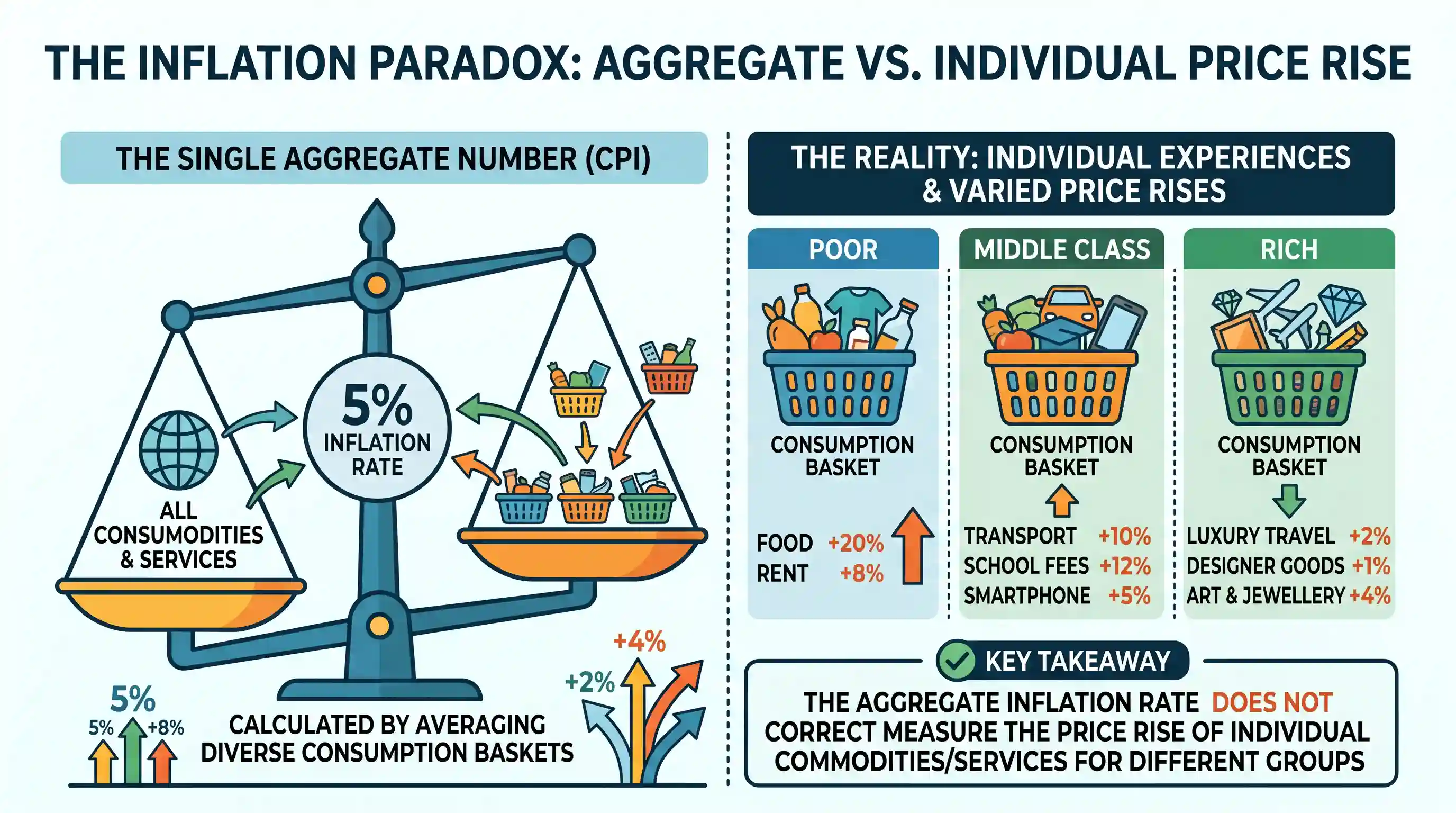
A single number for inflation is an aggregate across different commodities and services - the price rise differs for different items of consumption. So, the single number is arrived at by assigning weights to different commodities and services. For WPI, the weights in production are used; for CPI, the consumption basket is used. But people are not homogeneous. The consumption basket is vastly different for the poor, the middle classes, and the rich. Hence, the CPI is different for each of these classes and a composite index requires averaging the baskets. Which one of the following statements best reflects the most logical, rational and crucial message conveyed by the passage?

- AWe must use WPI exclusively in measuring price rise and CPI should be done away with.
- BThe present calculation of inflation rate does not correctly measure price rise of individual item/commodity.Correct
- CInflation data under-presents services in the consumption basket.
- DKnowledge of inflation rate is not really of any use to anybody in the country.
Explanation
The passage explains that a single inflation number, like CPI, is an aggregate that uses assigned weights and an averaged consumption basket. It explicitly states that "the price rise differs for different items of consumption" and "The consumption basket is vastly different for the poor, the middle classes, and the rich." This means a single, averaged number cannot accurately reflect the specific price changes for individual items or the distinct inflationary experience of different groups.
Let's analyze the options:
A) We must use WPI exclusively in measuring price rise and CPI should be done away with. The passage contrasts WPI and CPI but does not advocate for abolishing CPI or exclusively using WPI. It highlights the limitations of CPI, not its complete redundancy. This is an extreme conclusion not supported by the text.
B) The present calculation of inflation rate does not correctly measure price rise of individual item/commodity. This statement directly reflects the passage's core message. The passage states that "the price rise differs for different items of consumption" and that a single number is an "aggregate." Since the consumption baskets are vastly different for various groups, an aggregate number based on an averaged basket cannot accurately capture the specific price rise of every individual item or how it impacts diverse groups. The single number smooths out or averages these individual differences, thus not "correctly measuring" them in a granular sense.
C) Inflation data under-presents services in the consumption basket. The passage mentions "commodities and services" but does not state or imply that services are under-presented in the calculation. This is an assumption not supported by the text.
D) Knowledge of inflation rate is not really of any use to anybody in the country. This is an extreme and illogical conclusion. The passage discusses the challenges and limitations in calculating a truly representative single number, not that the data itself is useless. Inflation data is vital for economic policy, even with its complexities.
Therefore, option B best captures the crucial message that the aggregated, single number for inflation, due to its averaging nature and the diversity of consumption patterns, cannot precisely reflect the price rise of individual items or the specific inflation experienced by different segments of the population.
The final answer is B
Related questions
More UPSC Prelims practice from the same subject and topic.
- Prelims 2025CSATReading Comprehension
Maintaining an ecosystem just to conserve biodiversity will affect its commercial potential as well as the livelihoods dependent on the ecosystem. There is also a conflict between using an ecosystem o…
- Prelims 2025CSATReading Comprehension
Maintaining an ecosystem just to conserve biodiversity will affect its commercial potential as well as the livelihoods dependent on the ecosystem. There is also a conflict between using an ecosystem o…
- Prelims 2025CSATReading Comprehension
]The history of renewable energy suggests there is a steep learning curve, meaning that, as more is produced, costs fall rapidly because of economies of scale and learning by doing. The firms' green i…
- Prelims 2025CSATReading Comprehension
]The history of renewable energy suggests there is a steep learning curve, meaning that, as more is produced, costs fall rapidly because of economies of scale and learning by doing. The firms' green i…
- Prelims 2025CSATReading Comprehension
Each State in India faces a distinctive set of challenges regarding the impact of warming, but also offers its own set of opportunities for reducing emissions depending on its natural resources. For e…
- Prelims 2025CSATReading Comprehension
Each State in India faces a distinctive set of challenges regarding the impact of warming, but also offers its own set of opportunities for reducing emissions depending on its natural resources. For e…