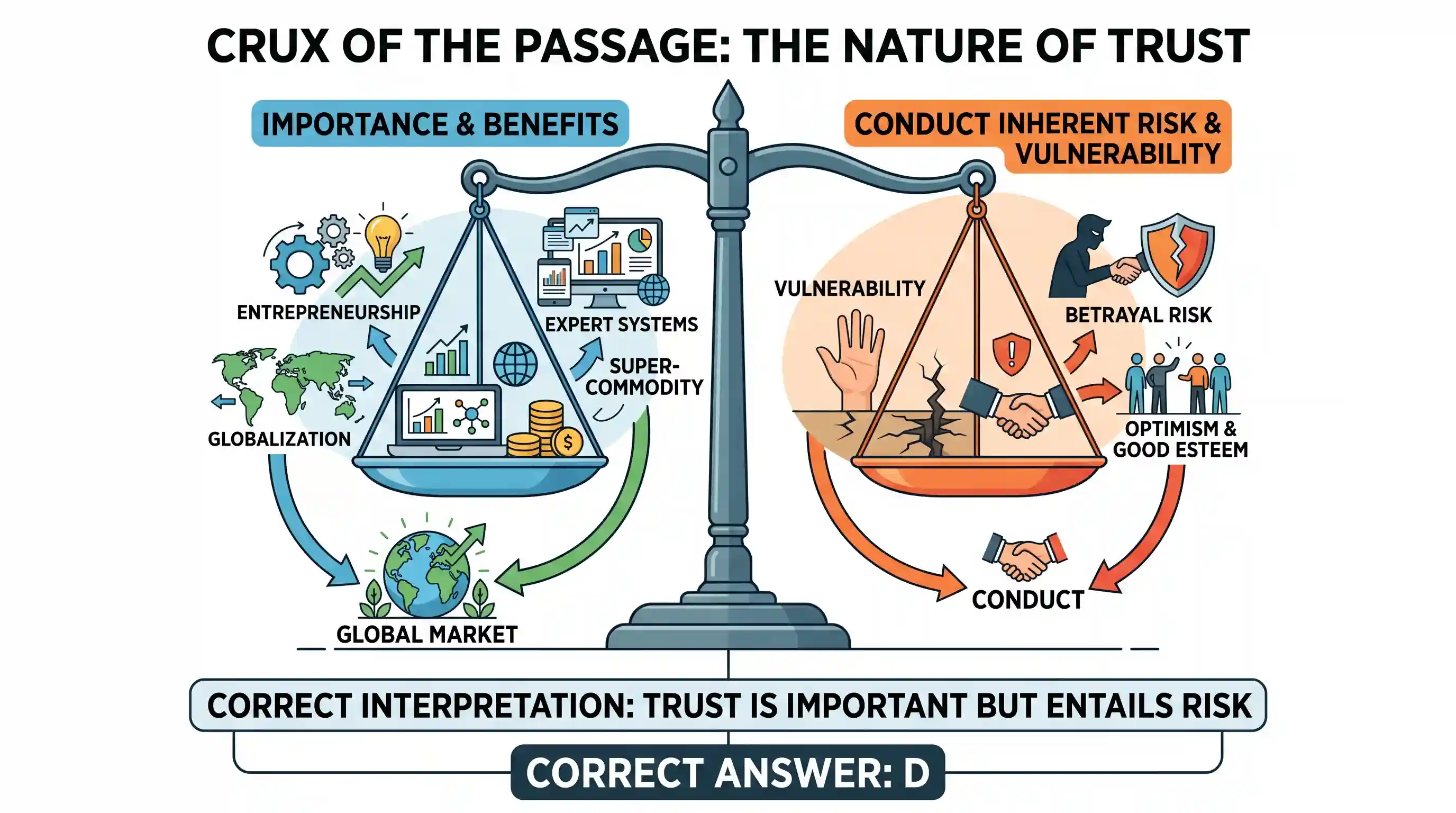
Trust stands commonly defined as being vulnerable to others. Entrepreneurship implies trust in others and willingness to expose oneself to betrayal. Trust in expert systems is the essence of globalizing behaviour; trust itself emerges as a super- commodity in the social market and defines the characteristics of goods and services in a global market. Trusting conduct also means holding others in good esteem, and an optimism that they are, or will be, competent in certain respects. Which one of the following statements best reflects the crux of the passage?

- ATrustworthiness cannot be expected in entrepreneurship.
- BTrustworthy people are the most vulnerable people.
- CNo economic activity is possible without being exposed to betrayal.
- DTrust is important though it entails risk.Correct
Explanation
The passage defines trust as being vulnerable to others and explicitly states that entrepreneurship implies trust in others and a willingness to expose oneself to betrayal. It then emphasizes the importance of trust in expert systems for globalization, calling it a "super-commodity" that defines goods and services. The concluding sentence reinforces that trusting conduct involves optimism and holding others in good esteem.
Let's analyze the options:
A) Trustworthiness cannot be expected in entrepreneurship. This is an overstatement. The passage says entrepreneurship implies a willingness to expose oneself to betrayal, meaning there's a risk, but it doesn't state that trustworthiness cannot be expected at all. Trusting still implies an expectation of competence and good esteem.
B) Trustworthy people are the most vulnerable people. The passage states that trust (the act of trusting) makes one vulnerable, not necessarily that trustworthy people (those who are trusted) are the most vulnerable. There's a subtle but significant distinction.
C) No economic activity is possible without being exposed to betrayal. This is an extreme generalization. While the passage highlights the role of trust and the risk of betrayal in entrepreneurship and global markets, it doesn't claim that all economic activity necessarily involves exposure to betrayal, nor that it's impossible without it.
D) Trust is important though it entails risk. This option perfectly captures the essence. The passage clearly establishes the importance of trust (essence of globalizing behavior, super-commodity, defines goods/services) while simultaneously highlighting that it involves vulnerability and a willingness to expose oneself to betrayal (risk). This statement synthesizes the two main themes presented.
Therefore, D is the best reflection of the crux of the passage.
Related questions
More UPSC Prelims practice from the same subject and topic.
- Prelims 2025CSATReading Comprehension
Maintaining an ecosystem just to conserve biodiversity will affect its commercial potential as well as the livelihoods dependent on the ecosystem. There is also a conflict between using an ecosystem o…
- Prelims 2025CSATReading Comprehension
Maintaining an ecosystem just to conserve biodiversity will affect its commercial potential as well as the livelihoods dependent on the ecosystem. There is also a conflict between using an ecosystem o…
- Prelims 2025CSATReading Comprehension
]The history of renewable energy suggests there is a steep learning curve, meaning that, as more is produced, costs fall rapidly because of economies of scale and learning by doing. The firms' green i…
- Prelims 2025CSATReading Comprehension
]The history of renewable energy suggests there is a steep learning curve, meaning that, as more is produced, costs fall rapidly because of economies of scale and learning by doing. The firms' green i…
- Prelims 2025CSATReading Comprehension
Each State in India faces a distinctive set of challenges regarding the impact of warming, but also offers its own set of opportunities for reducing emissions depending on its natural resources. For e…
- Prelims 2025CSATReading Comprehension
Each State in India faces a distinctive set of challenges regarding the impact of warming, but also offers its own set of opportunities for reducing emissions depending on its natural resources. For e…