A question is given followed by two Statements I and II. Consider the Question and the Statements and mark the correct option. Let P, Q, R, S be distinct non- zero digits. If PP × PQ = RRSS , where P ≤ 3 and Q ≤ 4 , then what is Q equal to? Statement I: R = 1 . Statement II: S = 2 . Which one of the following is correct in respect of the above Question and the Statements?

- AThe Question can be answered by using one of the Statements alone, but cannot be answered using the other statement alone.
- BThe Question can be answered by using either Statement alone.
- CThe Question can be answered by using both the Statements together, but cannot be answered using either Statement alone.
- DThe Question can be answered even without using any of the Statements.Correct
Explanation
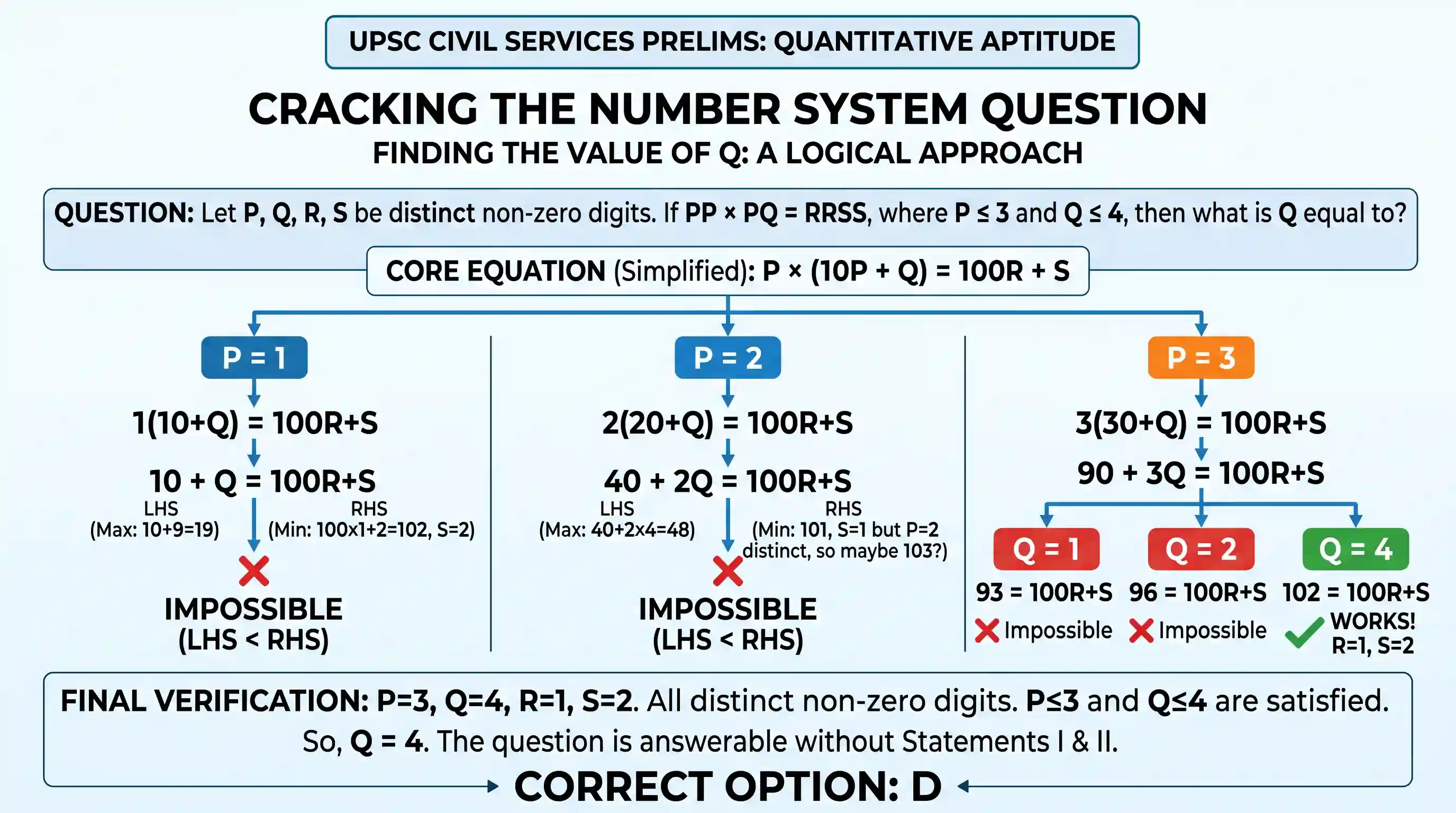
The given equation is PP x PQ = RRSS. We can expand this as: (11 x P) x (10 x P + Q) = 1100 x R + 11 x S Dividing by 11: P x (10 x P + Q) = 100 x R + S
We are given the following constraints:
- P, Q, R, S are distinct non-zero digits (i.e., from {1, 2, ..., 9}).
- P = 100 + 1 = 101 (if S=1, but S must be distinct from P, Q, R). In any case, 100 x R + S will always be 100 or greater. Since 10 + Q is at most 19, it cannot equal 100 x R + S. Therefore, P cannot be 1.
Case 2: P = 2 Substitute P=2 into the simplified equation: 2 x (10 x 2 + Q) = 100 x R + S 2 x (20 + Q) = 100 x R + S 40 + 2Q = 100 x R + S
Constraints for Q: Q = 100. If Q = 3: 40 + 2(3) = 46. So, 100 x R + S = 46. This is impossible. If Q = 4: 40 + 2(4) = 48. So, 100 x R + S = 48. This is impossible. Therefore, P cannot be 2.
Case 3: P = 3 Substitute P=3 into the simplified equation: 3 x (10 x 3 + Q) = 100 x R + S 3 x (30 + Q) = 100 x R + S 90 + 3Q = 100 x R + S
Constraints for Q: Q = 100. If Q = 2: 90 + 3(2) = 96. So, 100 x R + S = 96. This is impossible. If Q = 4: 90 + 3(4) = 90 + 12 = 102. So, 100 x R + S = 102.
This result (100 x R + S = 102) implies R = 1 and S = 2. Let's check if P=3, Q=4, R=1, S=2 satisfy all conditions:
- P, Q, R, S are distinct non-zero digits: 3, 4, 1, 2 are all distinct and non-zero. (Satisfied)
- P <= 3: P=3. (Satisfied)
- Q <= 4: Q=4. (Satisfied)
All conditions are met uniquely for P=3, Q=4, R=1, S=2. The question asks "what is Q equal to?". We found Q = 4.
Since we were able to determine the unique value of Q (Q=4) using only the information provided in the question and its initial constraints, the statements are not required to answer the question.
Therefore, the question can be answered even without using any of the Statements.
The final answer is D
Related questions
More UPSC Prelims practice from the same subject and topic.
- Prelims 2025CSATQuantitative Aptitude
A natural number N is such that it can be expressed as N = p + q + r , where p, q and r are distinct factors of N. How many numbers below 50 have this property?
- Prelims 2025CSATQuantitative Aptitude
Three prime numbers p, q and r, each less than 20, are such that p - q = q - r . How many distinct possible values can we get for (p + q + r) ?
- Prelims 2025CSATQuantitative Aptitude
How many possible values of (p + q + r) are there satisfying (1)/(p) + (1)/(q) + (1)/(r) = 1 , where p, q and r are natural numbers (not necessarily distinct)?
- Prelims 2025CSATQuantitative Aptitude
A 4-digit number N is such that when divided by 3, 5, 6, 9 leaves a remainder 1, 3, 4, 7 respectively. What is the smallest value of N?
- Prelims 2025CSATQuantitative Aptitude
What is the unit digit in the multiplication of 1× 3× 5× 7× 9× … × 999 ?
- Prelims 2025CSATQuantitative Aptitude
Consider the first 100 natural numbers. How many of them are not divisible by any one of 2, 3, 5, 7 and 9?