A question is given followed by two Statements I and II. Consider the Question and the Statements and mark the correct option. What is the smallest 1-digit number having exactly 4 distinct factors ? Statement I : 2 is one of the factors. Statement II : 3 is one of the factors. Which one of the following is correct in respect of the above Question and the Statements ?

- AThe Question can be answered by using one of the Statements alone, but cannot be answered using the other statement alone.
- BThe Question can be answered by using either Statement alone.
- CThe Question can be answered by using both the Statements together, but cannot be answered using either Statement alone.
- DThe Question can be answered even without using any of the Statements.Correct
Explanation
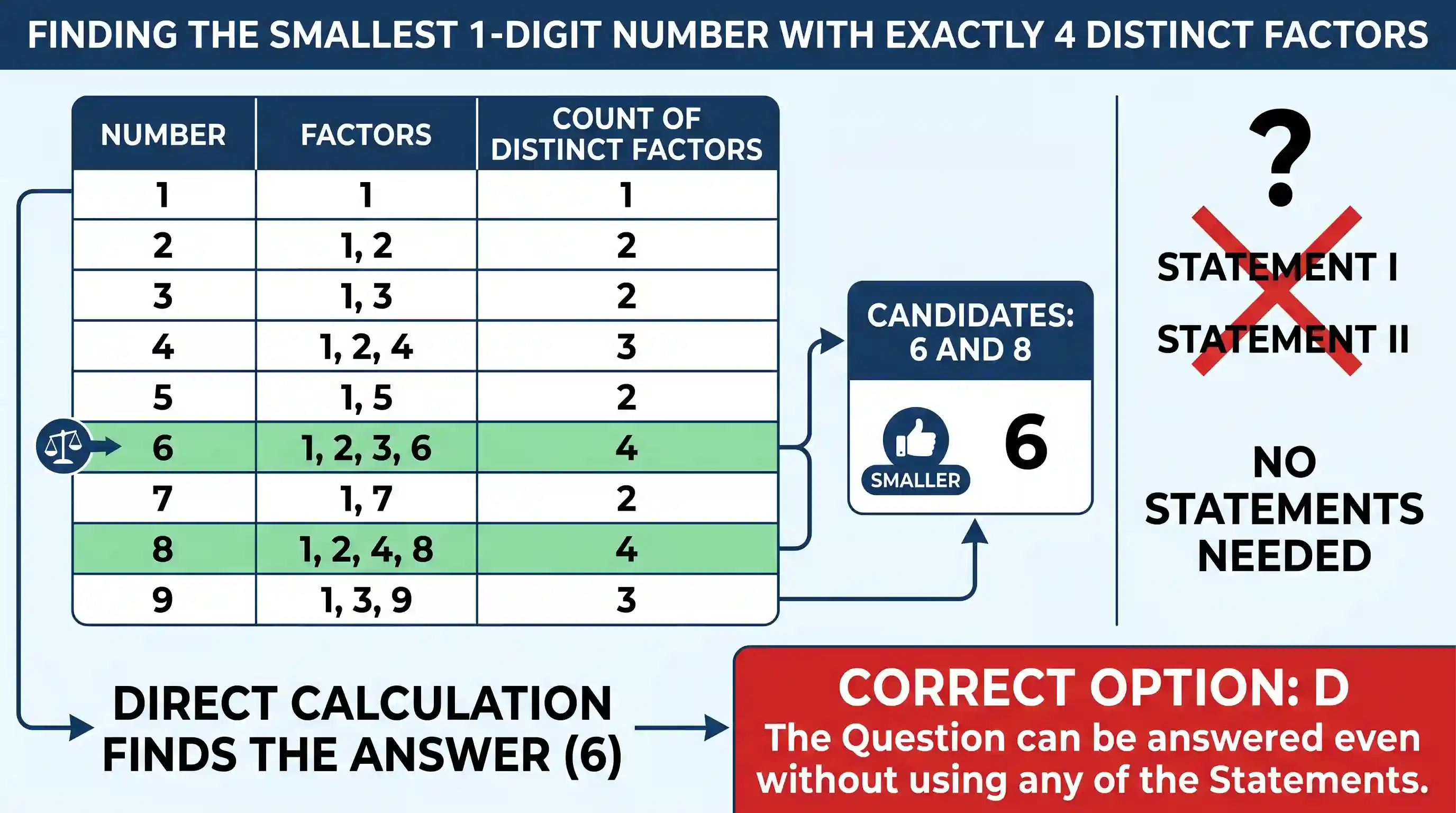
The question asks for the smallest 1-digit number having exactly 4 distinct factors.
Let's find this number by checking 1-digit numbers:
- 1 has 1 factor (1)
- 2 has 2 factors (1, 2)
- 3 has 2 factors (1, 3)
- 4 has 3 factors (1, 2, 4)
- 5 has 2 factors (1, 5)
- 6 has 4 factors (1, 2, 3, 6)
- 7 has 2 factors (1, 7)
- 8 has 4 factors (1, 2, 4, 8)
- 9 has 3 factors (1, 3, 9)
The 1-digit numbers with exactly 4 distinct factors are 6 and 8. The smallest among these is 6.
Therefore, the answer to the question "What is the smallest 1-digit number having exactly 4 distinct factors?" is 6.
We were able to determine this answer (6) by directly analyzing the 1-digit numbers and their factors, without using any information from Statement I or Statement II.
Let's briefly analyze the statements, though not strictly necessary for option D: Statement I: 2 is one of the factors.
- If the number is 6, 2 is a factor.
- If the number is 8, 2 is a factor. This statement alone would not uniquely identify 6 as the smallest, as both 6 and 8 satisfy having 2 as a factor and 4 distinct factors.
Statement II: 3 is one of the factors.
- If the number is 6, 3 is a factor.
- If the number is 8, 3 is NOT a factor. This statement alone would uniquely identify 6 as the answer among the candidates (6 and 8).
However, the core point is that the original question can be solved independently.
Option D states: The Question can be answered even without using any of the Statements. As shown above, we found the answer to be 6 by direct calculation, without needing Statement I or Statement II. Hence, option D is correct.
The final answer is D.
Related questions
More UPSC Prelims practice from the same subject and topic.
- Prelims 2025CSATQuantitative Aptitude
A natural number N is such that it can be expressed as N = p + q + r , where p, q and r are distinct factors of N. How many numbers below 50 have this property?
- Prelims 2025CSATQuantitative Aptitude
Three prime numbers p, q and r, each less than 20, are such that p - q = q - r . How many distinct possible values can we get for (p + q + r) ?
- Prelims 2025CSATQuantitative Aptitude
How many possible values of (p + q + r) are there satisfying (1)/(p) + (1)/(q) + (1)/(r) = 1 , where p, q and r are natural numbers (not necessarily distinct)?
- Prelims 2025CSATQuantitative Aptitude
A 4-digit number N is such that when divided by 3, 5, 6, 9 leaves a remainder 1, 3, 4, 7 respectively. What is the smallest value of N?
- Prelims 2025CSATQuantitative Aptitude
What is the unit digit in the multiplication of 1× 3× 5× 7× 9× … × 999 ?
- Prelims 2025CSATQuantitative Aptitude
Consider the first 100 natural numbers. How many of them are not divisible by any one of 2, 3, 5, 7 and 9?