Three partners A, B and C entered into a business. A invested one-third of the capital for one-third duration. B invested one-fourth of the capital for one-fourth duration. C invested the remaining capital for the whole duration. Out of a profit of ₹ 17,000, how much profit will C get?

- A₹ 12,000Correct
- B₹ 10,000
- C₹ 12,500
- D₹ 10,750
Explanation
Why the correct option is correct: In business partnerships, profit is distributed in proportion to the product of the capital invested and the time period for which it is invested (Profit ∝ Capital × Time). This concept is a core component of the UPSC Civil Services Aptitude Test (CSAT) Paper-II quantitative syllabus.
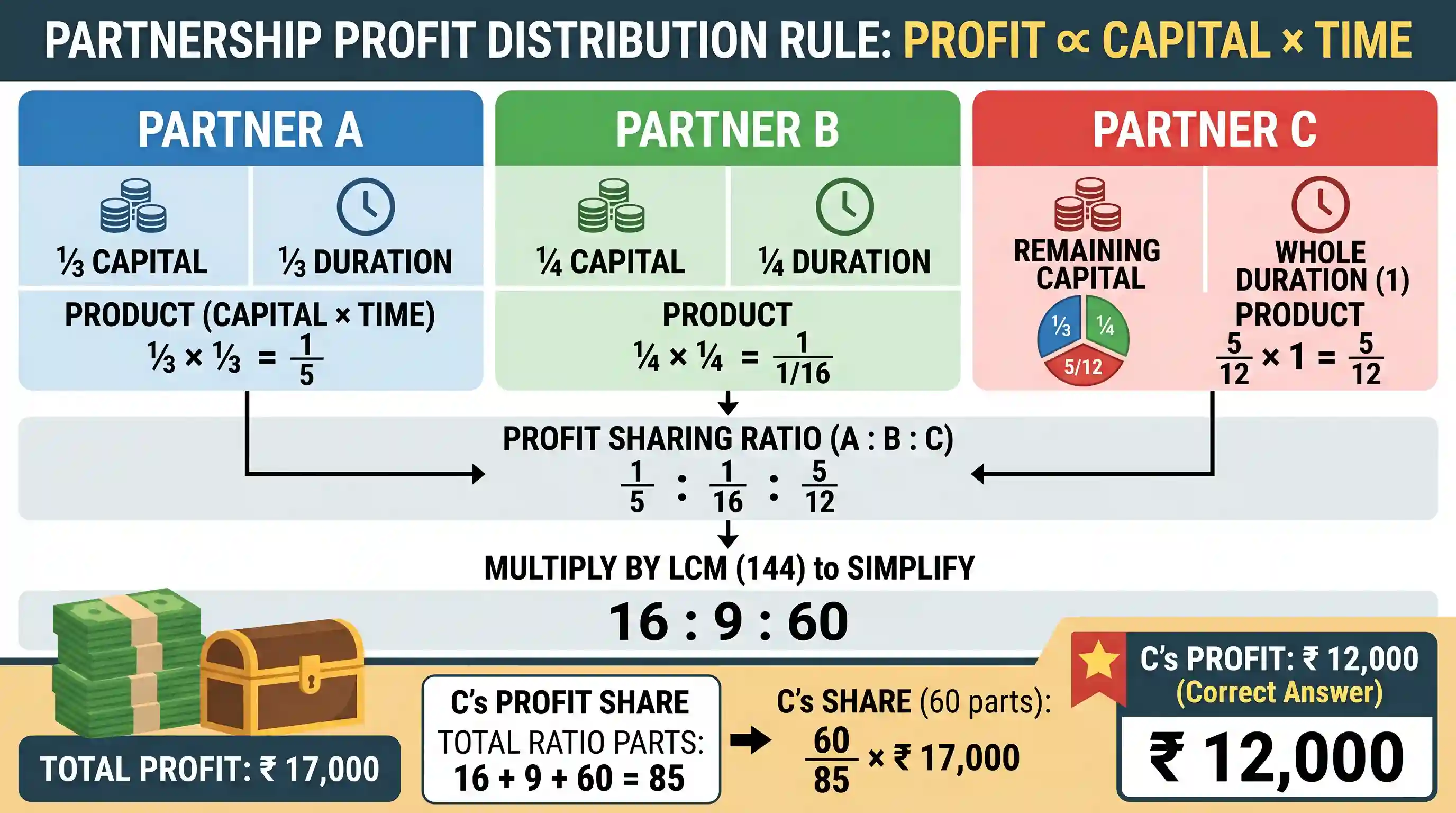
Let the total capital be 1 unit and the total duration be 1 unit.
- Partner A: Invests ⅓ capital for ⅓ time. Product = ⅓ × ⅓ = ⅑.
- Partner B: Invests ¼ capital for ¼ time. Product = ¼ × ¼ = 1/16.
- Partner C: Invests the remaining capital for the whole duration. Remaining capital = 1 - (⅓ + ¼) = 1 - 7/12 = 5/12. Duration = 1. Product = 5/12 × 1 = 5/12.
The ratio of profit shares for A : B : C is ⅑ : 1/16 : 5/12. To simplify, multiply by the least common multiple (LCM) of the denominators (9, 16, and 12), which is 144.
- A's share = 144 × (⅑) = 16
- B's share = 144 × (1/16) = 9
- C's share = 144 × (5/12) = 60
The simplified profit ratio is 16 : 9 : 60. The total number of ratio parts is 16 + 9 + 60 = 85. Given the total profit is ₹ 17,000, the value of one part is 17,000 / 85 = ₹ 200. Therefore, C's profit share is 60 × 200 = ₹ 12,000. Thus, Option A is correct.
Why the incorrect options are wrong:
- Option B (₹ 10,000): Incorrect; this figure typically results from a fundamental error, such as failing to multiply the capital by the respective time duration.
- Option C (₹ 12,500): Incorrect; this arises if a candidate mistakenly calculates C's investment fraction incorrectly without correctly subtracting A and B's shares.
- Option D (₹ 10,750): Incorrect; this is an arbitrary distractor value resulting from arithmetic errors when distributing the ₹ 17,000 among miscalculated ratio parts.
Takeaway: In partnership problems, always rely on the rule: Profit Share = Capital × Time. Calculate the remaining fractions systematically before establishing the final simplified ratio using the LCM.
Related questions
More UPSC Prelims practice from the same subject and topic.
- Prelims 2026CSATother
What is the minimum number of times one needs to measure to get 298 litres of water from a tank, if the measuring cylinders have capacities 1 litre, 6 litres, 25 litres and 100 litres?
- Prelims 2026CSATother
Three variables x, y and z take values 2, 3, 4 or 5 such that their values are always distinct. If M and N denote the largest possible value and the smallest possible value, respectively, for the expr…
- Prelims 2026CSATother
Suppose x, y and z are variables taking positive real numbers as their possible values. It is given that y is directly proportional to x² and x is inversely proportional to z. For z = 7/25, the values…
- Prelims 2026CSATother
In an objective type question paper, 5 marks are awarded for a correct answer and 2 marks are deducted for a wrong answer. A student attempted all the questions and got a score of 69. Had he been awar…
- Prelims 2026CSATother
The digit in the unit place of the number 6¹²⁹ × 7³⁰⁷ is
- Prelims 2026CSATother
An alloy P contains 20% copper and 80% zinc by weight. Another alloy Q contains 60% copper and 40% zinc by weight. A third alloy R is to be prepared from P and Q so that it contains equal amount of co…