There are two chemicals which do not react with each other. A container contains 10 litres of the chemical A. One litre of this chemical is removed from it and one litre of the chemical B is poured. Then one litre of the mixture is removed from the container and one litre of B is poured. If this process of replacing one litre of the mixture by one litre of B is performed once more, then what is the volume of B that is present in the container approximately (in percentage)?

- A25
- B27Correct
- C29
- D31
Explanation
Correct Option: B (27)
This problem evaluates the mathematical concept of successive replacement in mixtures, a standard topic in quantitative aptitude examinations such as the UPSC Civil Services Aptitude Test (CSAT), introduced in 2011.
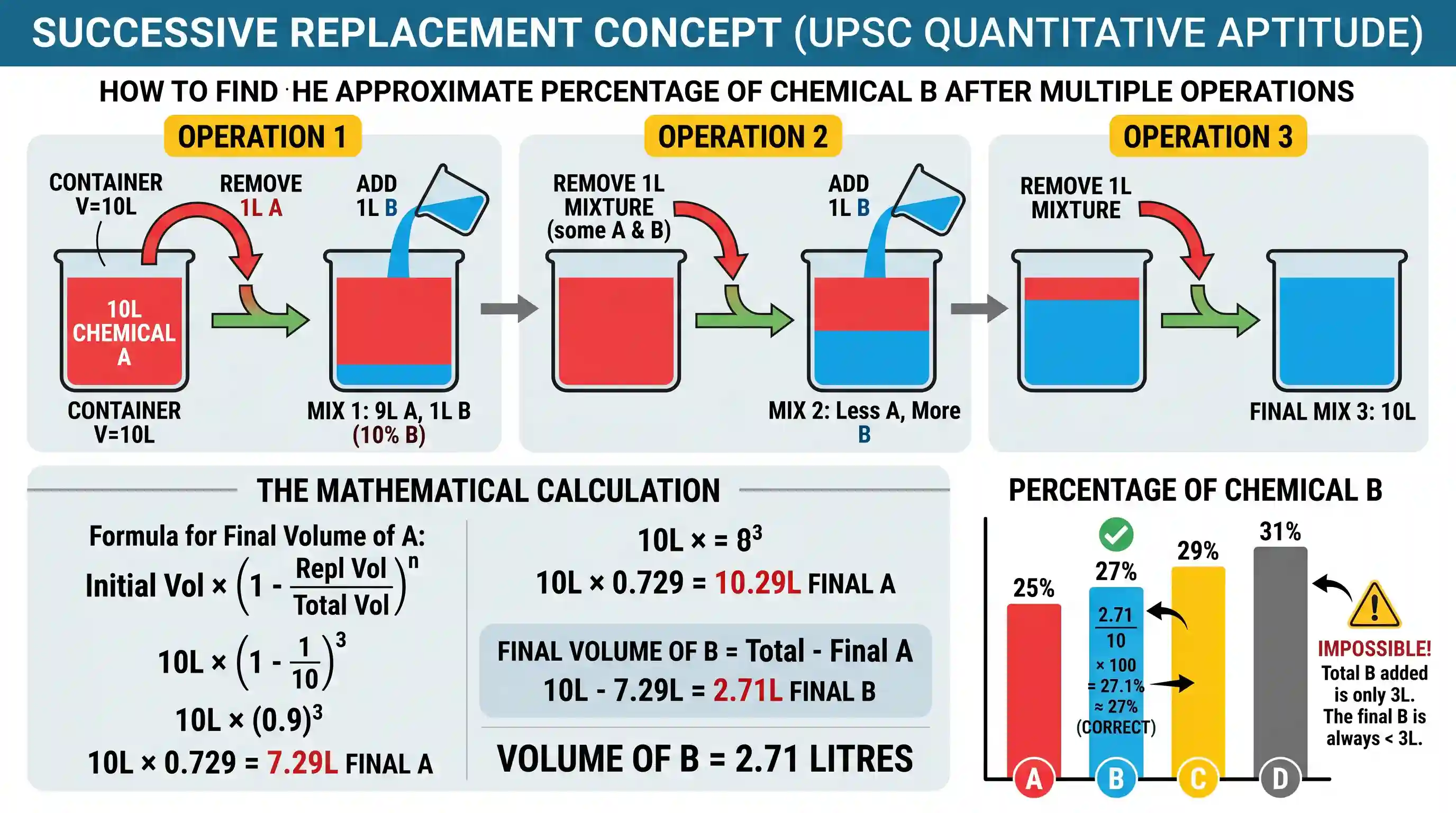
To find the final volume of the original chemical (A) after multiple identical replacements, we apply the successive replacement formula: Final Volume = Initial Volume × (1 - (Replacement Volume / Total Volume))ⁿ, where 'n' is the number of replacement operations.
Here, the total volume of the mixture remains constant at 10 litres.
- Initial Volume of A = 10 L
- Replacement Volume = 1 L
- Number of operations (n) = 3 (the initial replacement, the second replacement, and the process 'performed once more').
Calculation: Final Volume of A = 10 × (1 - 1/10)³ Final Volume of A = 10 × (0.9)³ = 10 × 0.729 = 7.29 L.
Since the total container volume is 10 L, the volume of chemical B is the remainder: Volume of B = 10 L - 7.29 L = 2.71 L. To find the approximate percentage of B in the container: (2.71 / 10) × 100 = 27.1%, which rounds to approximately 27%. Thus, Option B is mathematically correct as established by foundational mixture principles (e.g., referenced in authoritative textbooks like R.S. Aggarwal's Quantitative Aptitude).
Why other options are incorrect:
- Option A (25): Incorrect. Choosing 25% assumes an erroneous calculation where the dilution effect is misjudged, yielding exactly 2.5 L of B.
- Option C (29): Incorrect. This results from arithmetic errors in exponentiation or misjudging the fractional remainders across the three iterative steps.
- Option D (31): Incorrect. This implies a final volume of B (3.1 L) that exceeds the absolute total amount of B poured into the container across all three operations (which is exactly 3 L). This is mathematically and physically impossible.
Takeaway: For successive replacement problems, always track the remaining volume of the original substance using the formula Final = Initial × (1 - x/V)ⁿ. Calculating the introduced substance directly is complex because a fraction of it is removed with every subsequent step.
Related questions
More UPSC Prelims practice from the same subject and topic.
- Prelims 2026CSATother
What is the minimum number of times one needs to measure to get 298 litres of water from a tank, if the measuring cylinders have capacities 1 litre, 6 litres, 25 litres and 100 litres?
- Prelims 2026CSATother
Three variables x, y and z take values 2, 3, 4 or 5 such that their values are always distinct. If M and N denote the largest possible value and the smallest possible value, respectively, for the expr…
- Prelims 2026CSATother
Suppose x, y and z are variables taking positive real numbers as their possible values. It is given that y is directly proportional to x² and x is inversely proportional to z. For z = 7/25, the values…
- Prelims 2026CSATother
In an objective type question paper, 5 marks are awarded for a correct answer and 2 marks are deducted for a wrong answer. A student attempted all the questions and got a score of 69. Had he been awar…
- Prelims 2026CSATother
The digit in the unit place of the number 6¹²⁹ × 7³⁰⁷ is
- Prelims 2026CSATother
An alloy P contains 20% copper and 80% zinc by weight. Another alloy Q contains 60% copper and 40% zinc by weight. A third alloy R is to be prepared from P and Q so that it contains equal amount of co…