X, Y and Z jump forward 4', 6' and 5', respectively. At 8 AM, they all land on mark 199'. How many times will they all land on the same mark (need not be at the same moment) between mark 195' and 1000', if all of them cross mark 1000' by 9 AM?

- A11
- B12
- C13
- D14Correct
Explanation
Why the correct option is correct: To determine how many times X, Y, and Z will land on the same mark, we must utilize the Least Common Multiple (LCM). This mathematical principle is fundamental in solving synchronized periodic events, a core component of the UPSC CSAT syllabus.
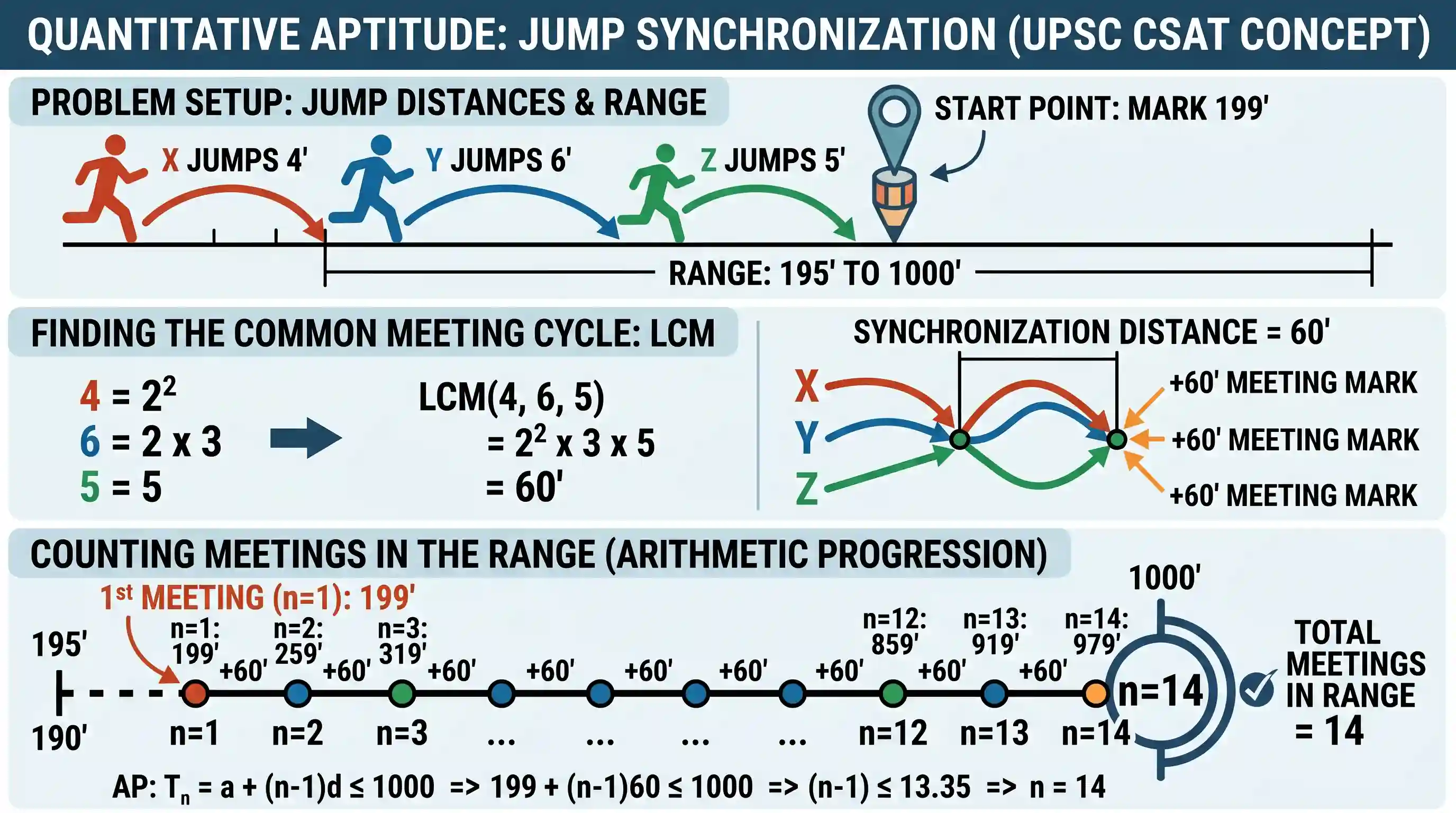
The jump lengths are 4′, 6′, and 5′. The LCM of these values (2² × 3 × 5) is 60. This establishes that all three will simultaneously land on the same mark every 60 feet.
The problem states they land together on mark 199′. We must count the total synchronized landings between the 195′ and 1000′ marks. These landing points form an Arithmetic Progression (AP) where the first valid term (a) is 199 and the common difference (d) is 60.
To find the total number of terms (n) up to the 1000′ mark, we use the AP formula: Tₙ = a + (n-1)d ≤ 1000 199 + (n-1)60 ≤ 1000 (n-1)60 ≤ 801 n-1 ≤ 13.35
Since n must be an integer, n-1 = 13, which gives n = 14. Thus, there are exactly 14 instances where they land on the same mark within the specified range. Option D is correct.
Why the incorrect options are wrong:
- Option A (11): Incorrectly underestimates the occurrences due to a miscalculated LCM or an erroneous baseline.
- Option B (12): Incorrect; usually stems from dividing the remaining distance (800/60) and dropping remainders without properly tracking the sequence.
- Option C (13): Incorrect because it fails to count the initial synchronized landing at 199′ (the 1st term), which is validly positioned between 195′ and 1000′.
Concluding Takeaway: Takeaway: For synchronized events, calculate the LCM of the intervals. To find the exact count of occurrences within a boundary, map the instances using the Arithmetic Progression formula, taking special care not to skip the first valid occurrence.
Related questions
More UPSC Prelims practice from the same subject and topic.
- Prelims 2026CSATother
What is the minimum number of times one needs to measure to get 298 litres of water from a tank, if the measuring cylinders have capacities 1 litre, 6 litres, 25 litres and 100 litres?
- Prelims 2026CSATother
Three variables x, y and z take values 2, 3, 4 or 5 such that their values are always distinct. If M and N denote the largest possible value and the smallest possible value, respectively, for the expr…
- Prelims 2026CSATother
Suppose x, y and z are variables taking positive real numbers as their possible values. It is given that y is directly proportional to x² and x is inversely proportional to z. For z = 7/25, the values…
- Prelims 2026CSATother
In an objective type question paper, 5 marks are awarded for a correct answer and 2 marks are deducted for a wrong answer. A student attempted all the questions and got a score of 69. Had he been awar…
- Prelims 2026CSATother
The digit in the unit place of the number 6¹²⁹ × 7³⁰⁷ is
- Prelims 2026CSATother
An alloy P contains 20% copper and 80% zinc by weight. Another alloy Q contains 60% copper and 40% zinc by weight. A third alloy R is to be prepared from P and Q so that it contains equal amount of co…