How many words can one form by shuffling the letters of the word QUEUE, if Q is always followed by U? The words thus formed need not necessarily have any meaning.

- A6
- B8
- C10
- D12Correct
Explanation
The correct answer is Option D (12).
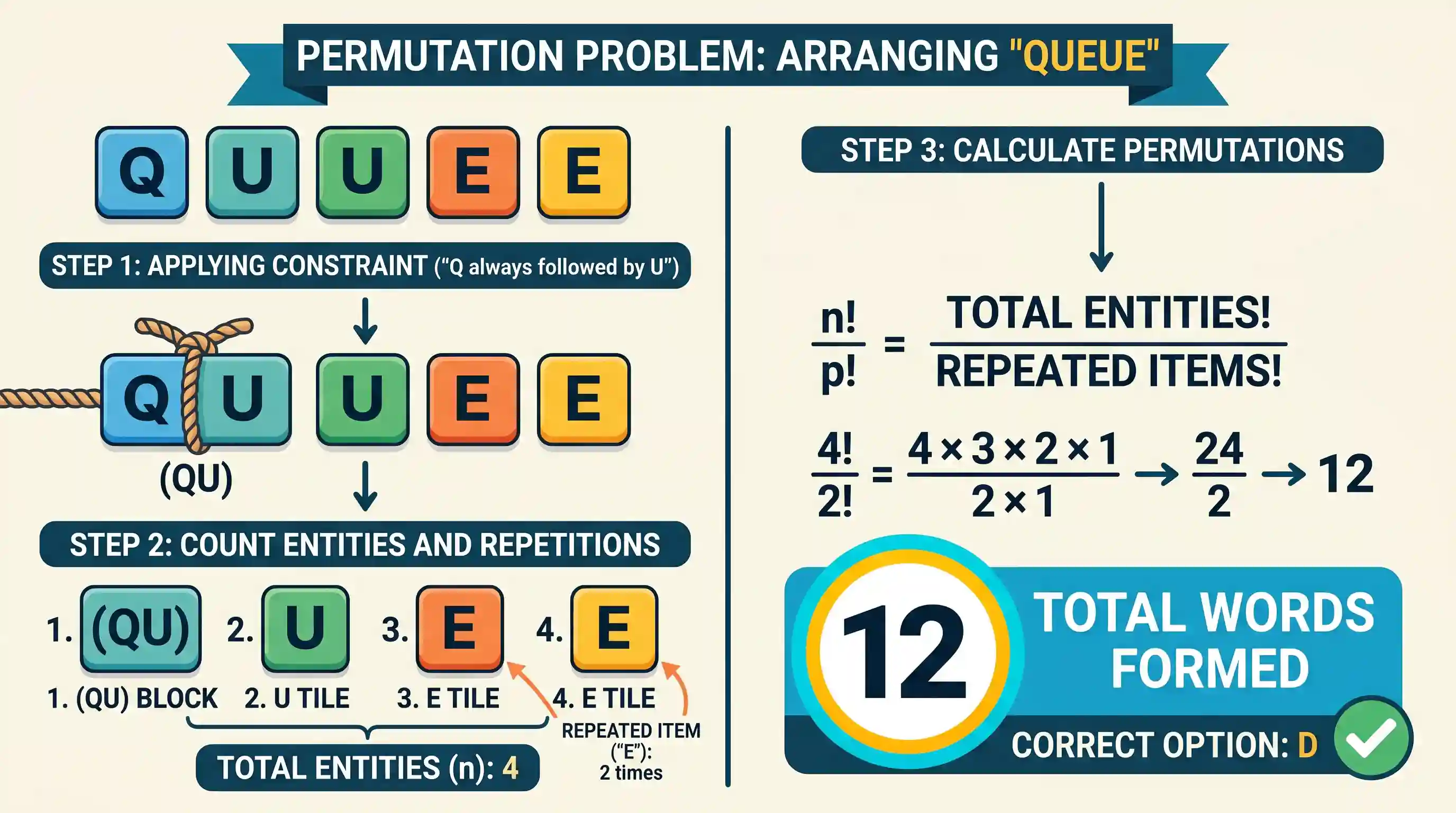
Why the correct option is correct: This problem is solved using the standard 'Block Method' (or Tie Method) in combinatorics. The word QUEUE consists of 5 letters: Q, U, U, E, E. The condition mandates that 'Q' is always followed by 'U'. To ensure this, we tie one 'Q' and one 'U' together into a single indivisible block: (QU).
After forming this block, the remaining letters available for arrangement are U, E, and E. We now arrange these four separate entities:
- The block (QU)
- The free letter U
- The letter E
- The letter E
We have n = 4 total entities. Among them, the letter 'E' is repeated twice (p = 2). (The 'U' inside the block is fixed and distinct from the free 'U'). According to the permutation formula for repeated identical items (n!/p!), the total number of unique words is: 4!/2! = 24/2 = 12
Thus, exactly 12 words can be formed.
Why the wrong options are incorrect:
- Option A (6): This represents 3! = 6. It is the erroneous result of dropping the second 'U' altogether or arranging only the non-block letters without placing the block.
- Option B (8): This is a mathematical distraction, likely resulting from faulty addition (e.g., 4 + 4) instead of applying the fundamental principle of counting.
- Option C (10): This is incorrect and stems from guessing or improperly modifying the unconstrained total permutations (5!/(2! × 2!) = 30) without properly utilizing the block method.
Concluding Takeaway: When a sequence of elements must stay together in a specific order in a permutation problem, apply the Block Method: treat the restricted sequence as a single unit, count the remaining standalone elements to find total entities, and divide the total factorial by the factorials of any identical remaining items.
Related questions
More UPSC Prelims practice from the same subject and topic.
- Prelims 2026GS1other
Which of the following statements with regard to the Grand Slam Tennis Tournaments is/are correct ? 1. The tournaments have a shared governance structure establishing the partnership among the four Gr…
- Prelims 2026GS1other
Ms. X is a mid-level civil service official working in the urban development department of a major city. Recently, she was involved in approving a contract for a public infrastructure project — a new …
- Prelims 2026GS1other
Which one of the following pairs is not correctly matched? (Indian Army Corps) : (Headquarters)
- Prelims 2026CSATother
For ⅓ < x < y < 2, which of the following statements is/are always correct? I. x + 1/x < y + 1/y II. √(1 + y²)/y < √(1 + x²)/x Select the answer using the code given below.
- Prelims 2026CSATother
What is the minimum number of times one needs to measure to get 298 litres of water from a tank, if the measuring cylinders have capacities 1 litre, 6 litres, 25 litres and 100 litres?
- Prelims 2026CSATother
There are four types of weights, namely 1 kg, 2 kg, 5 kg and 10 kg. What is the maximum number of different ways one can measure 20 kg, if at least eight but not more than eleven weights of 1 kg are t…