The Indian National Congress agreed in 1947 to the partition of the country mainly because

- Athe principle of two Nation theory was then acceptable to them
- Bit was imposed by the British Government and the Congress was helpless in this regard
- Cthey wanted to avoid large-scale communal riotsCorrect
- DIndia would have otherwise lost the opportunity to attain freedom
Explanation
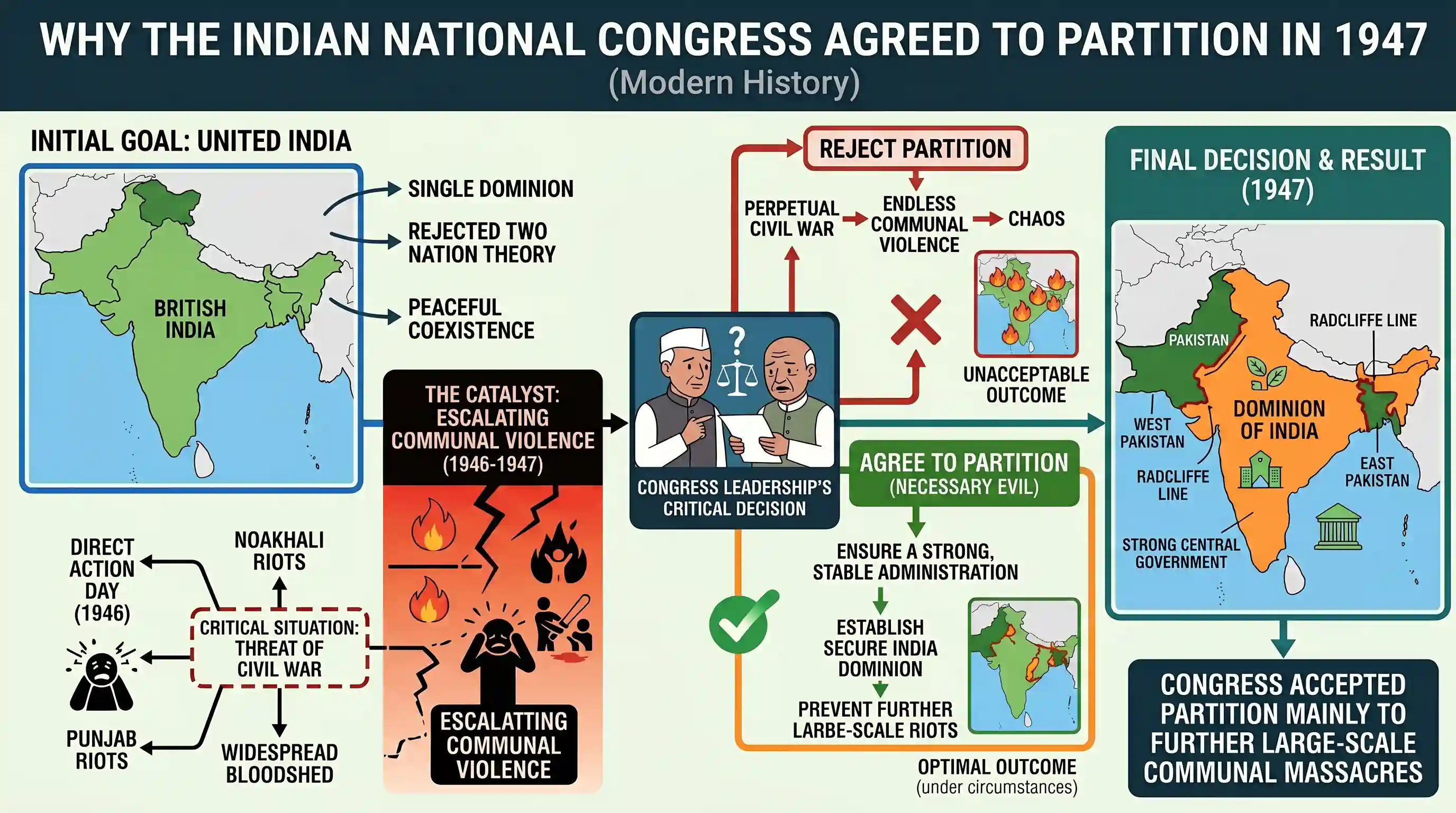
The Indian National Congress was fundamentally opposed to the partition of India and never fully accepted the Two Nation Theory. However, by 1947, the country was witnessing extreme communal violence and bloodbath following the Direct Action Day and subsequent riots in regions like Noakhali and Punjab.
The Congress leadership, including Sardar Patel and Jawaharlal Nehru, realized that the interim government was unable to function effectively due to the deadlock with the Muslim League. They concluded that accepting partition was a necessary evil to prevent further large scale communal massacres and to ensure a strong, centralized administration for the rest of India. They believed that a peaceful, partitioned India was better than a united India engulfed in a perpetual civil war. Therefore, avoiding large scale communal riots was the primary reason for their agreement.
Related questions
More UPSC Prelims practice from the same subject and topic.
- Prelims 1998GS1history
The educated middle class in India
- Prelims 1998GS1history
Lord Mountbatten came to India as Viceroy along with specific instructions to
- Prelims 1998GS1history
Assertion (A): The Khilafat movement did bring the urban Muslims into the fold of the National Movement. Reason (R): There was a predominant element of anti-imperialism in both the National and Khilaf…
- Prelims 1998GS1history
Assertion (A): Partition of Bengal in 1905 brought to an end the Moderates’ role in the Indian freedom movement. Reason (R): The Surat session of Indian National Congress separated the Extremists from…
- Prelims 1998GS1history
Assertion (A): The first ever Bill to make primary education compulsory in India was rejected in 1911. Reason (R): Discontent would have increased if every cultivator could read.
- Prelims 1998GS1history
Assertion (A): The Congress rejected the Cripps proposals. Reason (R): The Cripps Mission consisted solely of whites.