Rivers that pass through Himachal Pradesh are

- ABeas and Chenab only
- BBeas and Ravi only
- CChenab, Ravi and Satluj only
- DBeas, Chenab, Ravi, Satluj and YamunaCorrect
Explanation
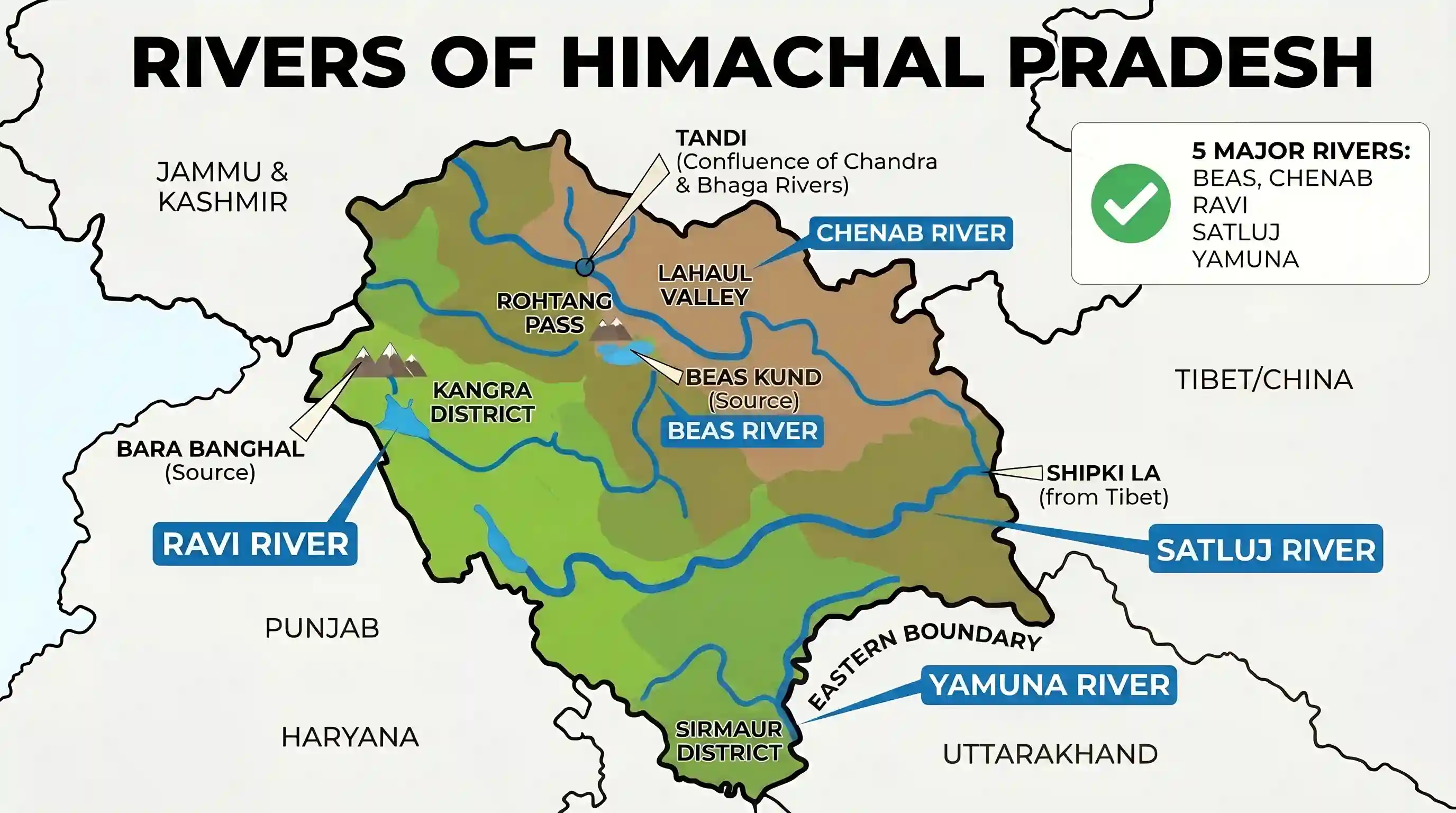
The correct option is D because all five rivers mentioned flow through the state of Himachal Pradesh.
- The Beas originates from the Beas Kund near the Rohtang Pass in Himachal Pradesh.
- The Chenab is formed by the confluence of the Chandra and Bhaga rivers at Tandi in the Lahaul valley of Himachal Pradesh.
- The Ravi originates in the Bara Banghal area of the Kangra district in Himachal Pradesh.
- The Satluj enters Himachal Pradesh from Tibet at Shipki La and flows through several districts of the state.
- The Yamuna flows along the eastern boundary of Himachal Pradesh, specifically touching the Sirmaur district.
Since all five rivers have a presence in the state, option D is the most comprehensive and accurate choice.
Related questions
More UPSC Prelims practice from the same subject and topic.
- Prelims 2010GS1geography
Though coffee and tea both are cultivated on hill slopes, there is some difference between them regarding their cultivation. In this context, consider the following statements: 1. Coffee plant require…
- Prelims 2010GS1geography
Following are the characteristics of an area in India: 1. Hot and humid climate 2. Annual rainfall 200 cm 3. Hill slopes up to an altitude of 1100 metres 4. Annual range of temperature 15°C to 30°C Wh…
- Prelims 2010GS1geography
With reference to the mineral resources of India, consider the following pairs: Mineral 90% Natural sources in 1. Copper ... Jharkhand 2. Nickel ... Orissa 3. Tungsten ... Kerala Which of the pairs gi…
- Prelims 2010GS1geography
In India, which type of forest among the following occupies the largest area?
- Prelims 2010GS1geography
Tamil Nadu is a leading producer of mill-made cotton yarn in the country. What could be the reason? 1. Black cotton soil is the predominant type of soil in the State. 2. Rich pool of skilled labour is…
- Prelims 2010GS1geography
When you travel in certain parts of India, you will notice red soil. What is the main reason for this colour?