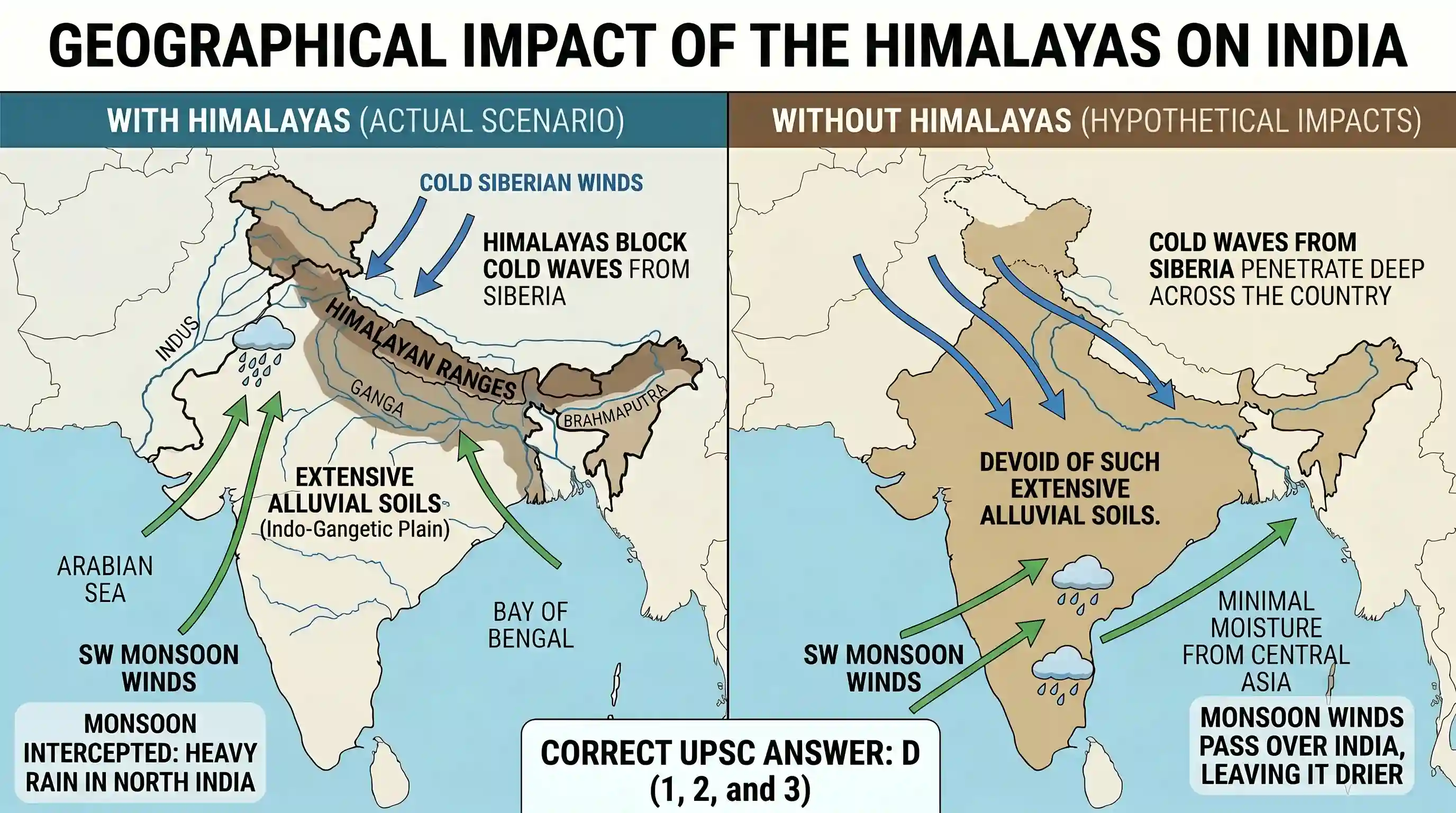
If there were no Himalayan ranges, what would have been the most likely geographical impact on India? 1. Much of the country would experience the cold waves from Siberia. 2. Indo-gangetic plain would be devoid of such extensive alluvial soils.

- A1 only
- B1 and 3 only
- C2 and 3 only.
- D1, 2 and 3Correct
Explanation
The correct answer is D because the Himalayas play a vital role in shaping Indias geography and climate through three main mechanisms.
First, they act as a physical barrier that prevents the freezing cold winds from Siberia and Central Asia from entering the Indian subcontinent. Without them, most of India would experience severe cold waves during winter.
Second, the Himalayas are the source of perennial rivers like the Indus, Ganga, and Brahmaputra. These rivers carry and deposit massive amounts of silt and sediment from the mountains to the plains. Without the Himalayas, the Indo-gangetic plain would not have developed its extensive and fertile alluvial soil.
Third, although not explicitly listed in your numbered points but included in option D as point 3, the Himalayas act as a wall that intercepts the moisture-laden South-West monsoon winds. This forces the clouds to rise and shed rain over northern India. Without this barrier, the monsoon winds would pass over the region into Central Asia, leaving India much drier.
Therefore, all three statements accurately describe the geographical impacts, making D the correct choice.
Related questions
More UPSC Prelims practice from the same subject and topic.
- Prelims 2010GS1geography
Though coffee and tea both are cultivated on hill slopes, there is some difference between them regarding their cultivation. In this context, consider the following statements: 1. Coffee plant require…
- Prelims 2010GS1geography
Following are the characteristics of an area in India: 1. Hot and humid climate 2. Annual rainfall 200 cm 3. Hill slopes up to an altitude of 1100 metres 4. Annual range of temperature 15°C to 30°C Wh…
- Prelims 2010GS1geography
With reference to the mineral resources of India, consider the following pairs: Mineral 90% Natural sources in 1. Copper ... Jharkhand 2. Nickel ... Orissa 3. Tungsten ... Kerala Which of the pairs gi…
- Prelims 2010GS1geography
In India, which type of forest among the following occupies the largest area?
- Prelims 2010GS1geography
Tamil Nadu is a leading producer of mill-made cotton yarn in the country. What could be the reason? 1. Black cotton soil is the predominant type of soil in the State. 2. Rich pool of skilled labour is…
- Prelims 2010GS1geography
Rivers that pass through Himachal Pradesh are