The given item describes a situation and is followed by four possible responses. Indicate the response you find most appropriate. Choose only one response for each item. The responses will be evaluated based on the level of appropriateness for the given situation. You are involved in setting up a water supply project in a remote area. Full recovery of cost is impossible in any case. The income levels in the area are low and 25% of the population is below poverty line (BPL). When a decision has to be taken on pricing you would

- ARecommend that the supply of water be free of charge in all respects
- BRecommend that the users pay a onetime fixed sum for the installation of taps and the usage of water be free
- CRecommend that a fixed monthly charge be levied only on the non-BPL families and for BPL families water should be free
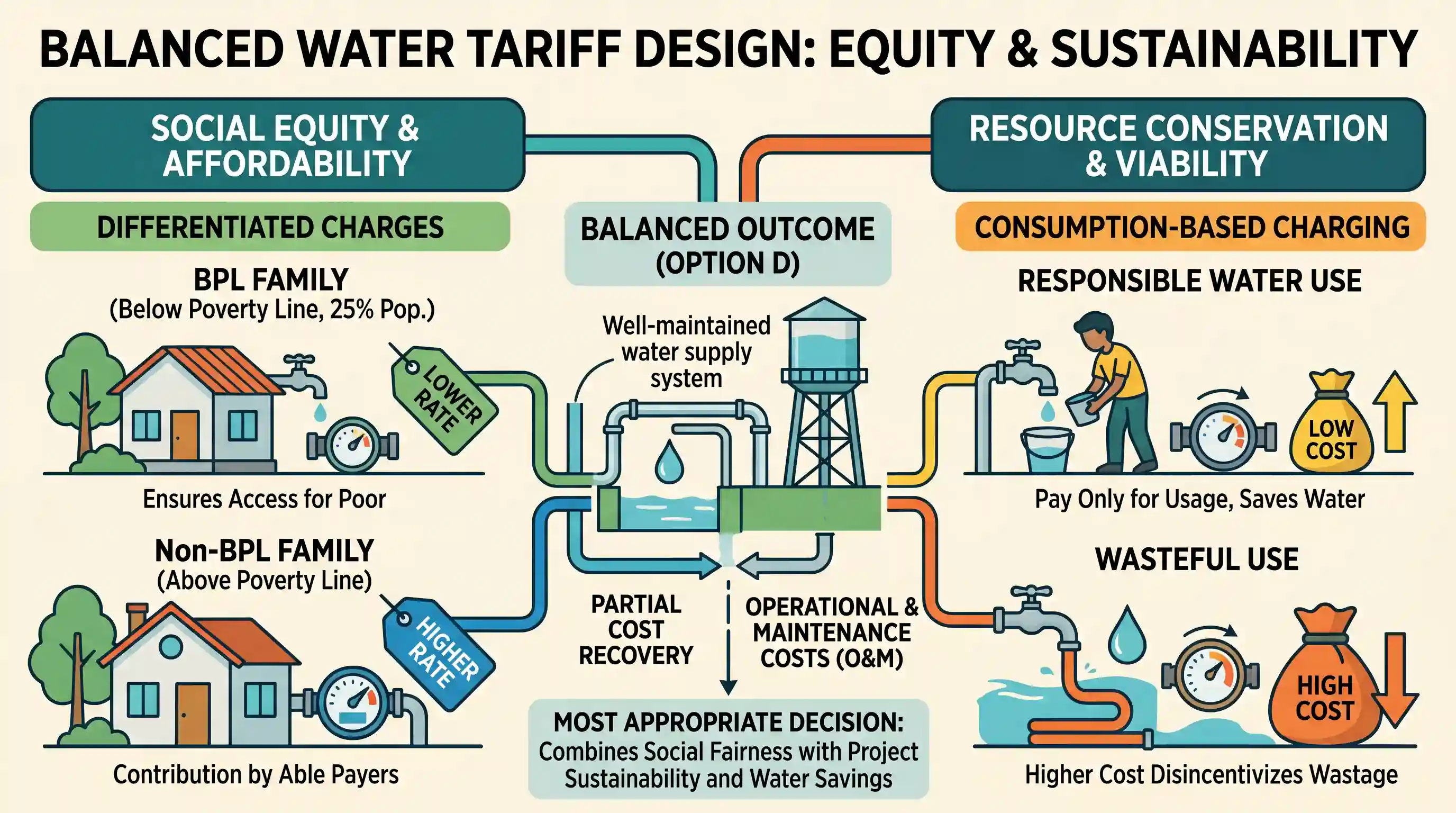
- DRecommend that the users pay a charge based on the consumption of water with differentiated charges for non-BPL and BPL families.Correct
Explanation
The correct answer is D because it offers the most balanced and sustainable approach to providing a vital service like water, considering the given constraints.
Analysis of Options:
A) Recommend that the supply of water be free of charge in all respects: This option is highly unsustainable. Even if full cost recovery is impossible, there will always be operational and maintenance costs for the project. Providing water completely free would mean no revenue to cover these essential ongoing expenses, leading to the eventual failure of the project. It also disincentivizes conservation, potentially leading to wastage.
B) Recommend that the users pay a onetime fixed sum for the installation of taps and the usage of water be free: Similar to option A, this approach fails to address the ongoing operational and maintenance costs. A one-time payment might cover initial installation but provides no recurring revenue for the continuous supply, treatment, and distribution of water. Free usage would still lead to wastage and make the project unsustainable in the long run.
C) Recommend that a fixed monthly charge be levied only on the non-BPL families and for BPL families water should be free: This option is better than A and B as it introduces some recurring revenue and differentiates based on income. However, a fixed monthly charge for non-BPL families does not incentivize conservation, as they pay the same amount regardless of how much water they use. For BPL families, water being completely free could still lead to wastage. The revenue generated might also be insufficient if a significant portion of the population (25% BPL) pays nothing and others pay a fixed sum, which may not cover even partial operational costs effectively.
D) Recommend that the users pay a charge based on the consumption of water with differentiated charges for non-BPL and BPL families: This is the most appropriate option because:
- Consumption-based charging: This incentivizes responsible use and conservation of water, which is crucial for resource management. People pay more if they use more, encouraging efficiency.
- Differentiated charges: This addresses the equity and affordability concerns. BPL families can be charged a lower rate (or even a nominal rate for essential consumption), ensuring access for the poor, while non-BPL families pay a higher rate, contributing more to the project's sustainability. This acknowledges that full cost recovery is impossible but aims for partial recovery to maintain the service.
- Sustainability: By generating recurring revenue from all users (albeit differentiated), the project gains a financial base to cover at least a portion of its operational and maintenance costs, making it more sustainable than the other options. This approach balances social equity with the practical need for financial viability.
Related questions
More UPSC Prelims practice from the same subject and topic.
- Prelims 2012CSATDecision Making
The given item describes a situation and is followed by four possible responses. Indicate the response you find most appropriate. Choose only one response for each item. The responses will be evaluate…
- Prelims 2012CSATDecision Making
The given item describes a situation and is followed by four possible responses. Indicate the response you find most appropriate. Choose only one response for each item. The responses will be evaluate…
- Prelims 2012CSATDecision Making
The given item describes a situation and is followed by four possible responses. Indicate the response you find most appropriate. Choose only one response for each item. The responses will be evaluate…
- Prelims 2012CSATDecision Making
The given item describes a situation and is followed by four possible responses. Indicate the response you find most appropriate. Choose only one response for each item. The responses will be evaluate…
- Prelims 2012CSATDecision Making
The given item describes a situation and is followed by four possible responses. Indicate the response you find most appropriate. Choose only one response for each item. The responses will be evaluate…
- Prelims 2012CSATDecision Making
The given item describes a situation and is followed by four possible responses. Indicate the response you find most appropriate. Choose only one response for each item. The responses will be evaluate…