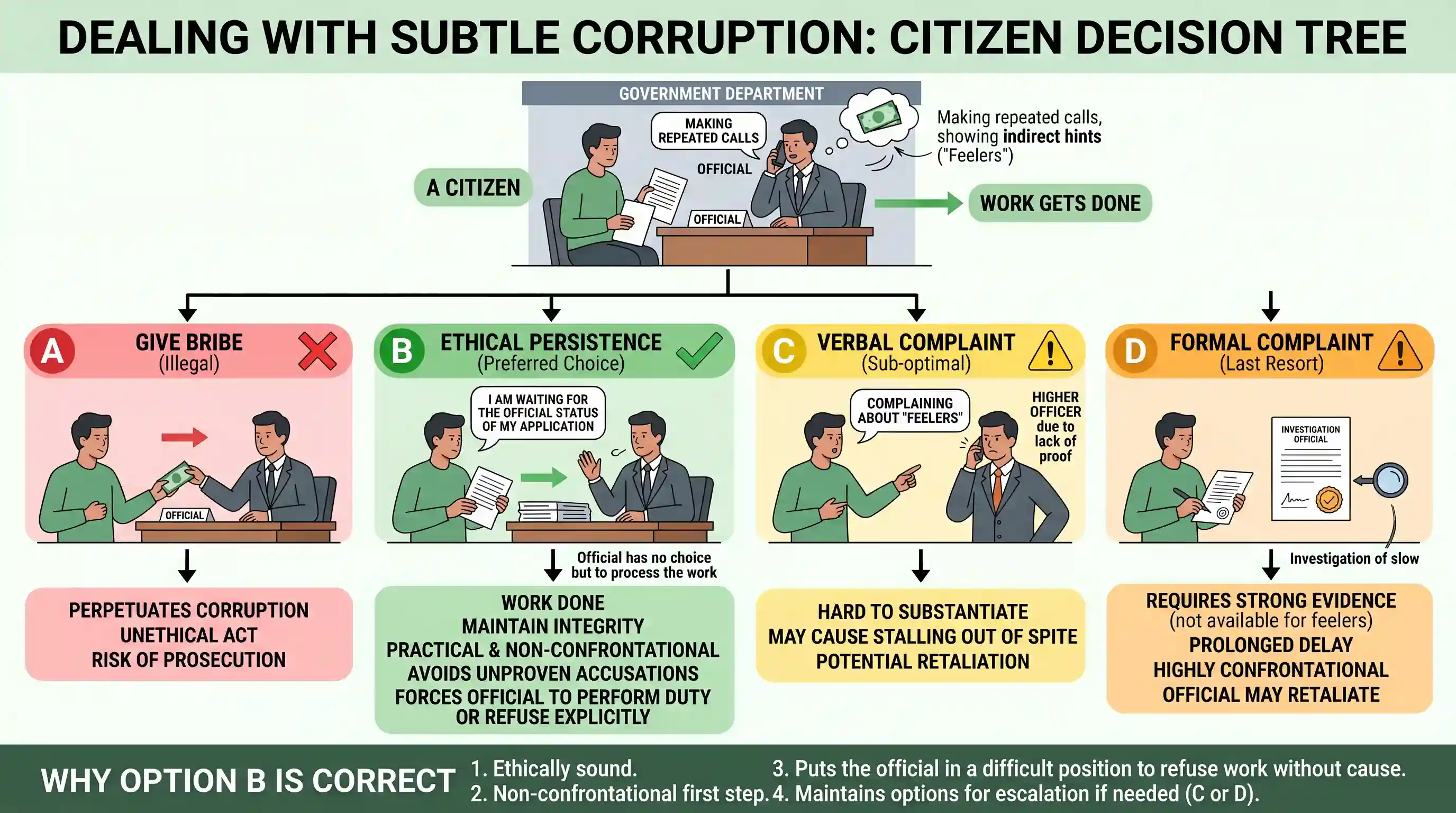
The given item describes a situation and is followed by four possible responses. Indicate the response you find most appropriate. Choose only one response for each item. The responses will be evaluated based on the level of appropriateness for the given situation. As a citizen you have some work with a government department. The official calls you again and again; and without directly asking you, sends out feelers for a bribe. You want to get your work done. You would

- AGive a bribe
- BBehave as if you have not understood the feelers and persist with your applicationCorrect
- CGo to the higher officer for help verbally complaining about feelers
- DSend in a formal complaint.
Explanation
The correct answer is B because it represents a practical, ethical, and non-confrontational approach to dealing with subtle corruption.
Analysis of options:
A) Give a bribe: This is illegal, unethical, and perpetuates corruption. As a responsible citizen, one should not engage in such acts, even if it seems like the quickest way to get work done.
B) Behave as if you have not understood the feelers and persist with your application: This is the most appropriate first step. It avoids directly confronting the official (which might lead to retaliation or further delays) while also refusing to engage in corruption. By persisting, you are asserting your right to have your work done without illegal means. It puts the onus on the official to either do their job or explicitly refuse, which is harder for them to do without cause. It gives them an "out" to avoid explicitly asking for a bribe and just do their job.
C) Go to the higher officer for help verbally complaining about feelers: While a valid option, "feelers" are indirect and difficult to prove verbally. A verbal complaint might be easily dismissed or could lead to the official finding ways to stall your work out of spite. It might be an overreaction as a first step when the demand is not explicit.
D) Send in a formal complaint: A formal complaint requires concrete evidence, which is hard to obtain when dealing with subtle "feelers." Without strong evidence, a formal complaint might be dismissed and could significantly delay your work, as the official might feel targeted and retaliate. This is generally a last resort, after other avenues have been exhausted or if the corruption becomes explicit.
Option B allows you to continue pursuing your work ethically without escalating the situation prematurely, giving the official a chance to perform their duty without an explicit bribe.
Related questions
More UPSC Prelims practice from the same subject and topic.
- Prelims 2012CSATDecision Making
The given item describes a situation and is followed by four possible responses. Indicate the response you find most appropriate. Choose only one response for each item. The responses will be evaluate…
- Prelims 2012CSATDecision Making
The given item describes a situation and is followed by four possible responses. Indicate the response you find most appropriate. Choose only one response for each item. The responses will be evaluate…
- Prelims 2012CSATDecision Making
The given item describes a situation and is followed by four possible responses. Indicate the response you find most appropriate. Choose only one response for each item. The responses will be evaluate…
- Prelims 2012CSATDecision Making
The given item describes a situation and is followed by four possible responses. Indicate the response you find most appropriate. Choose only one response for each item. The responses will be evaluate…
- Prelims 2012CSATDecision Making
The given item describes a situation and is followed by four possible responses. Indicate the response you find most appropriate. Choose only one response for each item. The responses will be evaluate…
- Prelims 2012CSATDecision Making
The given item describes a situation and is followed by four possible responses. Indicate the response you find most appropriate. Choose only one response for each item. The responses will be evaluate…