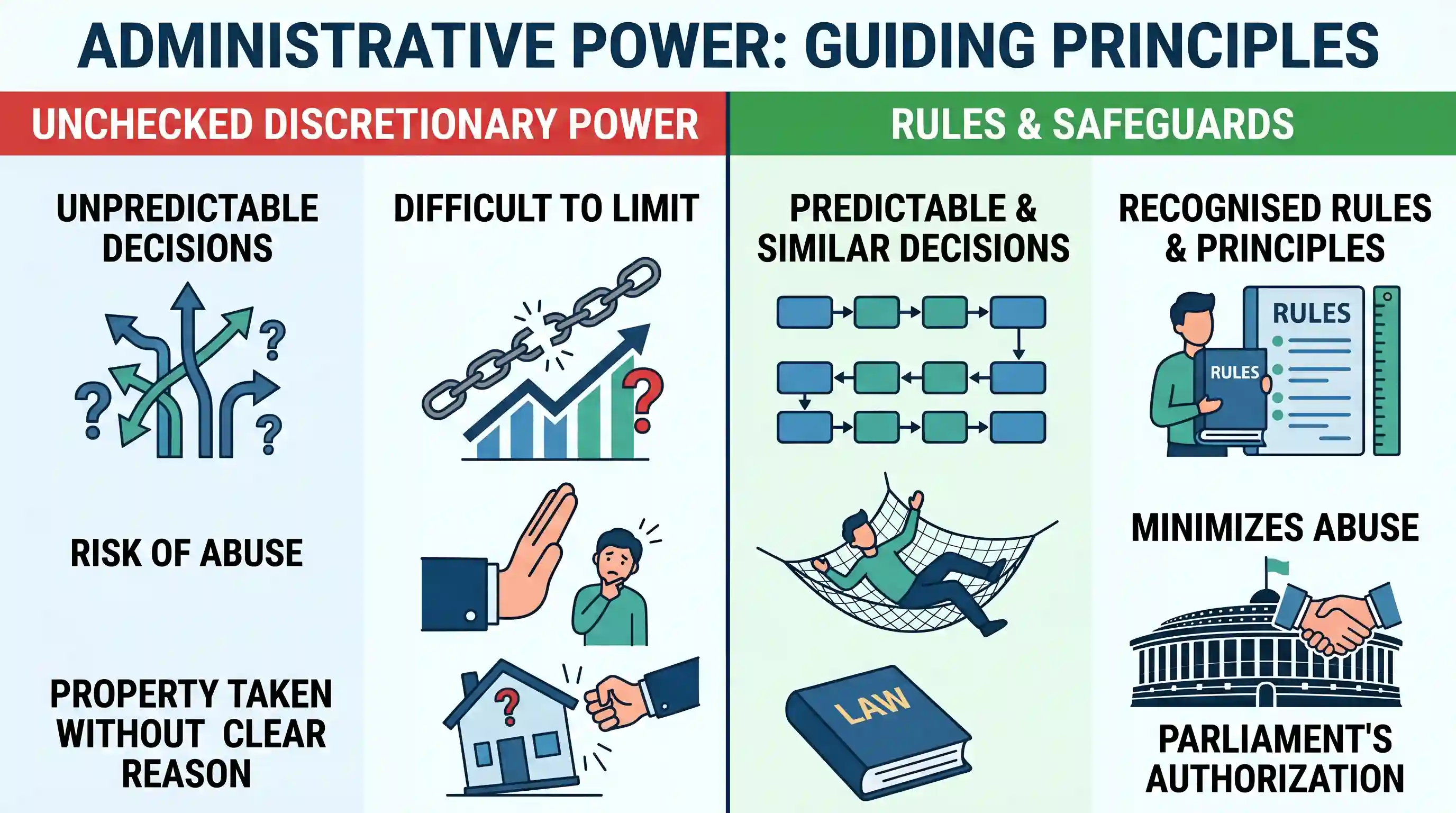
Governments may have to take steps which would otherwise be an infringement on the Fundamental Rights of individuals, such as acquiring a person's land against his will, or refusing permission for putting up a building, but the larger public interest for which these are done must be authorized by the people (Parliament). Discretionary powers to the administration can be done away with. It is becoming more and more difficult to keep this power within limits as the government has many number of tasks to perform. Where discretion has to be used, there must be rules and safeguards to prevent misuse of that power. Systems have to be devised which minimise, if not prevent, the abuse of discretionary power. Government work must be conducted within a framework of recognised rules and principles, and decisions should be similar and predictable. Which among the following is the most logical assumption that can be made from the above passage?

- AGovernment should always be given wide discretionary power in all matters of administration
- BThe supremacy of rules and safeguards should prevail as opposed to the influence of exclusive discretion of authorityCorrect
- CParliamentary democracy is possible only if the Government has wider discretionary power
- DNone of the above statements is a logical assumption that can be made from this passage.
Explanation
The passage highlights the challenges of discretionary power in government, acknowledging its necessity in some cases (e.g., acquiring land for public interest) but strongly advocating for its limitation and control.
Let's analyze each option:
A) Government should always be given wide discretionary power in all matters of administration. This contradicts the passage. The passage states it's "difficult to keep this power within limits" and emphasizes the need for "rules and safeguards to prevent misuse." It argues for minimizing, not expanding, unchecked discretionary power.
B) The supremacy of rules and safeguards should prevail as opposed to the influence of exclusive discretion of authority. This is the most logical assumption. The passage repeatedly stresses that "Where discretion has to be used, there must be rules and safeguards to prevent misuse of that power." It further states that "Government work must be conducted within a framework of recognised rules and principles, and decisions should be similar and predictable." This clearly indicates a preference for rules and safeguards to govern and limit discretion, making them supreme over arbitrary individual authority.
C) Parliamentary democracy is possible only if the Government has wider discretionary power. The passage mentions Parliament authorizing actions but does not link the possibility of parliamentary democracy to wider discretionary power. In fact, it argues for controlling discretionary power, which would be more in line with democratic accountability.
D) None of the above statements is a logical assumption that can be made from this passage. Since option B is a strong logical assumption, this option is incorrect.
Therefore, the passage's central argument is the necessity of rules and safeguards to control discretionary power, making the supremacy of rules and safeguards over unchecked discretion the most logical assumption.
Related questions
More UPSC Prelims practice from the same subject and topic.
- Prelims 2015CSATReading Comprehension
Human history abounds in claims and theories confining the right of governing to a few select citizens. Exclusion of the many is justified on the ground that human beings may be rightfully segregated …
- Prelims 2015CSATReading Comprehension
By 2050, the Earth's population will likely have swelled from seven to nine billion people. To fill all those stomachs while accounting for shifting consumption patterns, climate change, and a finite …
- Prelims 2015CSATReading Comprehension
Many people in India feel that if we cut our defence expenditure on weapon- building, we can create a climate of peace with our neighbours, subsequently reducing the conflict or creating a no- war sit…
- Prelims 2015CSATReading Comprehension
India accounts for nearly a fifth of the world's child deaths. In terms of numbers, it is the highest in the world - nearly 16 lakhs every year. Of these, more than half die in the first month of life…
- Prelims 2015CSATReading Comprehension
Foods travel more than the people who eat them. Grocery stores and supermarkets are loaded with preserved and processed foods. This, however, often leads to environmental threats, such as pollution ge…
- Prelims 2015CSATReading Comprehension
I must say that, beyond occasionally exposing me to laughter, my constitutional shyness has been of no disadvantage whatever. In fact I can see that, on the contrary, it has been all to my advantage. …