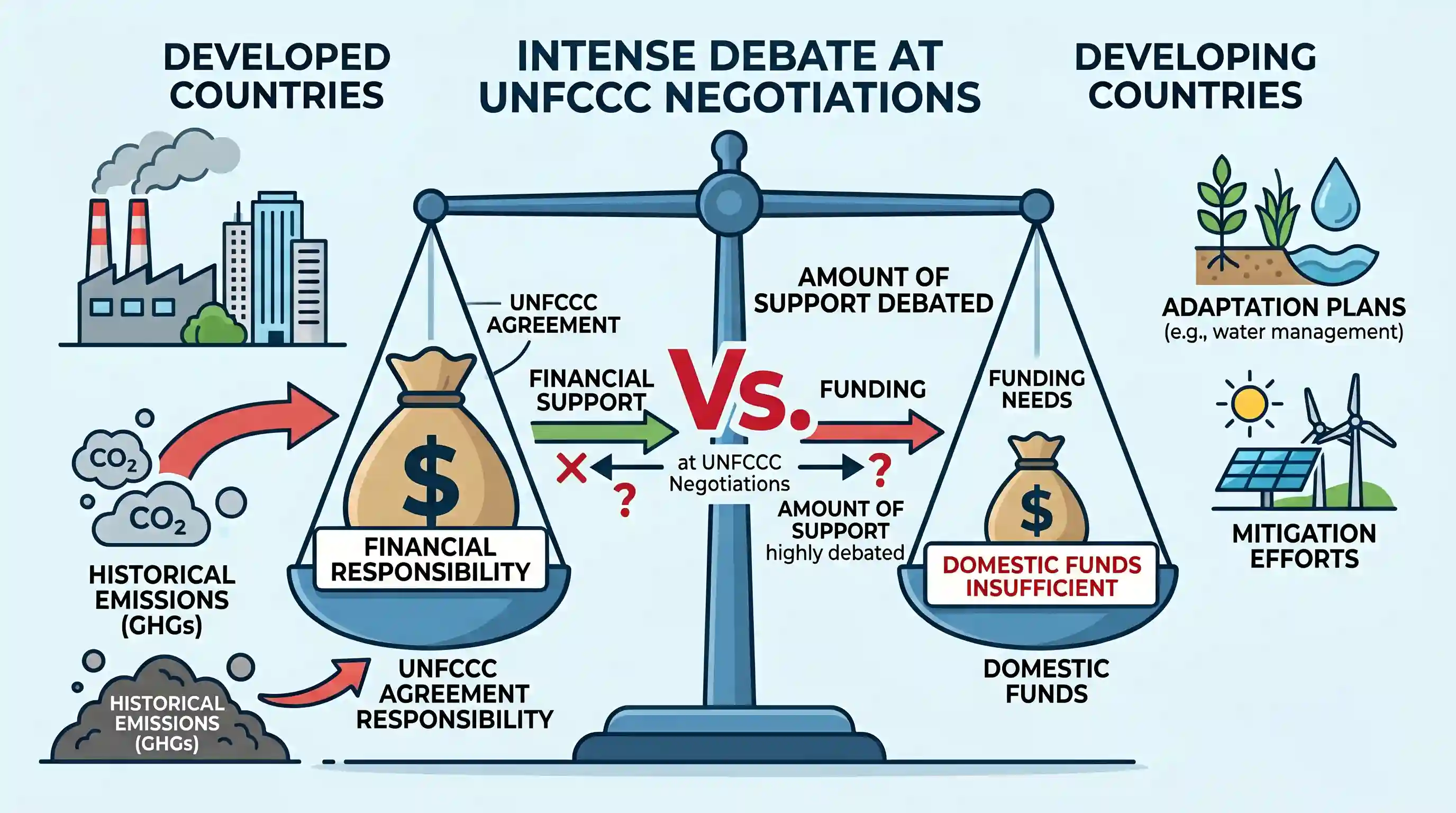
Climate change is a complex policy issue with major implications in terms of finance. All actions to address climate change ultimately involve costs. Funding is vital for countries like India to design and implement adaptation and mitigation plans and projects. Lack of funding is a large impediment to implementing adaptation plans. The scale and magnitude of the financial support required by developing countries to enhance their domestic mitigation and adaptation actions are a matter of intense debate in the multilateral negotiations under the United Nations Framework Convention on Climate Change (UNFCCC)' The Convention squarely puts the responsibility for provision of financial support on the developed countries, taking into account their contribution to the stock of greenhouse gases (GHGs) in the atmosphere. Given the magnitude of the task and the funds required, domestic finances are likely to fall short of the current and projected needs of the developing countries. Global funding through the multilateral mechanism of the Convention will enhance their domestic capacity to finance the mitigation efforts. Which one of the following is essentially discussed in the passage?

- AConflict between developed and developing countries regarding support for mitigationCorrect
- BOccurrence of climate change due to excessive exploitation of natural resources by the developed countries
- CLack of political will on the part of all the countries to implement adaptation plans
- DGovernance problems of developing countries as a result of climate change
Explanation
The passage essentially discusses the financial challenges faced by developing countries in addressing climate change and the ongoing debate and responsibility for providing this funding.
A) Conflict between developed and developing countries regarding support for mitigation. The passage explicitly states that the "scale and magnitude of the financial support required by developing countries... are a matter of intense debate in the multilateral negotiations under the United Nations Framework Convention on Climate Change (UNFCCC)". It also highlights that the "Convention squarely puts the responsibility for provision of financial support on the developed countries". This clearly points to a conflict or disagreement between these two groups over financial support for climate actions (mitigation and adaptation). This is the central theme of the passage.
B) Occurrence of climate change due to excessive exploitation of natural resources by the developed countries. While the passage mentions developed countries' "contribution to the stock of greenhouse gases (GHGs)" as the basis for their financial responsibility, it does not essentially discuss the cause of climate change in terms of "excessive exploitation of natural resources". The focus is on financial support and the debate surrounding it, not the detailed origins of climate change.
C) Lack of political will on the part of all the countries to implement adaptation plans. The passage states that "Lack of funding is a large impediment to implementing adaptation plans." This indicates a financial barrier, not necessarily a lack of political will from all countries. In fact, developing countries are portrayed as needing funds to implement plans, implying a desire to act.
D) Governance problems of developing countries as a result of climate change. The passage mentions that "domestic finances are likely to fall short" and that global funding "will enhance their domestic capacity to finance the mitigation efforts." This highlights a financial capacity issue, not "governance problems" as a result of climate change. Governance issues are not discussed in the passage.
Therefore, option A accurately captures the essential discussion in the passage about the financial debate and differing responsibilities between developed and developing nations concerning climate change actions.
Related questions
More UPSC Prelims practice from the same subject and topic.
- Prelims 2015CSATReading Comprehension
Human history abounds in claims and theories confining the right of governing to a few select citizens. Exclusion of the many is justified on the ground that human beings may be rightfully segregated …
- Prelims 2015CSATReading Comprehension
By 2050, the Earth's population will likely have swelled from seven to nine billion people. To fill all those stomachs while accounting for shifting consumption patterns, climate change, and a finite …
- Prelims 2015CSATReading Comprehension
Many people in India feel that if we cut our defence expenditure on weapon- building, we can create a climate of peace with our neighbours, subsequently reducing the conflict or creating a no- war sit…
- Prelims 2015CSATReading Comprehension
India accounts for nearly a fifth of the world's child deaths. In terms of numbers, it is the highest in the world - nearly 16 lakhs every year. Of these, more than half die in the first month of life…
- Prelims 2015CSATReading Comprehension
Foods travel more than the people who eat them. Grocery stores and supermarkets are loaded with preserved and processed foods. This, however, often leads to environmental threats, such as pollution ge…
- Prelims 2015CSATReading Comprehension
I must say that, beyond occasionally exposing me to laughter, my constitutional shyness has been of no disadvantage whatever. In fact I can see that, on the contrary, it has been all to my advantage. …