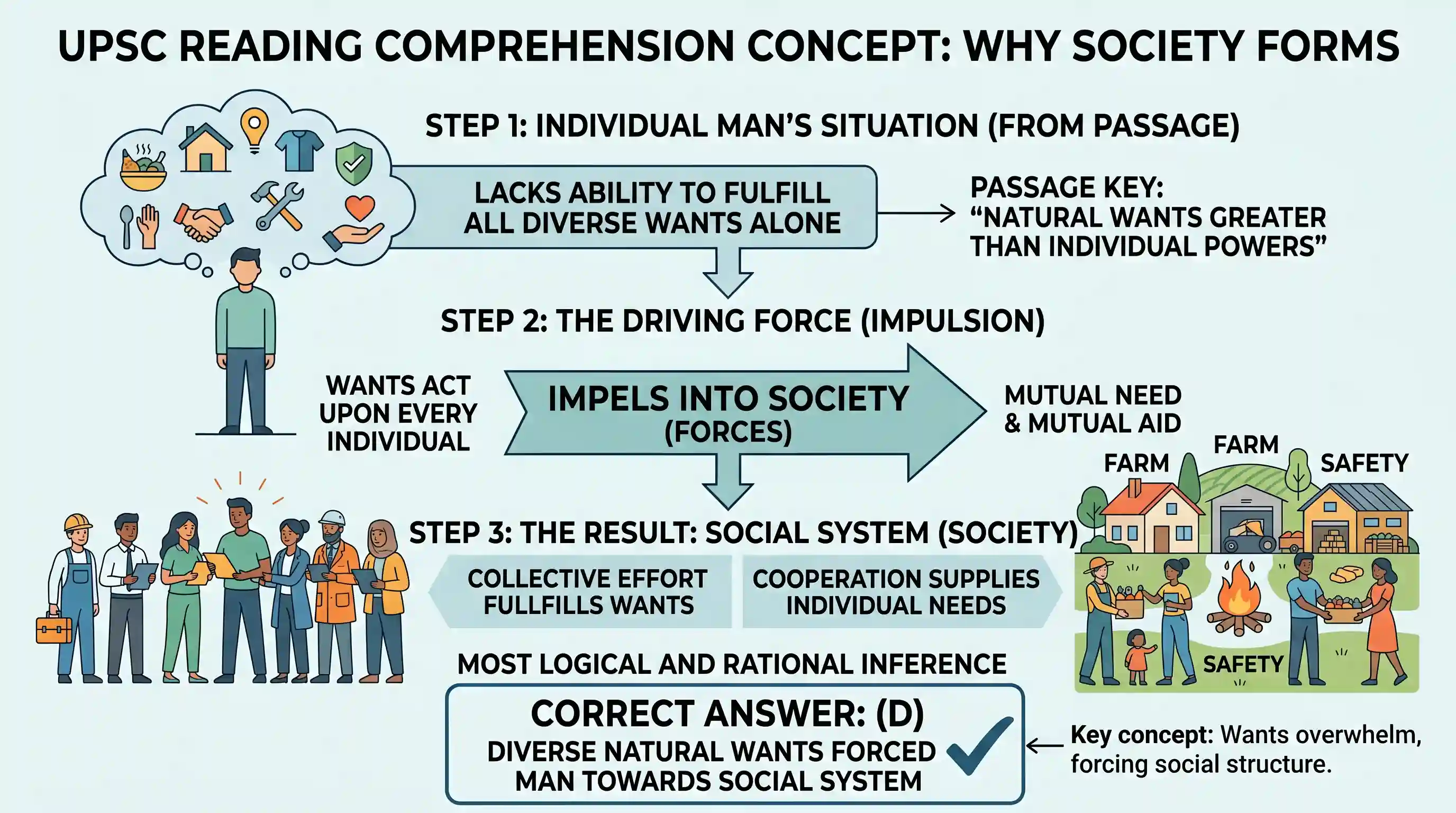
To understand the nature and quantity of Government proper for man, it is necessary to attend to his character. As nature created him for social life, she fitted him for the station she intended. In all cases she made his natural wants greater than his individual powers. No one man is capable, without the aid of society, of supplying his own wants; and those wants, acting upon every individual, impel the whole of them into society. Which among the following is the most logical and rational inference that can be made from the above passage?

- ANature has created a great diversity in human society
- BAny given human society is always short of its wants
- CSocial life is a specific characteristic of man
- DDiverse natural wants forced man towards social systemCorrect
Explanation
The passage explains that man's natural wants are greater than his individual powers, making it impossible for any single person to fulfill their own needs without the aid of society. These wants then "impel" (force) individuals into society.
Let's analyze the options:
A) Nature has created a great diversity in human society: The passage discusses the reason for society's formation based on individual needs and powers, not the diversity within society itself.
B) Any given human society is always short of its wants: The passage states individual wants are greater than individual powers, leading to society as a means to fulfill them. It doesn't suggest society itself is always short of its wants; rather, society is presented as a solution.
C) Social life is a specific characteristic of man: While the passage begins by stating nature created man for social life, the core argument and explanation that follows focuses on why this is so – because individual wants exceed individual capabilities, thus forcing man into social systems. This option states a fact mentioned, but not the primary inference about the underlying mechanism explained.
D) Diverse natural wants forced man towards social system: The passage clearly states "natural wants greater than his individual powers" and "No one man is capable, without the aid of society, of supplying his own wants; and those wants...impel the whole of them into society." The term "diverse" is a reasonable inference for "wants greater than individual powers" that require collective effort. The crucial part is that these wants forced (impelled) man into a social system, which directly aligns with the passage's explanation. This option captures the causal link and the core argument of the passage.
Therefore, D is the most logical and rational inference as it directly reflects the passage's explanation of why man forms a social system.
Related questions
More UPSC Prelims practice from the same subject and topic.
- Prelims 2016CSATReading Comprehension
Accountability, or the lack of it, in governance generally, and civil services, in particular, is a major factor underlying the deficiencies in governance and public administration. Designing an effec…
- Prelims 2016CSATReading Comprehension
Accountability, or the lack of it, in governance generally, and civil services, in particular, is a major factor underlying the deficiencies in governance and public administration. Designing an effec…
- Prelims 2016CSATReading Comprehension
Accountability, or the lack of it, in governance generally, and civil services, in particular, is a major factor underlying the deficiencies in governance and public administration. Designing an effec…
- Prelims 2016CSATReading Comprehension
Accountability, or the lack of it, in governance generally, and civil services, in particular, is a major factor underlying the deficiencies in governance and public administration. Designing an effec…
- Prelims 2016CSATReading Comprehension
In general, religious traditions stress our duty to god, or to some universal ethical principle. Our duties to one another derive from these. The religious concept of rights is primarily derived from …
- Prelims 2016CSATReading Comprehension
In general, religious traditions stress our duty to god, or to some universal ethical principle. Our duties to one another derive from these. The religious concept of rights is primarily derived from …