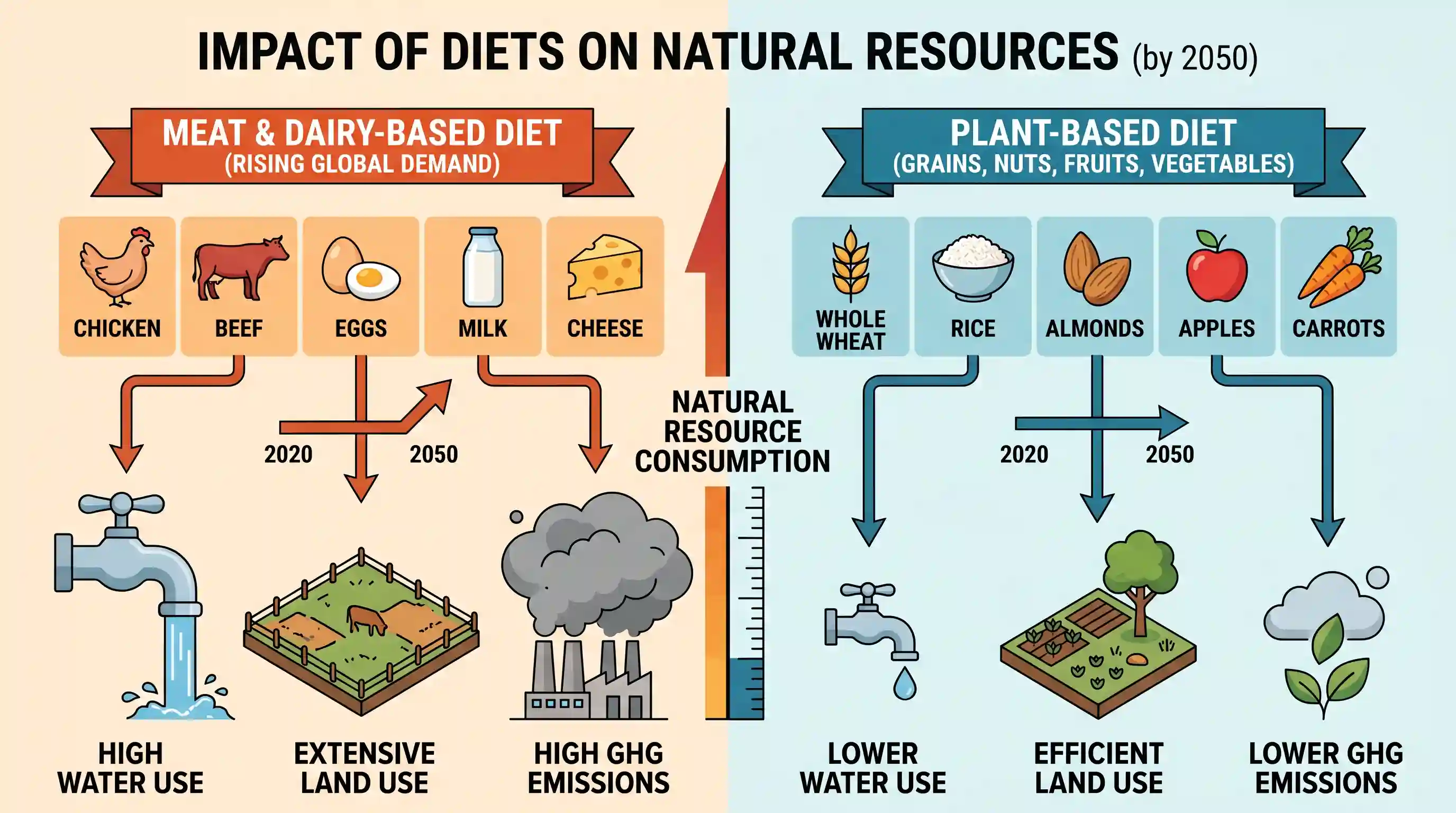
As we look to 2050, when we will need to feed two billion more people, the question of which diet is best hartaen on new urgency. The foods we choose to eat in the coming decades will have dramatic ramifications for the planet. Simply put, a diet that revolves around meat and dairy a way of eating that is on the rise throughout the developing. world, will take a greater toll on the world's resources than one that revolves around unrefined grains, nuts, fruits and vegetables. What is the critical message conveyed by the above passage?

- AOur increasing demand for foods sourced from animals puts a greater burden on our natural resourcesCorrect
- BDiets based on grains, nuts, fruits and vegetables are best suited for health in developing countries
- CHuman beings change their food habits from time to time irrespective of the health concerns
- DFrom a global perspective, we still do not know which type of diet is best for us
Explanation
The passage directly states that a diet revolving around meat and dairy "will take a greater toll on the world's resources" compared to one based on unrefined grains, nuts, fruits, and vegetables. It also notes that the meat and dairy-centric diet is "on the rise throughout the developing world," implying an increasing demand.
Analysis of options:
A) Our increasing demand for foods sourced from animals puts a greater burden on our natural resources. This option perfectly captures the critical message. The passage explicitly links the rise of meat and dairy consumption (foods sourced from animals) to a "greater toll on the world's resources."
B) Diets based on grains, nuts, fruits and vegetables are best suited for health in developing countries. While such diets might be healthy, the passage's primary focus is on their lower environmental impact ("lesser toll on the world's resources"), not specifically their health benefits, nor does it limit this benefit to developing countries.
C) Human beings change their food habits from time to time irrespective of the health concerns. The passage mentions a change in food habits (rise of meat/dairy), but it doesn't state this happens "irrespective of health concerns." More importantly, this is a general observation, not the critical message about the environmental impact of specific dietary choices.
D) From a global perspective, we still do not know which type of diet is best for us. This contradicts the passage. The passage clearly argues that a plant-based diet is better from a resource perspective, implying a clear understanding of which diet is "best" in that context.
Related questions
More UPSC Prelims practice from the same subject and topic.
- Prelims 2016CSATReading Comprehension
Accountability, or the lack of it, in governance generally, and civil services, in particular, is a major factor underlying the deficiencies in governance and public administration. Designing an effec…
- Prelims 2016CSATReading Comprehension
Accountability, or the lack of it, in governance generally, and civil services, in particular, is a major factor underlying the deficiencies in governance and public administration. Designing an effec…
- Prelims 2016CSATReading Comprehension
Accountability, or the lack of it, in governance generally, and civil services, in particular, is a major factor underlying the deficiencies in governance and public administration. Designing an effec…
- Prelims 2016CSATReading Comprehension
Accountability, or the lack of it, in governance generally, and civil services, in particular, is a major factor underlying the deficiencies in governance and public administration. Designing an effec…
- Prelims 2016CSATReading Comprehension
In general, religious traditions stress our duty to god, or to some universal ethical principle. Our duties to one another derive from these. The religious concept of rights is primarily derived from …
- Prelims 2016CSATReading Comprehension
In general, religious traditions stress our duty to god, or to some universal ethical principle. Our duties to one another derive from these. The religious concept of rights is primarily derived from …