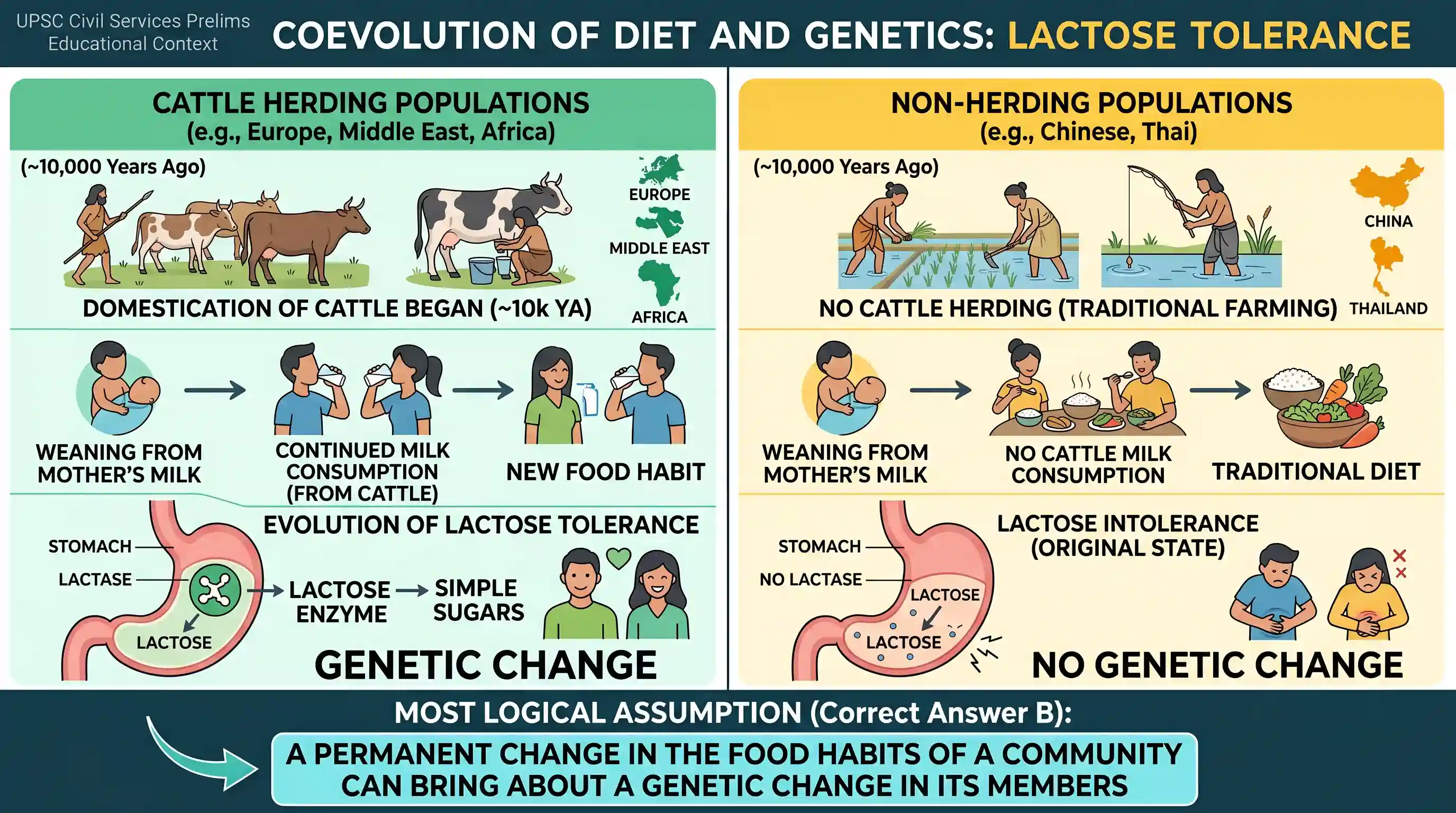
All humans digest mother's milk as infants, but until cattle began being domesticated 10,000 years ago, children once weaned no longer needed to digest milk. As a result, they stopped making the enzyme lactase, which breaks down the sugar lactose into simple sugars. After humans began herding cattle, it became tremendously advantageous to digest milk, and lactose tolerance evolved independently among cattle herders in Europe, the Middle East and Africa. Groups not dependent on cattle, such as the Chinese and Thai, remain lactose intolerant. Which among the following is the most logical assumption that can be made from the above passage?

- AAbout 10,000 years ago, the domestication of animals took place in some parts of the world
- BA permanent change in the food habits of a community can bring about a genetic change in its membersCorrect
- CLactose tolerant people only are capable of getting simple sugars in their bodies
- DPeople who are not lactose tolerant cannot digest any dairy product
Explanation
The passage describes how the domestication of cattle led to a change in human diet (consuming milk), which in turn created a selective advantage for individuals who could digest lactose. This advantage resulted in the evolution of lactose tolerance, a genetic change, in those populations.
Let's analyze the options:
A) About 10,000 years ago, the domestication of animals took place in some parts of the world. This is a direct statement from the passage ("until cattle began being domesticated 10,000 years ago"), not an assumption.
B) A permanent change in the food habits of a community can bring about a genetic change in its members. This is the central theme and a logical conclusion from the passage. The passage explicitly states that "After humans began herding cattle, it became tremendously advantageous to digest milk, and lactose tolerance evolved independently among cattle herders." Herding cattle implies a permanent change in food habits, and lactose tolerance evolving is a genetic change. This option accurately summarizes the evolutionary principle demonstrated.
C) Lactose tolerant people only are capable of getting simple sugars in their bodies. This is incorrect. Simple sugars can be obtained from many other food sources (fruits, grains, etc.) not related to milk. The passage only discusses simple sugars derived from lactose.
D) People who are not lactose tolerant cannot digest any dairy product. This is an overgeneralization. Many lactose-intolerant individuals can consume dairy products with low lactose content (like hard cheeses or yogurt where bacteria have broken down lactose) without issues. The passage focuses on the inability to break down lactose, not all dairy.
Therefore, B is the most logical assumption/conclusion that can be made from the information provided in the passage.
Related questions
More UPSC Prelims practice from the same subject and topic.
- Prelims 2016CSATReading Comprehension
Accountability, or the lack of it, in governance generally, and civil services, in particular, is a major factor underlying the deficiencies in governance and public administration. Designing an effec…
- Prelims 2016CSATReading Comprehension
Accountability, or the lack of it, in governance generally, and civil services, in particular, is a major factor underlying the deficiencies in governance and public administration. Designing an effec…
- Prelims 2016CSATReading Comprehension
Accountability, or the lack of it, in governance generally, and civil services, in particular, is a major factor underlying the deficiencies in governance and public administration. Designing an effec…
- Prelims 2016CSATReading Comprehension
Accountability, or the lack of it, in governance generally, and civil services, in particular, is a major factor underlying the deficiencies in governance and public administration. Designing an effec…
- Prelims 2016CSATReading Comprehension
In general, religious traditions stress our duty to god, or to some universal ethical principle. Our duties to one another derive from these. The religious concept of rights is primarily derived from …
- Prelims 2016CSATReading Comprehension
In general, religious traditions stress our duty to god, or to some universal ethical principle. Our duties to one another derive from these. The religious concept of rights is primarily derived from …