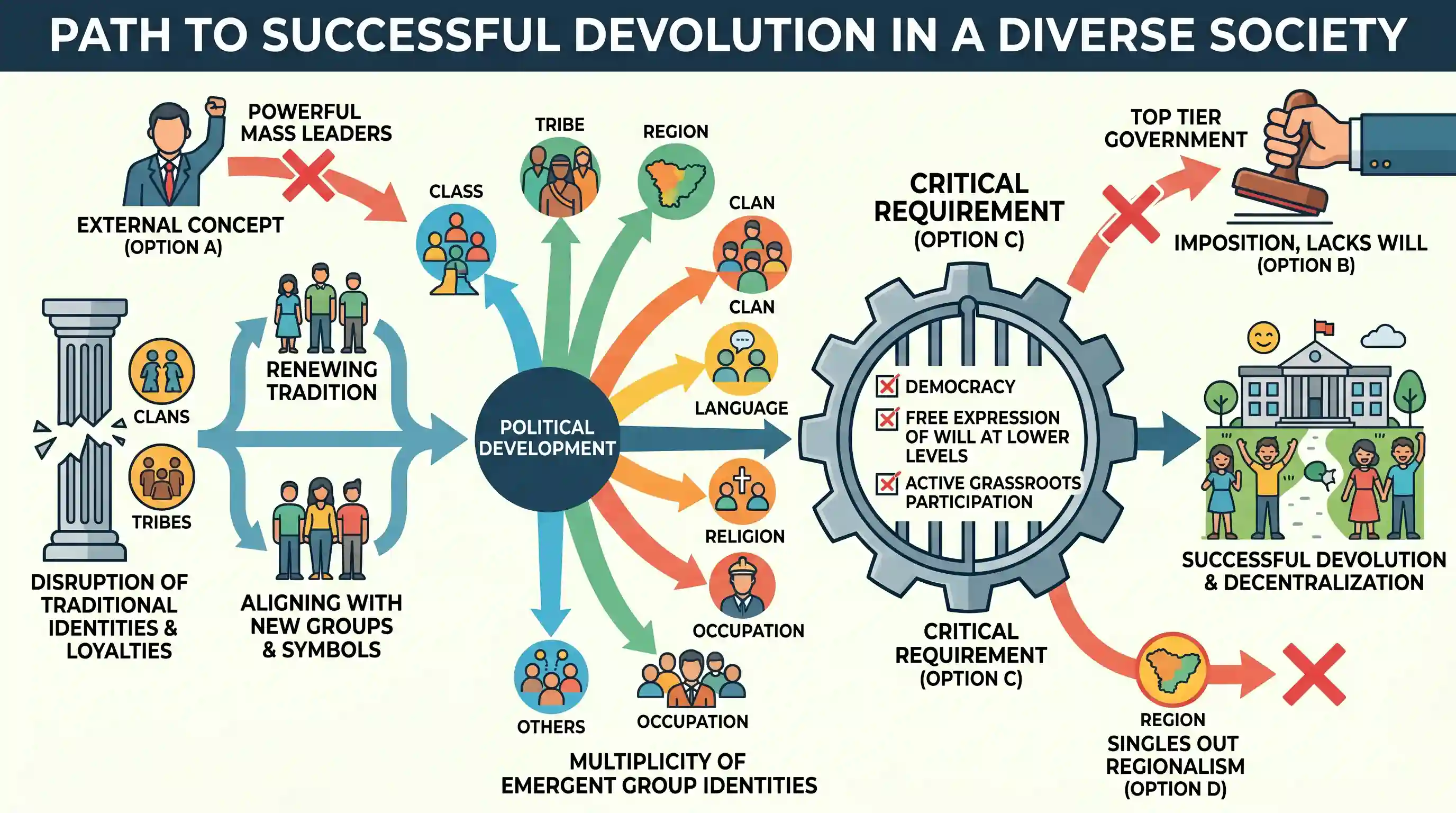
Disruption of traditional institutions, identifications and loyalties is likely to lead to ambivalent situations. It is possible that some people may renew their identification with traditional groups whereas others align themselves with new groups and symbols emergent from processes of political development. In addition, political development tends to foster group awareness of a variety of class, tribe, region, clan, language, religion, occupation and others. Which among the following is the most logical, rational and critical inference that can be made from the above passage?

- AEmergence of powerful mass leaders is essential to create sub-national political entities and thus ensure successful devolution and decentralization.
- BThe upper tier of government should impose devolution and decentralization on the regional communities by law or otherwise.
- CDevolution, to be successful, requires a democracy in which there is free expression of the will of the people at lower level and their active participation at the grassroots level.Correct
- DFor devolution to take place, a strong feeling of regionalism in the masses is essential.
Explanation
The passage describes a society where traditional institutions are disrupted, leading to ambivalent situations. People either renew traditional ties or align with new groups. Crucially, political development fosters awareness based on a variety of identities like class, tribe, region, language, religion, and occupation.
Let's analyze the options:
A) Emergence of powerful mass leaders is essential to create sub-national political entities and thus ensure successful devolution and decentralization. The passage focuses on societal shifts and group identities, not on the necessity of powerful mass leaders for devolution. This is an external concept not directly supported as an essential condition by the passage.
B) The upper tier of government should impose devolution and decentralization on the regional communities by law or otherwise. The passage describes a complex, evolving societal landscape where various identities emerge. Imposing devolution from above would contradict the idea of accommodating diverse group awareness and the implied need for bottom-up engagement.
C) Devolution, to be successful, requires a democracy in which there is free expression of the will of the people at lower level and their active participation at the grassroots level. This option directly addresses how devolution can succeed in the context described by the passage. If traditional loyalties are disrupted, new groups and identities emerge, and group awareness is fostered across various lines (class, tribe, region, etc.), then for power transfer (devolution) to be successful, it must allow these diverse groups and individuals to express their will and actively participate. This ensures that devolution responds to the actual needs and aspirations arising from the societal changes.
D) For devolution to take place, a strong feeling of regionalism in the masses is essential. The passage mentions "region" as one among many bases for group awareness (class, tribe, clan, language, religion, occupation, and others). It does not single out regionalism as the sole or primary essential factor. The passage presents a much broader and more complex picture of identity formation.
Therefore, C is the most logical inference because it provides a mechanism for devolution to effectively navigate the complex and diverse societal landscape described in the passage, where various identities and loyalties are in flux and asserting themselves.
Related questions
More UPSC Prelims practice from the same subject and topic.
- Prelims 2017CSATReading Comprehension
Disruption of traditional institutions, identifications and loyalties is likely to lead to ambivalent situations. It is possible that some people may renew their identification with traditional groups…
- Prelims 2017CSATReading Comprehension
We live in digital times. The digital is not just something we use strategically and specifically to do a few tasks. Our very perception of who we are, how we connect to the world around us, and the w…
- Prelims 2017CSATReading Comprehension
The IMF has pointed out that the fast growing economies of Asia face the risk of falling into 'middle-income trap'. It means that average incomes in these countries, which till now have been growing r…
- Prelims 2017CSATReading Comprehension
An innovative India will be inclusive as well as technologically advanced, improving the lives of all Indians. Innovation and R&D can mitigate increases in social inequality and relieve the pressures …
- Prelims 2017CSATReading Comprehension
Climate change is likely to expose a large number of people to increasing environmental risks forcing them to migrate. The international community is yet to recognize this new category of migrants. Th…
- Prelims 2017CSATReading Comprehension
Many farmers use synthetic pesticides to kill infesting insects. The consumption of pesticides in some of the developed countries is touching 3000 grams/hectare. Unfortunately, there are reports that …