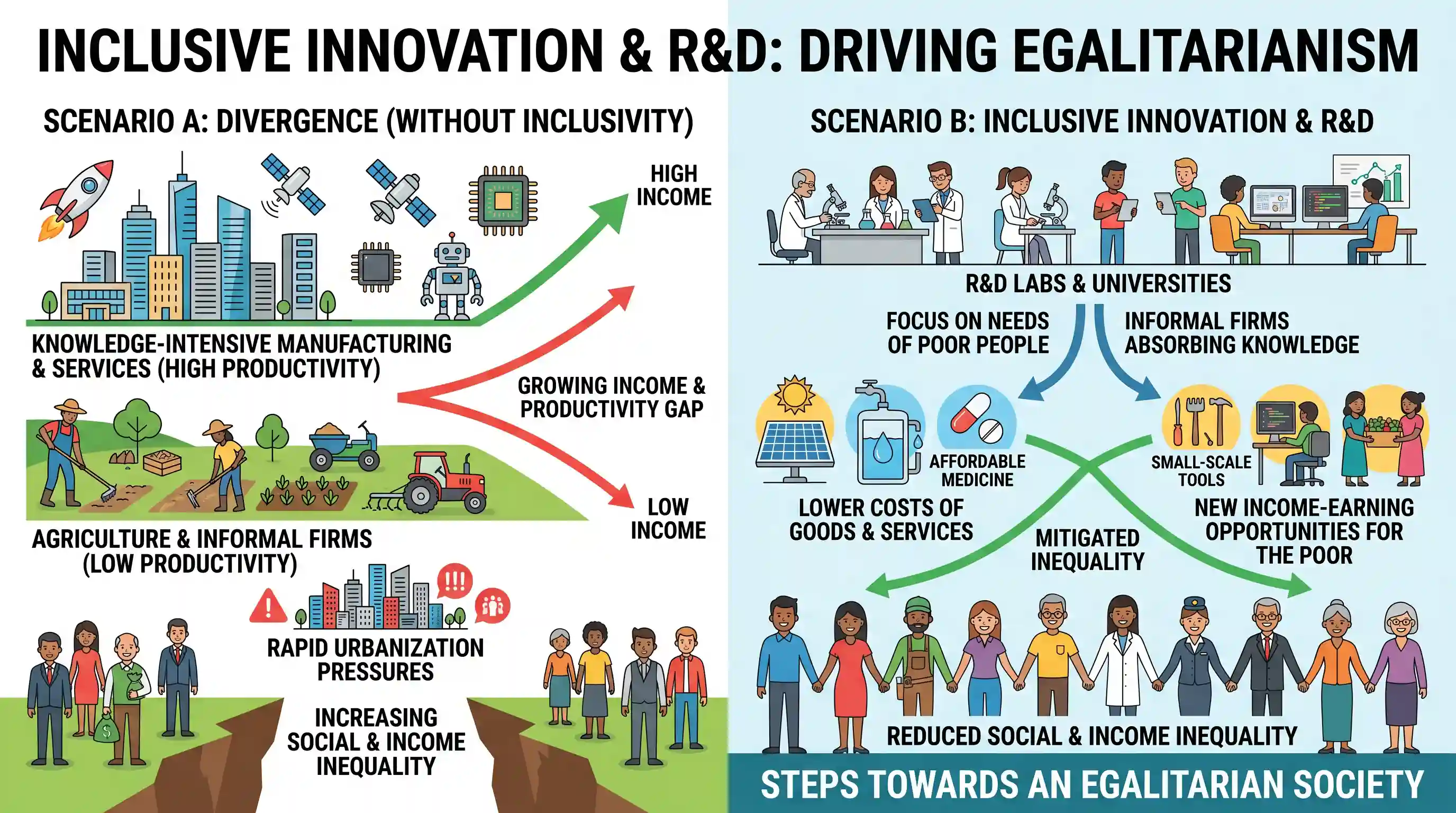
An innovative India will be inclusive as well as technologically advanced, improving the lives of all Indians. Innovation and R&D can mitigate increases in social inequality and relieve the pressures created by rapid urbanization. The growing divergence in productivity between agriculture and knowledge-intensive manufacturing and services threatens to increase income inequality. By encouraging India's R&D labs and universities to focus on the needs of poor people and by improving the ability of informal firms to absorb knowledge, an innovation and research agenda can counter this effect. Inclusive innovation can lower the costs of goods and services and create income - earning opportunities for the poor people. Which among the following is the most logical and rational assumption that can be made from the above passage?

- AInnovation and R&D is the only way to reduce rural to urban migration
- BEvery rapidly growing country needs to minimize the divergence between productivity in agriculture and other sectors
- CInclusive innovation and R&D can help create an egalitarian societyCorrect
- DRapid urbanization takes place only when a country's economic growth is rapid
Explanation
The passage emphasizes how innovation and R&D, particularly inclusive innovation focused on the poor, can mitigate social and income inequality, lower costs, and create income opportunities for the poor.
Let's analyze each option:
A) Innovation and R&D is the only way to reduce rural to urban migration. The passage states that innovation "can mitigate" pressures from rapid urbanization, not that it is the "only way" to reduce migration. The word "only" makes this statement too strong and not supported.
B) Every rapidly growing country needs to minimize the divergence between productivity in agriculture and other sectors. The passage identifies this divergence as a threat to income inequality in India, but it does not generalize this as a universal need for "every" rapidly growing country. The focus is on India.
C) Inclusive innovation and R&D can help create an egalitarian society. The passage explicitly states that innovation and R&D "can mitigate increases in social inequality," "counter this effect" (of increasing income inequality), and "create income - earning opportunities for the poor people." An egalitarian society is one characterized by equality, especially in social and economic opportunities. The passage's arguments directly point to reducing various forms of inequality and benefiting the disadvantaged, which aligns with the goal of an egalitarian society. The phrase "can help create" is consistent with the passage's conditional language ("can mitigate," "can counter").
D) Rapid urbanization takes place only when a country's economic growth is rapid. The passage mentions rapid urbanization and rapid economic growth but does not establish an "only when" causal link or define the conditions for urbanization. It focuses on the pressures created by urbanization and how R&D can relieve them.
Therefore, C is the most logical and rational assumption, as it synthesizes the core arguments about innovation's potential to reduce inequality and promote fairness.
Related questions
More UPSC Prelims practice from the same subject and topic.
- Prelims 2017CSATReading Comprehension
Disruption of traditional institutions, identifications and loyalties is likely to lead to ambivalent situations. It is possible that some people may renew their identification with traditional groups…
- Prelims 2017CSATReading Comprehension
Disruption of traditional institutions, identifications and loyalties is likely to lead to ambivalent situations. It is possible that some people may renew their identification with traditional groups…
- Prelims 2017CSATReading Comprehension
We live in digital times. The digital is not just something we use strategically and specifically to do a few tasks. Our very perception of who we are, how we connect to the world around us, and the w…
- Prelims 2017CSATReading Comprehension
The IMF has pointed out that the fast growing economies of Asia face the risk of falling into 'middle-income trap'. It means that average incomes in these countries, which till now have been growing r…
- Prelims 2017CSATReading Comprehension
Climate change is likely to expose a large number of people to increasing environmental risks forcing them to migrate. The international community is yet to recognize this new category of migrants. Th…
- Prelims 2017CSATReading Comprehension
Many farmers use synthetic pesticides to kill infesting insects. The consumption of pesticides in some of the developed countries is touching 3000 grams/hectare. Unfortunately, there are reports that …