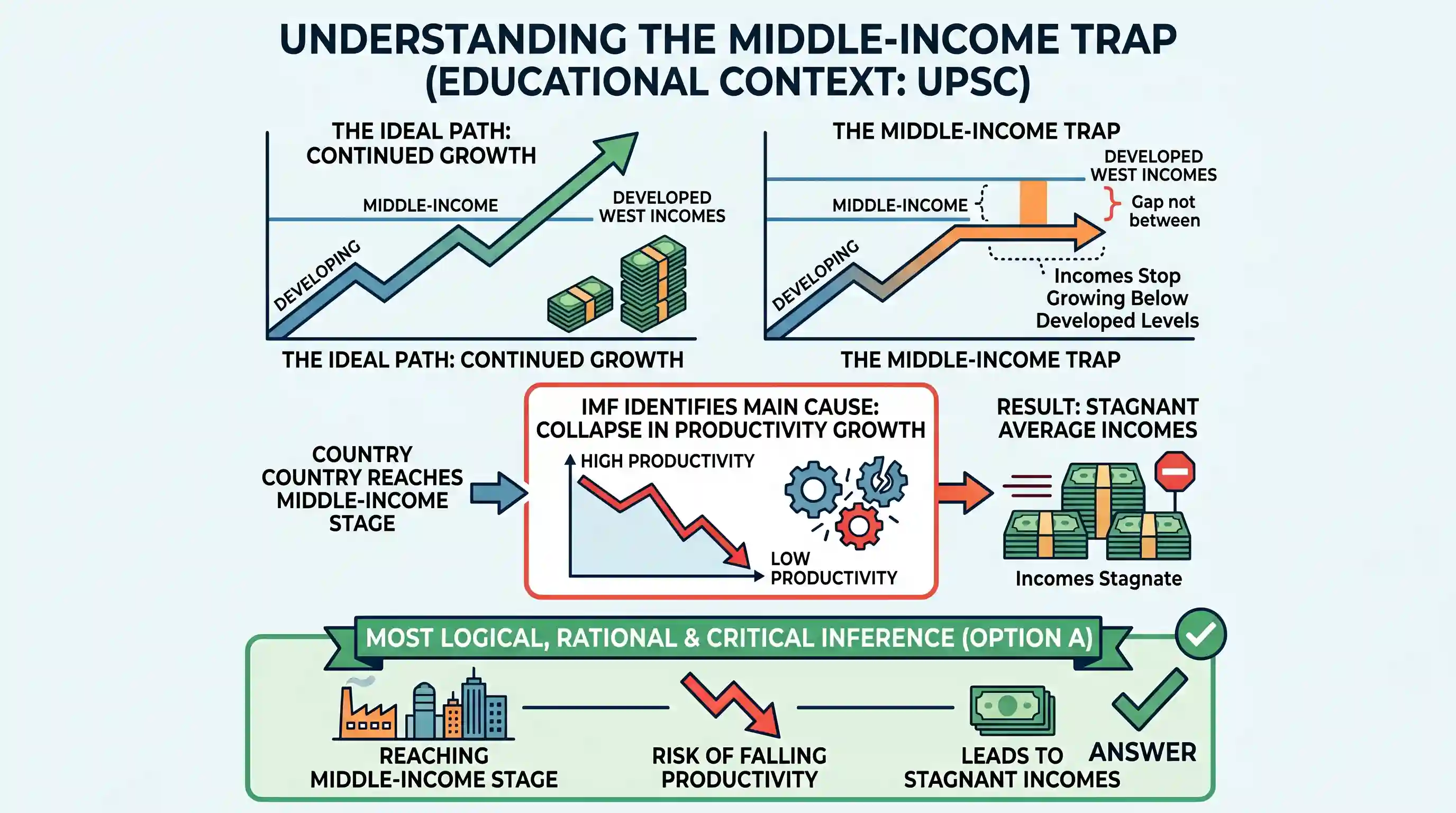
The IMF has pointed out that the fast growing economies of Asia face the risk of falling into 'middle-income trap'. It means that average incomes in these countries, which till now have been growing rapidly, will stop growing beyond a point—a point that is well short of incomes in the developed West. The IMF identifies a number of causes of middle income trap—none of which is surprising—from infrastructure to weak institutions, to leas than favourable macroeconomic conditions. But the broad, overall cause, says IMF, is a collapse in the growth of productivity. Which among the following is the most logical, rational and critical inference that can be made from the above passage?

- AOnce a country reaches middle-income stage, it runs the risk of falling productivity which leads to stagnant incomes.Correct
- BFalling into middle-income trap is a general characteristic of fast growing economies.
- CThere is no hope at all for emerging Asian economies to sustain the growth momentum
- DAs regards growth of productivity, the performance of Asian economies is not satisfactory.
Explanation
The passage explains the 'middle-income trap' as a situation where rapidly growing economies, typically those reaching a middle-income stage, experience a halt in income growth, falling short of developed nations. The core reason identified by the IMF for this trap is a "collapse in the growth of productivity."
Let's analyze each option:
A) Once a country reaches middle-income stage, it runs the risk of falling productivity which leads to stagnant incomes. This option directly synthesizes the key elements from the passage. The passage states that "fast growing economies of Asia face the risk of falling into 'middle-income trap'", implying they reach a middle-income stage. It defines the trap as incomes stopping growth ("stagnant incomes"). And it explicitly identifies the "broad, overall cause... is a collapse in the growth of productivity" ("falling productivity"). This option accurately describes the mechanism and consequence of the middle-income trap as presented.
B) Falling into middle-income trap is a general characteristic of fast growing economies. The passage states that "fast growing economies of Asia face the risk" of falling into the trap. It doesn't say it's a "general characteristic" of all fast-growing economies, nor does it imply inevitability. It's a risk for a specific group. This is too strong a generalization.
C) There is no hope at all for emerging Asian economies to sustain the growth momentum. The passage identifies a risk and its causes. It does not suggest that there is "no hope at all." Identifying problems often implies that solutions can be found to mitigate the risk. This is an overly pessimistic and unsupported inference.
D) As regards growth of productivity, the performance of Asian economies is not satisfactory. While the passage states that a "collapse in the growth of productivity" is the overall cause, implying unsatisfactory performance, this is a statement about a cause or a symptom. Option A, however, provides a more comprehensive inference about the nature of the middle-income trap itself, linking the stage of development, the risk, the cause (productivity), and the outcome (stagnant incomes). It explains the entire phenomenon described, making it the most logical, rational, and critical inference about the trap.
Therefore, option A is the most accurate and comprehensive inference, directly reflecting the definition, cause, and consequence of the middle-income trap as explained in the passage.
The final answer is A
Related questions
More UPSC Prelims practice from the same subject and topic.
- Prelims 2017CSATReading Comprehension
Disruption of traditional institutions, identifications and loyalties is likely to lead to ambivalent situations. It is possible that some people may renew their identification with traditional groups…
- Prelims 2017CSATReading Comprehension
Disruption of traditional institutions, identifications and loyalties is likely to lead to ambivalent situations. It is possible that some people may renew their identification with traditional groups…
- Prelims 2017CSATReading Comprehension
We live in digital times. The digital is not just something we use strategically and specifically to do a few tasks. Our very perception of who we are, how we connect to the world around us, and the w…
- Prelims 2017CSATReading Comprehension
An innovative India will be inclusive as well as technologically advanced, improving the lives of all Indians. Innovation and R&D can mitigate increases in social inequality and relieve the pressures …
- Prelims 2017CSATReading Comprehension
Climate change is likely to expose a large number of people to increasing environmental risks forcing them to migrate. The international community is yet to recognize this new category of migrants. Th…
- Prelims 2017CSATReading Comprehension
Many farmers use synthetic pesticides to kill infesting insects. The consumption of pesticides in some of the developed countries is touching 3000 grams/hectare. Unfortunately, there are reports that …