Many farmers use synthetic pesticides to kill infesting insects. The consumption of pesticides in some of the developed countries is touching 3000 grams/hectare. Unfortunately, there are reports that these compounds possess inherent toxicities that endanger, the health of the farm operators, consumers and the environment. Synthetic pesticides are generally persistent in environment. Entering in food chain they destroy the microbial diversity and cause ecological imbalance. Their indiscriminate use has resulted in development of resistance among insects to insecticides, upsetting of balance in nature and resurgence of treated populations. Natural pest control using the botanical pesticides is safer to the user and the environment because they break down into harmless compounds within hours or days in the presence of sunlight. Plants with pesticidal properties have been in nature for millions of years without any ill or adverse effects on the ecosystem. They are easily decomposed by many microbes common in most soil. They help in the maintenance of biological diversity, of predators and the reduction of environmental contamination and human health hazards. Botanical pesticides formulated from plants are biodegradable and their use in crop protection is a practical sustainable alternative. On the basis of the above passage, the following assumptions have been made: 1. Synthetic pesticides should never be used in modem agriculture. 2. One of the aims of sustainable agriculture is to ensure minimal ecological imbalance. 3. Botanical pesticides are more effective as compared to synthetic pesticides. Which of the assumptions given above is/are correct?

- A1 and 2 only
- B2 onlyCorrect
- C1 and 3 only
- D1, 2 and 3
Explanation
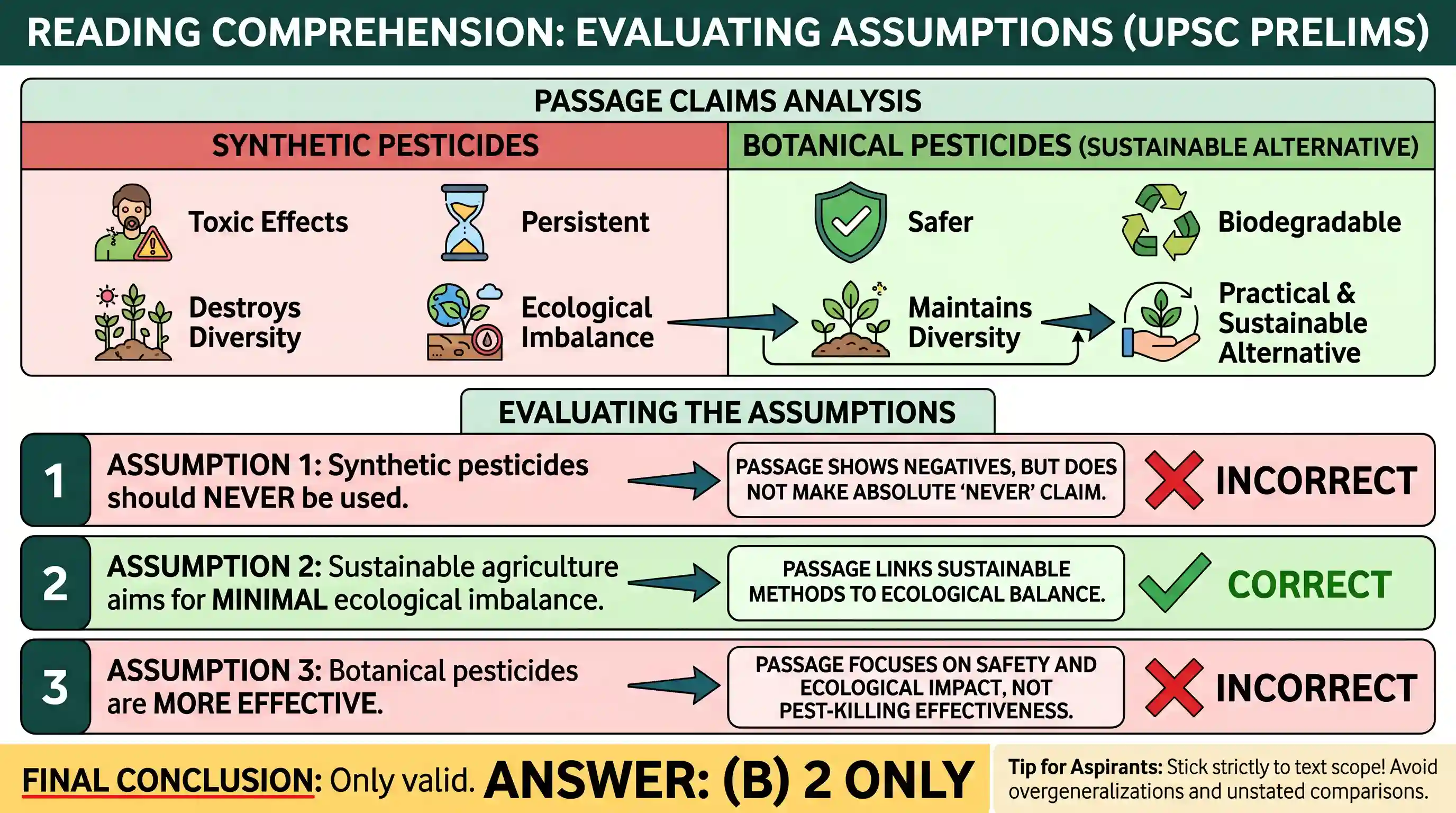
The passage highlights the dangers of synthetic pesticides (ecological imbalance, toxicity, persistence) and promotes botanical pesticides as a "safer" and "practical sustainable alternative" that helps "maintain biological diversity" and reduces "environmental contamination."
Let's analyze each statement:
-
Synthetic pesticides should never be used in modern agriculture. The passage details the problems with synthetic pesticides and suggests botanical alternatives, but it does not make the absolute claim that synthetic pesticides should never be used. It points out their negative aspects and offers a safer alternative, but "never" is too strong a conclusion to draw solely from the text.
-
One of the aims of sustainable agriculture is to ensure minimal ecological imbalance. The passage describes synthetic pesticides as causing "ecological imbalance" and then presents botanical pesticides as a "practical sustainable alternative" that helps in "maintenance of biological diversity" and "reduction of environmental contamination." Since sustainable agriculture is presented as an alternative that avoids these negative ecological impacts, it is a clear assumption that minimizing ecological imbalance is one of its aims.
-
Botanical pesticides are more effective as compared to synthetic pesticides. The passage emphasizes that botanical pesticides are "safer to the user and the environment," "biodegradable," and a "sustainable alternative." However, it never compares their effectiveness in killing pests to that of synthetic pesticides. We only learn about their safety and environmental benefits, not their comparative potency.
Therefore, only assumption 2 is correct.
The final answer is B.
Related questions
More UPSC Prelims practice from the same subject and topic.
- Prelims 2017CSATReading Comprehension
Disruption of traditional institutions, identifications and loyalties is likely to lead to ambivalent situations. It is possible that some people may renew their identification with traditional groups…
- Prelims 2017CSATReading Comprehension
Disruption of traditional institutions, identifications and loyalties is likely to lead to ambivalent situations. It is possible that some people may renew their identification with traditional groups…
- Prelims 2017CSATReading Comprehension
We live in digital times. The digital is not just something we use strategically and specifically to do a few tasks. Our very perception of who we are, how we connect to the world around us, and the w…
- Prelims 2017CSATReading Comprehension
The IMF has pointed out that the fast growing economies of Asia face the risk of falling into 'middle-income trap'. It means that average incomes in these countries, which till now have been growing r…
- Prelims 2017CSATReading Comprehension
An innovative India will be inclusive as well as technologically advanced, improving the lives of all Indians. Innovation and R&D can mitigate increases in social inequality and relieve the pressures …
- Prelims 2017CSATReading Comprehension
Climate change is likely to expose a large number of people to increasing environmental risks forcing them to migrate. The international community is yet to recognize this new category of migrants. Th…