Which of the following led to the introduction of English Education in India? 1. Charter Act of 1813 2. General Committee of Public Instruction, 1823 3. Orientalist and Anglicist Controversy Select the correct answer using the code given below:

- A1 and 2 only
- B2 only
- C1 and 3 only
- D1, 2 and 3Correct
Explanation
The introduction and establishment of English Education in India were the result of a series of developments and controversies:
-
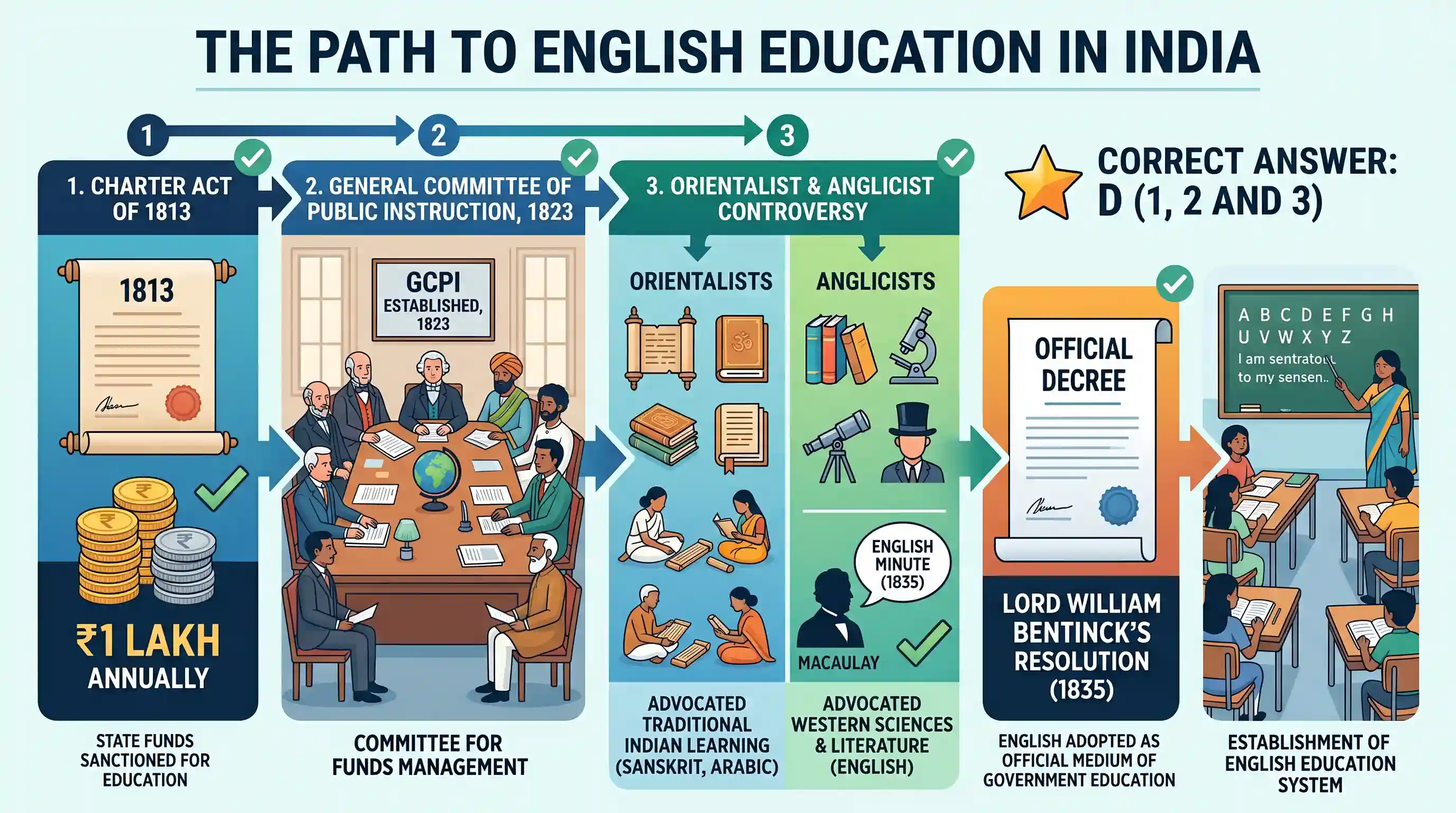
Charter Act of 1813: This Act was a significant turning point as it explicitly sanctioned a sum of one lakh rupees annually for the revival and improvement of literature and the encouragement of the learned natives of India, and for the introduction and promotion of a knowledge of the sciences among the inhabitants of the British territories in India. While it didn't specify English education directly, it opened the door for governmental intervention in education and led to subsequent debates on the medium of instruction.
-
General Committee of Public Instruction, 1823: This Committee was formed to manage the funds sanctioned by the Charter Act of 1813. It became the focal point of the debate between Orientalists and Anglicists regarding the direction of education in India. Initially, Orientalists dominated, favoring traditional Indian learning in classical languages, but the stage was set for a shift.
-
Orientalist and Anglicist Controversy: This was a major intellectual debate that arose within the General Committee of Public Instruction and the broader British administration. The Orientalists advocated for the promotion of traditional Indian learning through Sanskrit, Persian, and Arabic. The Anglicists, led by figures like Lord Macaulay, strongly argued for the introduction of Western sciences and literature through the medium of English. Macaulay's 'Minute on Indian Education' (1835) strongly favored English education, which was subsequently adopted by Lord William Bentinck's resolution of 1835, officially making English the medium of instruction for government education. This effectively settled the controversy in favour of English education.
All three points collectively contributed to the eventual introduction and dominance of English education in India.
Related questions
More UPSC Prelims practice from the same subject and topic.
- Prelims 2018GS1history
He wrote biographies of Mazzini, Garibaldi, Shivaji and Shrikrishna; stayed in America for some time; and was also elected to the Central Assembly. He was
- Prelims 2018GS1history
Regarding Wood's Dispatch, which of the following statements are true? 1. Grants-in-Aid system was introduced. 2. Establishment of universities was recommended. 3. English as a medium of instruction a…
- Prelims 2018GS1history
After the Santhal Uprising subsided, what was/were the measure/measures taken by the colonial government? 1. The territories called 'Santhal Paraganas' were created. 2. It became illegal for a Santhal…
- Prelims 2018GS1history
Economically, one of the results of the British rule in India in the 19th century was the
- Prelims 2018GS1history
The staple commodities of export by the English East India Company from Bengal in the middle of the 18th century were
- Prelims 2018GS1history
Which one of the following is a very significant aspect of the Champaran Satyagraha?