Which one of the following statements does not apply to the system of Subsidiary Alliance introduced by Lord Wellesley?

- ATo maintain a large standing army at other's expense
- BTo keep India safe from Napoleonic danger
- CTo secure a fixed income for the CompanyCorrect
- DTo establish British paramountcy over the Indian States
Explanation
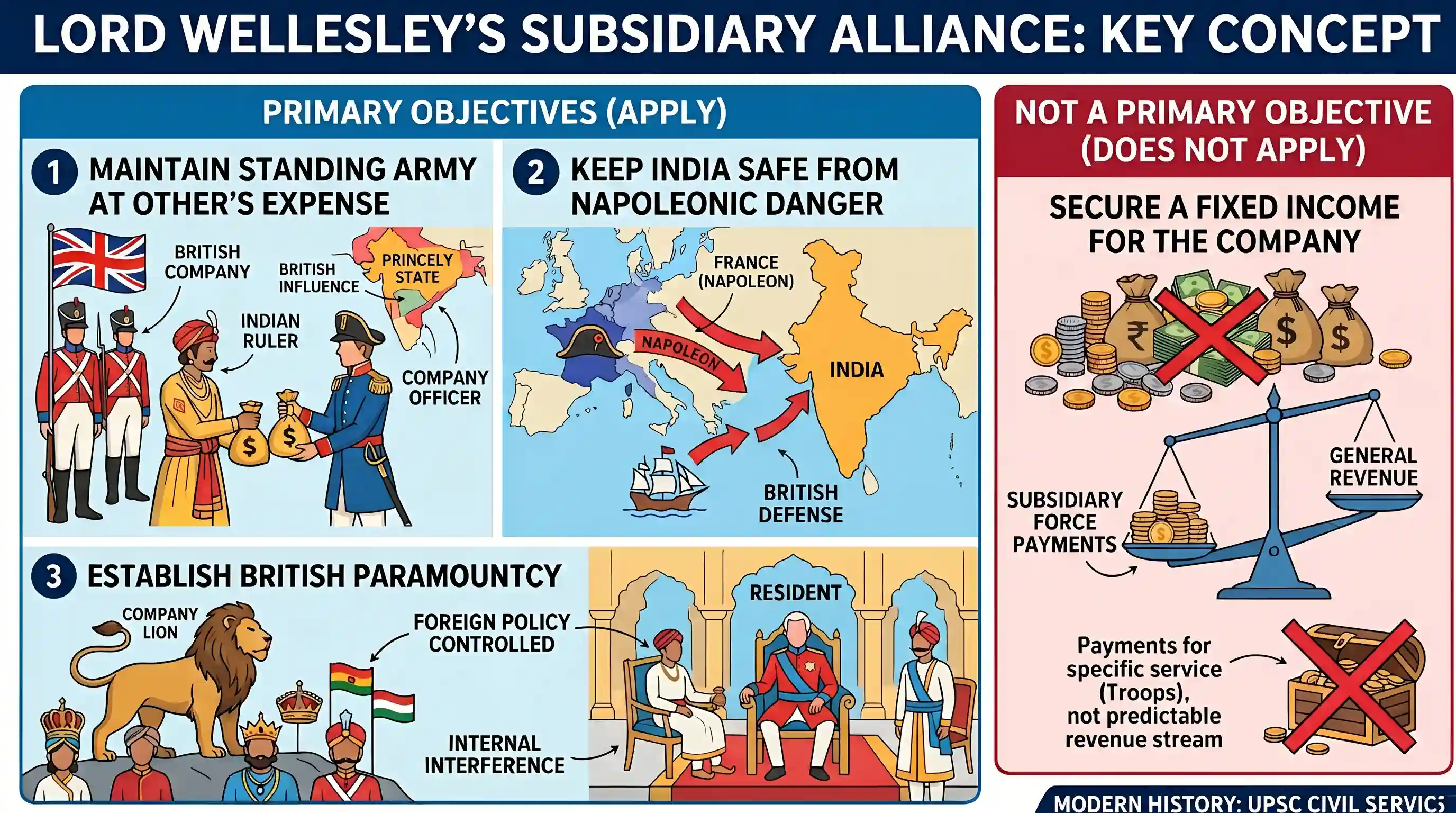
The Subsidiary Alliance system was a key policy instrument used by Lord Wellesley (Governor-General of India from 1798-1805) to extend British influence and control over Indian princely states without direct annexation. The primary objectives of this system were:
To maintain a large standing army at other's expense (A): Indian rulers who entered the alliance had to maintain a British contingent at their own cost, relieving the Company of the financial burden. To keep India safe from Napoleonic danger (B): A major strategic aim was to counter the perceived threat of Napoleon's influence in the East by securing British control over Indian states and preventing their alignment with any rival European power. To establish British paramountcy over the Indian States (D): The system effectively stripped Indian rulers of their independent foreign policy, disarmed their own armies, and placed them under British military protection, thereby establishing British dominance. The option C) To secure a fixed income for the Company does not primarily apply to the Subsidiary Alliance system as its direct objective. While the Company derived financial benefits from the payments for the subsidiary force, and defaulted payments often led to annexation (which then generated revenue), the direct purpose of the alliance was strategic control and military security, not securing a 'fixed income' in the sense of a general revenue stream from the states themselves through this agreement. The payments were for services rendered (maintenance of troops), not a tribute or direct tax in the sense of a fixed income from the territory.
Related questions
More UPSC Prelims practice from the same subject and topic.
- Prelims 2018GS1history
He wrote biographies of Mazzini, Garibaldi, Shivaji and Shrikrishna; stayed in America for some time; and was also elected to the Central Assembly. He was
- Prelims 2018GS1history
Regarding Wood's Dispatch, which of the following statements are true? 1. Grants-in-Aid system was introduced. 2. Establishment of universities was recommended. 3. English as a medium of instruction a…
- Prelims 2018GS1history
After the Santhal Uprising subsided, what was/were the measure/measures taken by the colonial government? 1. The territories called 'Santhal Paraganas' were created. 2. It became illegal for a Santhal…
- Prelims 2018GS1history
Economically, one of the results of the British rule in India in the 19th century was the
- Prelims 2018GS1history
The staple commodities of export by the English East India Company from Bengal in the middle of the 18th century were
- Prelims 2018GS1history
Which one of the following is a very significant aspect of the Champaran Satyagraha?