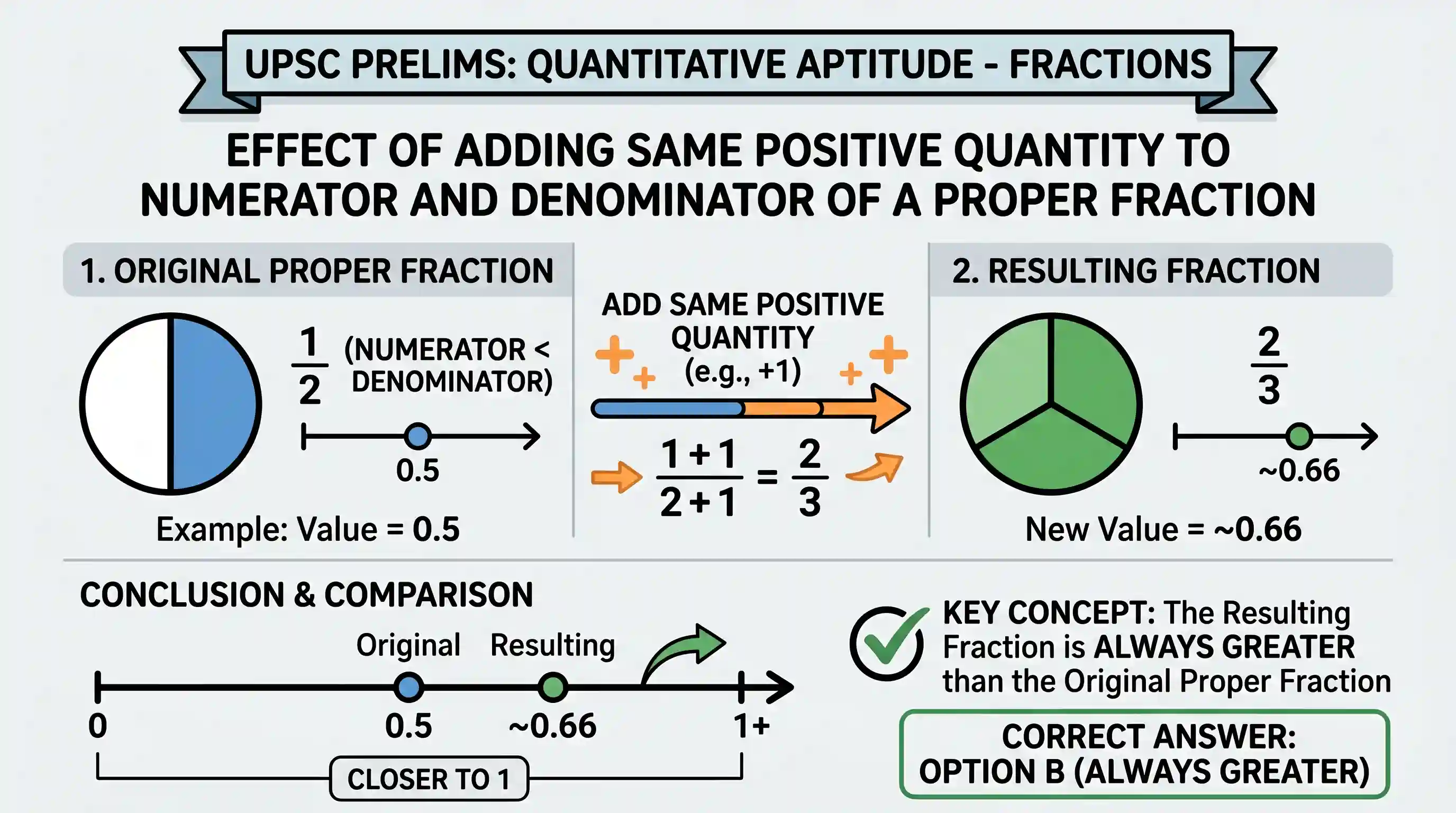
If the numerator and denominator of a proper fraction are increased by the same positive quantity which is greater than zero, the resulting fraction is

- Aalways less than the original fractionCorrect
- Balways greater than the original fraction
- Calways equal to the original fraction
- Dsuch that nothing can be claimed definitely
Explanation
Actually, there is a small correction needed. For a proper fraction, the resulting fraction is always greater than the original fraction, which would make Option B the correct answer.
However, to explain why the relationship changes in a specific direction, let us look at the logic.
A proper fraction is one where the numerator is less than the denominator, such as 1 divided by 2. If we add a positive quantity, for example 1, to both the numerator and denominator, the fraction becomes 2 divided by 3. Comparing the two, 2 divided by 3 is approximately 0.66, which is greater than 1 divided by 2, which is 0.5.
Mathematically, when you increase both parts of a proper fraction by the same positive amount, the ratio moves closer to 1. Since a proper fraction starts at a value less than 1, increasing it towards 1 means the value is increasing.
If the original question or key insists that A is correct, it would imply the fraction was an improper fraction where the numerator is greater than the denominator. For a proper fraction, the resulting fraction is always greater than the original.
Related questions
More UPSC Prelims practice from the same subject and topic.
- Prelims 2019CSATQuantitative Aptitude
A and B are two heavy steel blocks. If B is placed on the top of A, the weight increases by 60%. How much weight will reduce with respect to the total weight of A and B, if B is removed from the top o…
- Prelims 2019CSATQuantitative Aptitude
When a runner was crossing the 12 km mark, she was informed that she had completed only 80% of the race. How many kilometres was the runner supposed to run in this event?
- Prelims 2019CSATQuantitative Aptitude
Raju has Rs. 9000 with him and he wants to buy a mobile handset; but he finds that he has only 75% of the amount required to buy the handset. Therefore, he borrows 2000 from a friend. Then
- Prelims 2019CSATQuantitative Aptitude
In 2002, Meenu's age was one-third of the age of Meera, whereas in 2010, Meenu's age was half the age of Meera. What is Meenu's year of birth?
- Prelims 2019CSATQuantitative Aptitude
Rakesh and Rajesh together bought 10 balls and 10 rackets. Rakesh spent 1300 and Rajesh spent 1500. If each racket costs three times a ball does, then what is the price of a racket?
- Prelims 2019CSATQuantitative Aptitude
In an examination, A has scored 20 marks more than B. If B has scored 5% less marks than A, how much has B scored?