Consider the following statements: 1. Saint Nimbarka was a contemporary of Akbar. 2. Saint Kabir was greatly influenced by Shaikh Ahmad Sirhindi. Which of the statements given above is/are correct?

- A1 only
- B2 only
- CBoth 1 and 2
- DNeither 1 nor 2Correct
Explanation
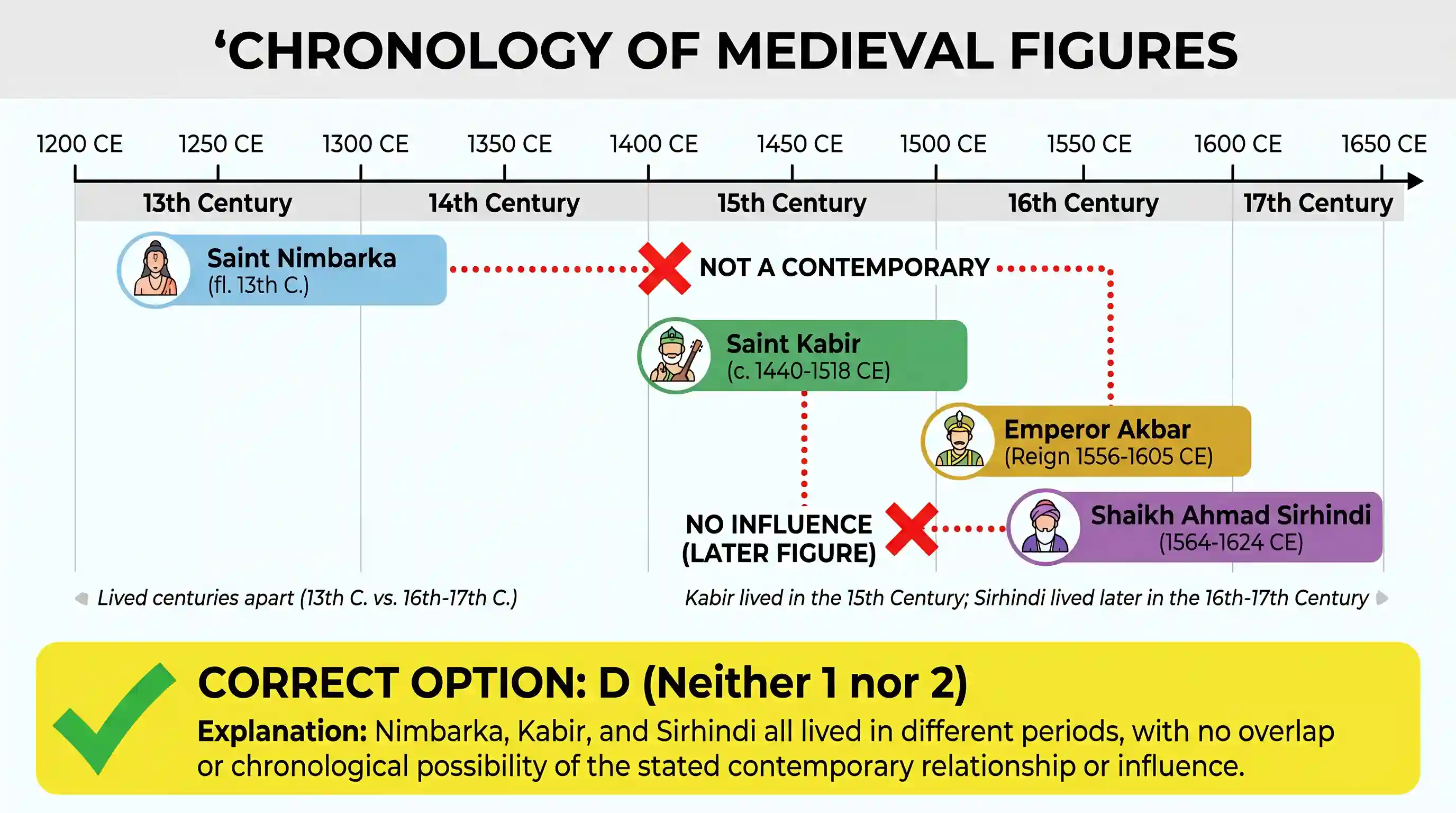
Statement 1 is incorrect. Saint Nimbarka was a prominent philosopher and Vaishnavite saint who lived in the 13th century CE. He was the founder of the Dvaitadvaita (dualistic monism) school of thought. Emperor Akbar ruled in the 16th century (1556-1605 CE), approximately three centuries after Nimbarka. Thus, Nimbarka was not a contemporary of Akbar.
Statement 2 is incorrect. Saint Kabir was a 15th-century mystic poet and saint, known for his syncretic philosophy that blended elements of Hinduism and Islam. He was a contemporary of Sikandar Lodi. Shaikh Ahmad Sirhindi was a prominent Naqshbandi Sufi saint and scholar who lived from 1564 to 1624 CE, primarily active during the late 16th and early 17th centuries, which means he lived much later than Kabir. Furthermore, Sirhindi was known for his orthodox revivalist views and for advocating for strict adherence to Islamic law, often opposing the syncretic trends encouraged by Akbar and prevalent in Sufism, which makes it highly improbable that Kabir was influenced by him. Their timelines and philosophies do not align for such influence.
Related questions
More UPSC Prelims practice from the same subject and topic.
- Prelims 2019GS1history
With reference to Mughal India, what is/are the difference/differences between Jagirdar and Zamindar? 1. Jagirdars were holders of land assignments in lieu of judicial and police duties, whereas Zamin…
- Prelims 2019GS1history
Consider the following statements: 1. In the revenue administration of Delhi Sultanate, the in-charge of revenue collection was known as 'Amil'. 2. The Iqta system of Sultans of Delhi was an ancient i…
- Prelims 2019GS1history
Consider the following statements about 'the Charter Act of 1813': 1. It ended the trade monopoly of the East India Company in India except for trade in tea and trade with China. 2. It asserted the so…
- Prelims 2019GS1history
With reference to Swadeshi Movement, consider the following statements: 1. It contributed to the revival of the indigenous artisan crafts and industries. 2. The National Council of Education was estab…
- Prelims 2019GS1history
Consider the following pairs: Movement/Organization Leader 1. All India Anti-Untouchability League : Mahatma Gandhi 2. All India Kisan Sabha : Swami Sahajanand Saraswati 3. Self-Respect Movement : E. …
- Prelims 2019GS1history
Which one of the following is not a Harappan site?