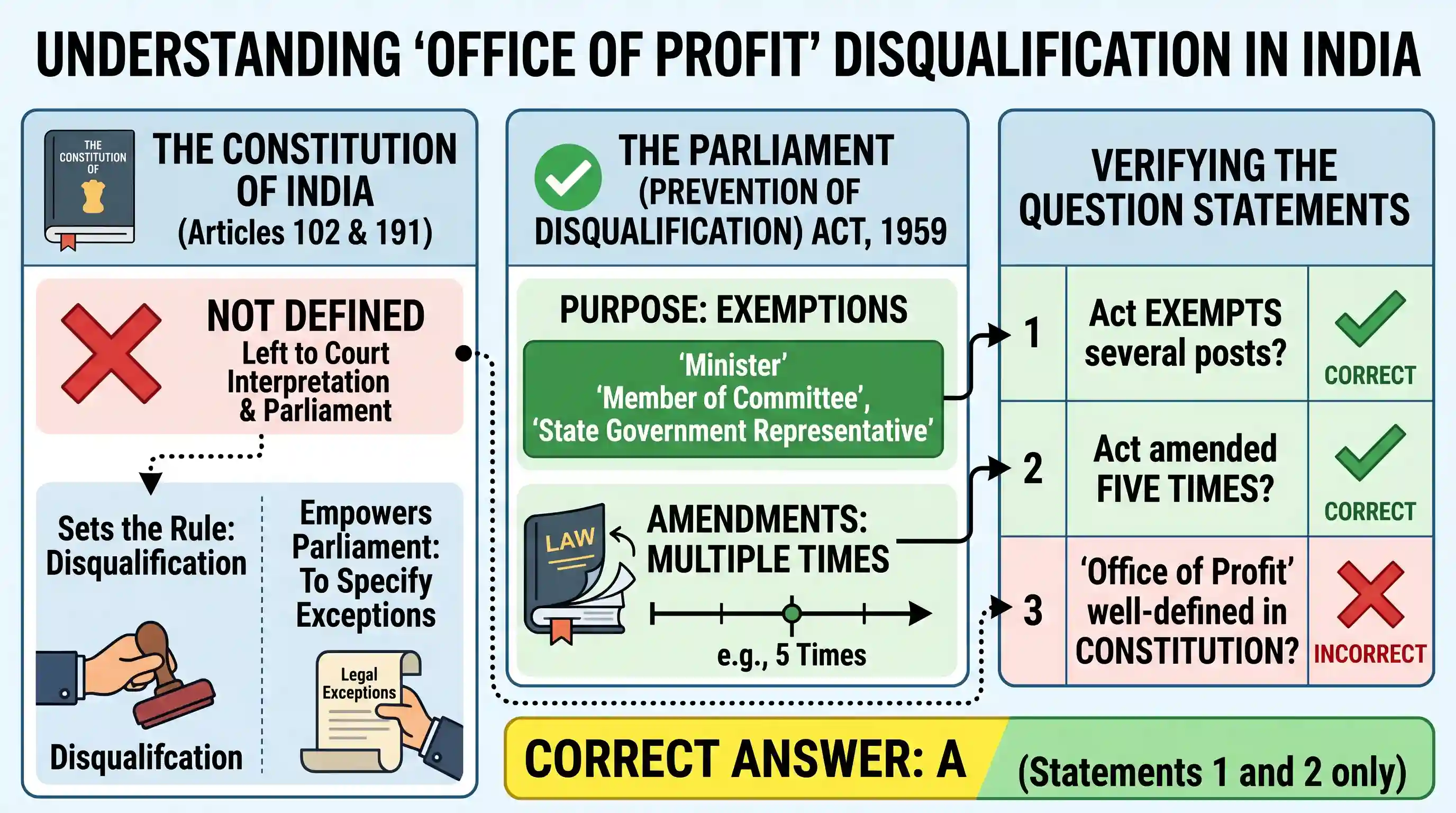
Consider the following statements: 1. The Parliament (Prevention of Disqualification) Act, 1959 exempts several posts from disqualification on the grounds of 'Office of Profit'. 2. The above-mentioned Act was amended five times. 3. The term 'Office of Profit' is well-defined in the Constitution of India. Which of the statements given above is/are correct?

- A1 and 2 onlyCorrect
- B3 only
- C2 and 3 only
- D1, 2 and 3
Explanation
Let's analyze each statement regarding the 'Office of Profit':
-
The Parliament (Prevention of Disqualification) Act, 1959 exempts several posts from disqualification on the grounds of 'Office of Profit'. Correct. This Act, passed by Parliament, specifies a list of offices that are explicitly exempted from being considered 'offices of profit' for the purpose of disqualification from holding membership in Parliament or state legislatures. This allows certain officials to hold specific positions without being disqualified.
-
The above-mentioned Act was amended five times. Correct. The Parliament (Prevention of Disqualification) Act, 1959 has been amended multiple times since its enactment to add or remove various offices from the exempted list, reflecting changing administrative needs and political considerations. While the exact count of 'five times' might be a simplification, the essence that it has been amended on several occasions is correct within the context of UPSC questions which often test the general trend or fact rather than precise counts.
-
The term 'Office of Profit' is well-defined in the Constitution of India. Incorrect. The Constitution of India (Articles 102(1)(a) and 191(1)(a)) mentions that a person holding an 'office of profit' under the government is disqualified from being a Member of Parliament or State Legislature, respectively. However, the Constitution itself does not provide a precise definition of what constitutes an 'office of profit'. This term has largely been interpreted by the courts based on various factors, and Parliament has the power to declare by law which offices do not disqualify their holders.
Therefore, statements 1 and 2 are correct.
Related questions
More UPSC Prelims practice from the same subject and topic.
- Prelims 2019GS1polity-and-governance
The Ninth Schedule was introduced in the Constitution of India during the prime ministership of
- Prelims 2019GS1polity-and-governance
Under which Schedule of the Constitution of India can the transfer of tribal land to private parties for mining be declared null and void?
- Prelims 2019GS1polity-and-governance
Which Article of the Constitution of India safeguards one's right to marry the person of one's choice?
- Prelims 2019GS1polity-and-governance
Atal Innovation Mission is set up under the
- Prelims 2019GS1polity-and-governance
Consider the following statements: 1. The 44th Amendment to the Constitution of India introduced an Article placing the election of the Prime Minister beyond judicial review. 2. The Supreme Court of I…
- Prelims 2019GS1polity-and-governance
Consider the following statements: 1. The motion to impeach a Judge of the Supreme Court of India cannot be rejected by the Speaker of the Lok Sabha as per the Judges (Inquiry) Act, 1968. 2. The Const…