Consider the following statements: 1. The motion to impeach a Judge of the Supreme Court of India cannot be rejected by the Speaker of the Lok Sabha as per the Judges (Inquiry) Act, 1968. 2. The Constitution of India defines and gives details of what constitutes 'incapacity and proved misbehaviour' of the Judges of the Supreme Court of India. 3. The details of the process of impeachment of the Judges of the Supreme Court of India are given in the Judges (Inquiry) Act, 1968. 4. If the motion for the impeachment of a Judge is taken up for voting, the law requires the motion to be backed by each House of the Parliament and supported by a majority of total membership of that House and by not less than two-thirds of total members of that House present and voting. Which of the statements given above is/are correct?

- A1 and 2
- B3 only
- C3 and 4 onlyCorrect
- D1, 3 and 4
Explanation
Let's analyze each statement regarding the impeachment of a Supreme Court Judge:
-
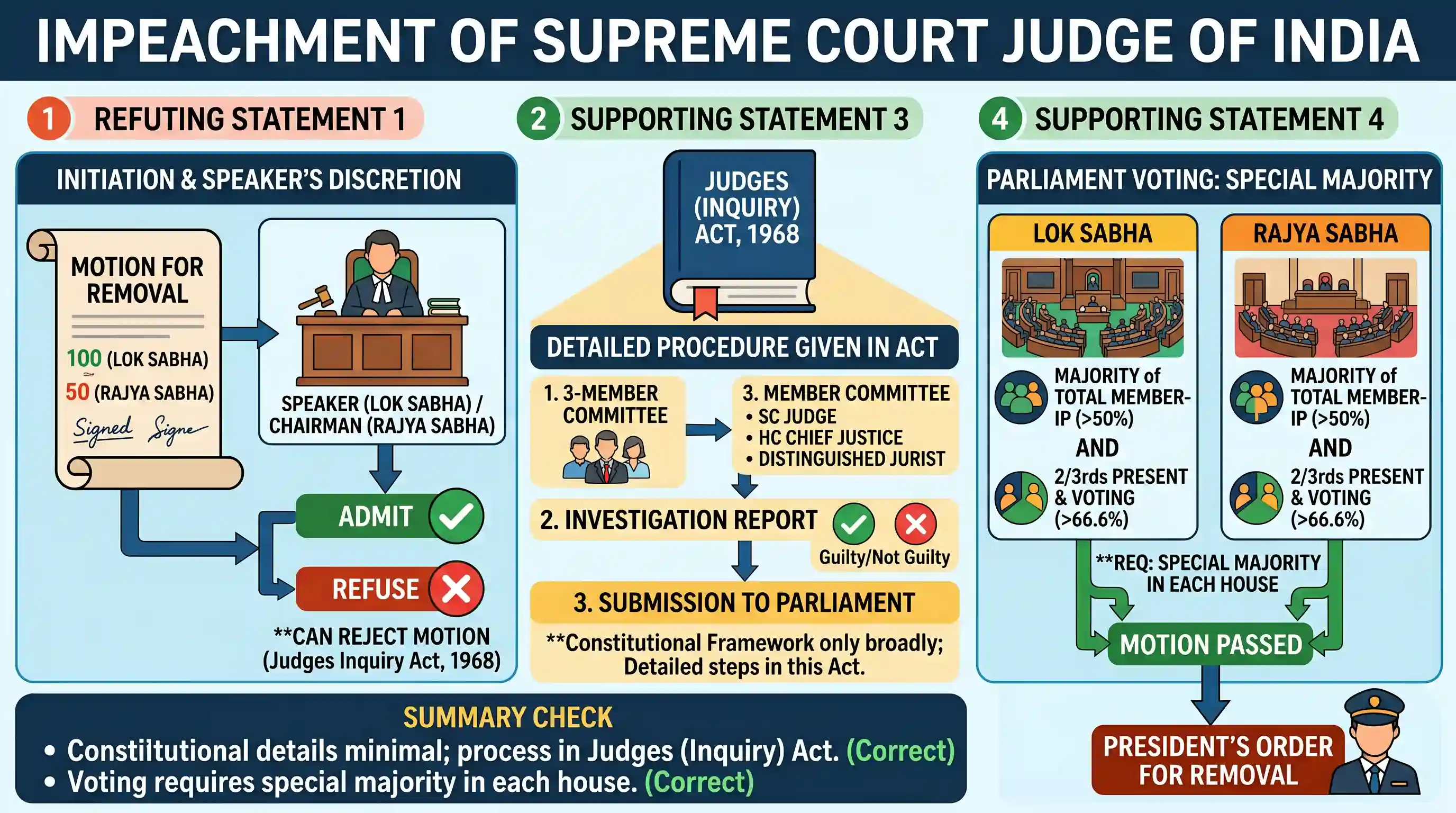
The motion to impeach a Judge of the Supreme Court of India cannot be rejected by the Speaker of the Lok Sabha as per the Judges (Inquiry) Act, 1968. Incorrect. The Judges (Inquiry) Act, 1968, which governs the procedure for impeachment, explicitly grants discretion to the Speaker (or Chairman of Rajya Sabha) to either admit or refuse to admit a motion for removal of a Judge. This power has been exercised in the past.
-
The Constitution of India defines and gives details of what constitutes 'incapacity and proved misbehaviour' of the Judges of the Supreme Court of India. Incorrect. Article 124(4) of the Constitution states that a Judge can be removed only on grounds of 'proved misbehaviour or incapacity'. However, the Constitution does not define these terms or provide their specific details. Their interpretation is generally left to parliamentary practice and judicial pronouncements.
-
The details of the process of impeachment of the Judges of the Supreme Court of India are given in the Judges (Inquiry) Act, 1968. Correct. While Article 124(4) and (5) of the Constitution lay down the broad framework for removal, the detailed procedure, including the formation of an inquiry committee, investigation, and reporting, is elaborated in the Judges (Inquiry) Act, 1968, enacted by Parliament.
-
If the motion for the impeachment of a Judge is taken up for voting, the law requires the motion to be backed by each House of the Parliament and supported by a majority of total membership of that House and by not less than two-thirds of total members of that House present and voting. Correct. This describes the special majority required for the removal of a Supreme Court Judge, as stipulated by Article 124(4) of the Constitution. The motion must be passed by both Houses of Parliament with this specific majority.
Therefore, statements 3 and 4 are correct.
Related questions
More UPSC Prelims practice from the same subject and topic.
- Prelims 2019GS1polity-and-governance
Consider the following statements: 1. The 44th Amendment to the Constitution of India introduced an Article placing the election of the Prime Minister beyond judicial review. 2. The Supreme Court of I…
- Prelims 2019GS1polity-and-governance
With reference to the Constitution of India, prohibitions or limitations or provisions contained in ordinary laws cannot act as prohibitions or limitations on the constitutional powers under Article 1…
- Prelims 2019GS1polity-and-governance
With reference to the Constitution of India, consider the following statements: 1. No High Court shall have the jurisdiction to declare any central law to be constitutionally invalid. 2. An amendment …
- Prelims 2019GS1polity-and-governance
Atal Innovation Mission is set up under the
- Prelims 2019GS1polity-and-governance
The Ninth Schedule was introduced in the Constitution of India during the prime ministership of
- Prelims 2019GS1polity-and-governance
Consider the following statements: 1. The Parliament (Prevention of Disqualification) Act, 1959 exempts several posts from disqualification on the grounds of 'Office of Profit'. 2. The above-mentioned…