With reference to the Constitution of India, consider the following statements: 1. No High Court shall have the jurisdiction to declare any central law to be constitutionally invalid. 2. An amendment to the Constitution of India cannot be called into question by the Supreme Court of India. Which of the statements given above is/are correct?

- A1 only
- B2 only
- CBoth 1 and 2
- DNeither 1 nor 2Correct
Explanation
Let's analyze each statement regarding the Constitution of India:
-
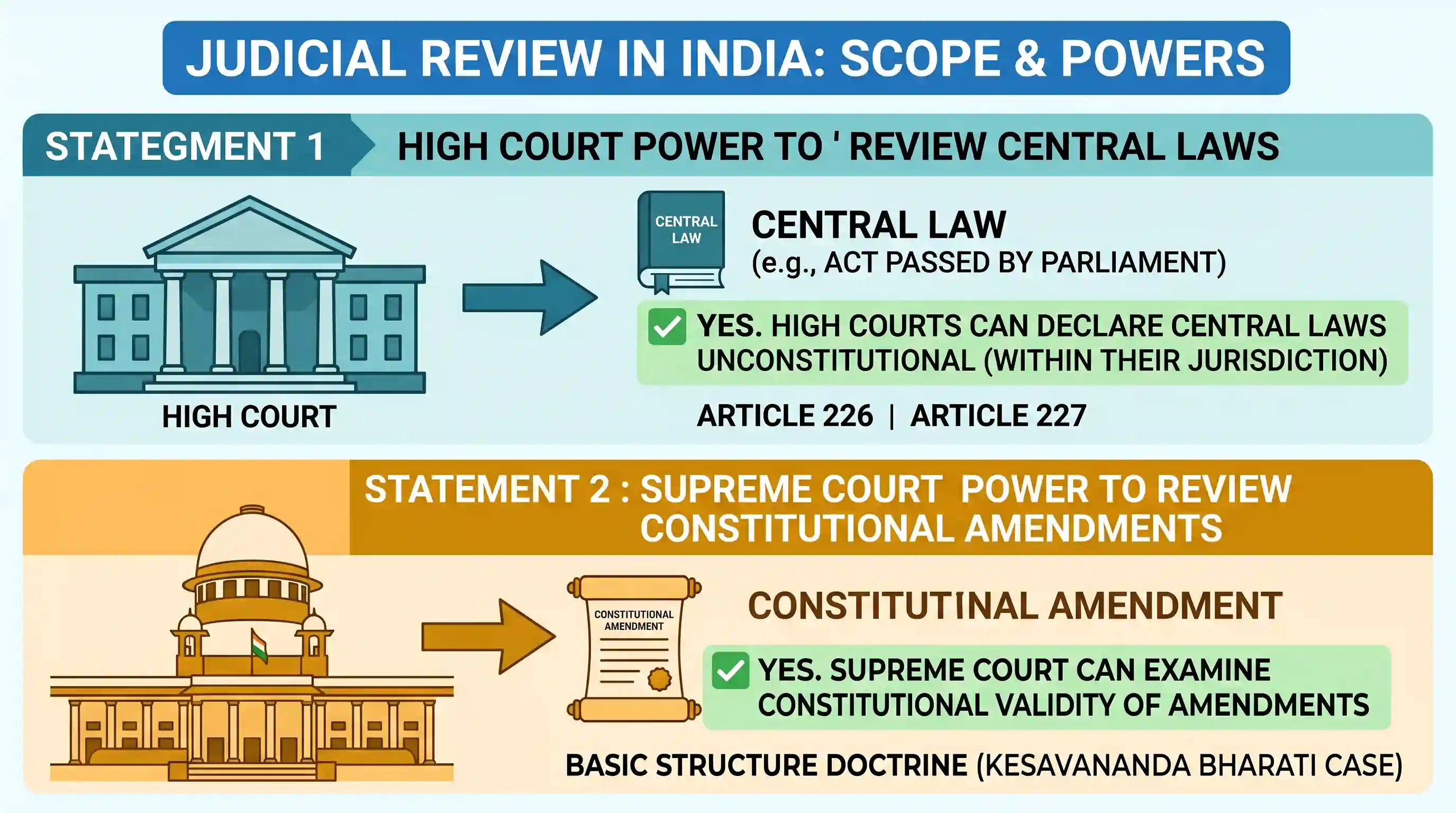
No High Court shall have the jurisdiction to declare any central law to be constitutionally invalid. This statement is incorrect. Both the Supreme Court (under Article 32) and the High Courts (under Article 226 and 227) have the power of judicial review to declare any law, be it central or state, constitutionally invalid if it violates the provisions of the Constitution. This power is a fundamental aspect of the Indian judiciary's role as the guardian of the Constitution.
-
An amendment to the Constitution of India cannot be called into question by the Supreme Court of India. This statement is also incorrect. The Supreme Court of India, through its power of judicial review, can indeed examine the constitutional validity of an amendment to the Constitution. The landmark Kesavananda Bharati case (1973) established the 'Basic Structure Doctrine', which allows the Supreme Court to strike down any constitutional amendment that violates the basic structure of the Constitution. Therefore, amendments can be called into question.
Since both statements are incorrect, the correct answer is 'Neither 1 nor 2'.
Related questions
More UPSC Prelims practice from the same subject and topic.
- Prelims 2019GS1polity-and-governance
Consider the following statements: 1. The 44th Amendment to the Constitution of India introduced an Article placing the election of the Prime Minister beyond judicial review. 2. The Supreme Court of I…
- Prelims 2019GS1polity-and-governance
Consider the following statements: 1. The motion to impeach a Judge of the Supreme Court of India cannot be rejected by the Speaker of the Lok Sabha as per the Judges (Inquiry) Act, 1968. 2. The Const…
- Prelims 2019GS1polity-and-governance
With reference to the Constitution of India, prohibitions or limitations or provisions contained in ordinary laws cannot act as prohibitions or limitations on the constitutional powers under Article 1…
- Prelims 2019GS1polity-and-governance
Atal Innovation Mission is set up under the
- Prelims 2019GS1polity-and-governance
The Ninth Schedule was introduced in the Constitution of India during the prime ministership of
- Prelims 2019GS1polity-and-governance
Consider the following statements: 1. The Parliament (Prevention of Disqualification) Act, 1959 exempts several posts from disqualification on the grounds of 'Office of Profit'. 2. The above-mentioned…