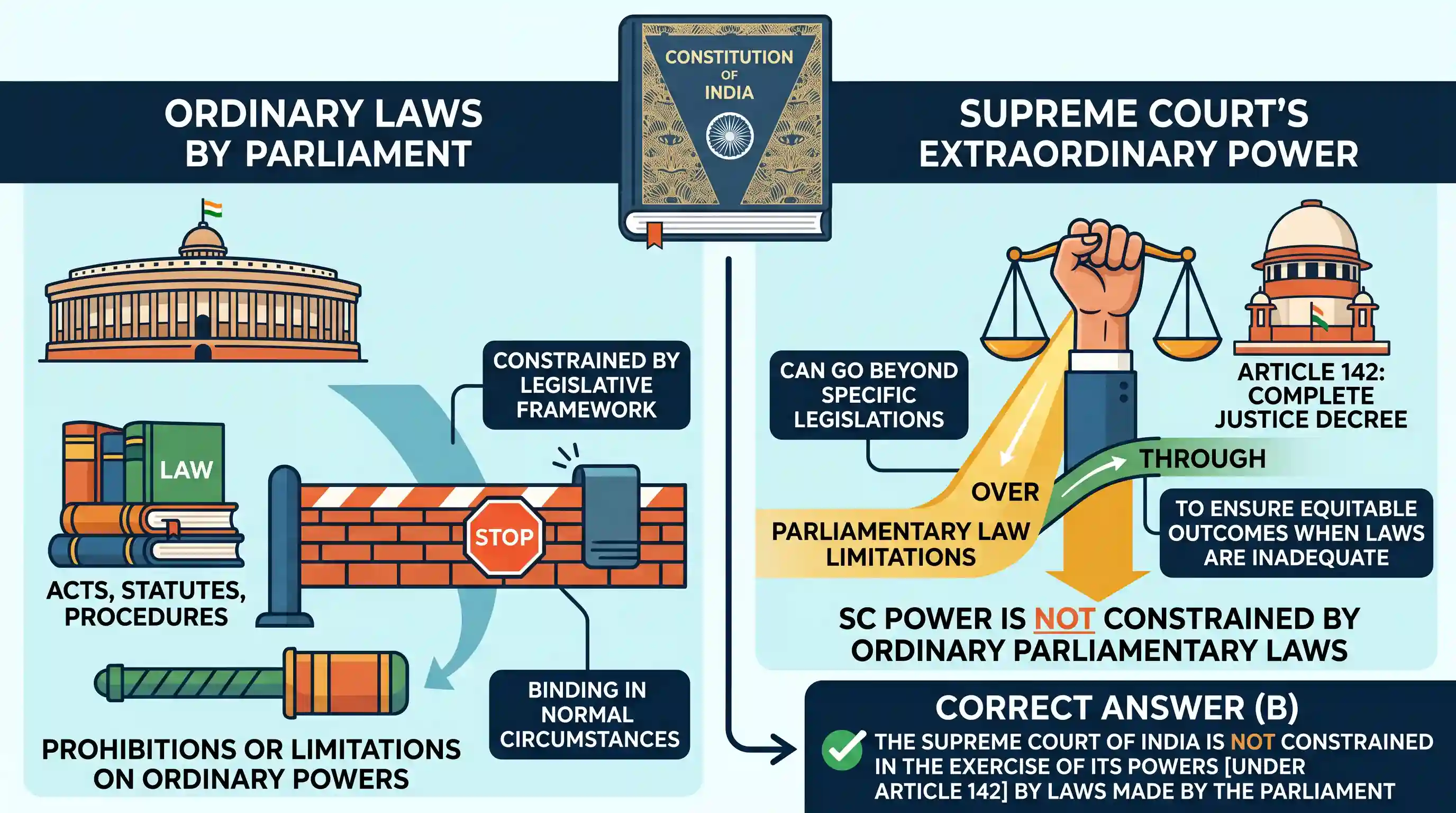
With reference to the Constitution of India, prohibitions or limitations or provisions contained in ordinary laws cannot act as prohibitions or limitations on the constitutional powers under Article 142. It could mean which one of the following?

- AThe decisions taken by the Election Commission of India while discharging its duties cannot be challenged in any court of law.
- BThe Supreme Court of India is not constrained in the exercise of its powers by laws made by the Parliament.Correct
- CIn the event of grave financial crisis in the country, the President of India can declare Financial Emergency without the counsel from the Cabinet.
- DState Legislatures cannot make laws on certain matters without the concurrence of Union Legislature.
Explanation
Article 142 of the Constitution of India grants the Supreme Court extraordinary power to pass any decree or order necessary for doing 'complete justice' in any case or matter pending before it. This power is intended to be invoked in situations where existing laws may not adequately address the unique circumstances to ensure equitable outcomes. The phrase "prohibitions or limitations or provisions contained in ordinary laws cannot act as prohibitions or limitations on the constitutional powers under Article 142" implies that the Supreme Court's power to do complete justice is not restricted by statutory laws passed by Parliament. The Court can issue directions and orders that might even override or go beyond the specific provisions of existing legislation, in the interest of delivering ultimate justice. Option B accurately captures this essence, stating that the Supreme Court is not constrained by laws made by the Parliament when exercising its powers under Article 142.
Related questions
More UPSC Prelims practice from the same subject and topic.
- Prelims 2019GS1polity-and-governance
Consider the following statements: 1. The 44th Amendment to the Constitution of India introduced an Article placing the election of the Prime Minister beyond judicial review. 2. The Supreme Court of I…
- Prelims 2019GS1polity-and-governance
Consider the following statements: 1. The motion to impeach a Judge of the Supreme Court of India cannot be rejected by the Speaker of the Lok Sabha as per the Judges (Inquiry) Act, 1968. 2. The Const…
- Prelims 2019GS1polity-and-governance
With reference to the Constitution of India, consider the following statements: 1. No High Court shall have the jurisdiction to declare any central law to be constitutionally invalid. 2. An amendment …
- Prelims 2019GS1polity-and-governance
Atal Innovation Mission is set up under the
- Prelims 2019GS1polity-and-governance
The Ninth Schedule was introduced in the Constitution of India during the prime ministership of
- Prelims 2019GS1polity-and-governance
Consider the following statements: 1. The Parliament (Prevention of Disqualification) Act, 1959 exempts several posts from disqualification on the grounds of 'Office of Profit'. 2. The above-mentioned…