Read the following two passages and answer the items that follow. Your answers to these items should be based on the passages only. "... most people would agree that telling deliberate lies is wrong, except perhaps in certain special situations where more harm will be done by telling the truth. Even the most truthful people probably tell a good many more lies that might be regarded as semantic lies; their use of words contains some measure of falsehood, more or less deliberate." Which one of the following habits is found more often in good people?

- AMixing up the true and false
- BIntentional mixing up of truth with the falseCorrect
- CFalsification of facts
- DComplete concealment of truth
Explanation
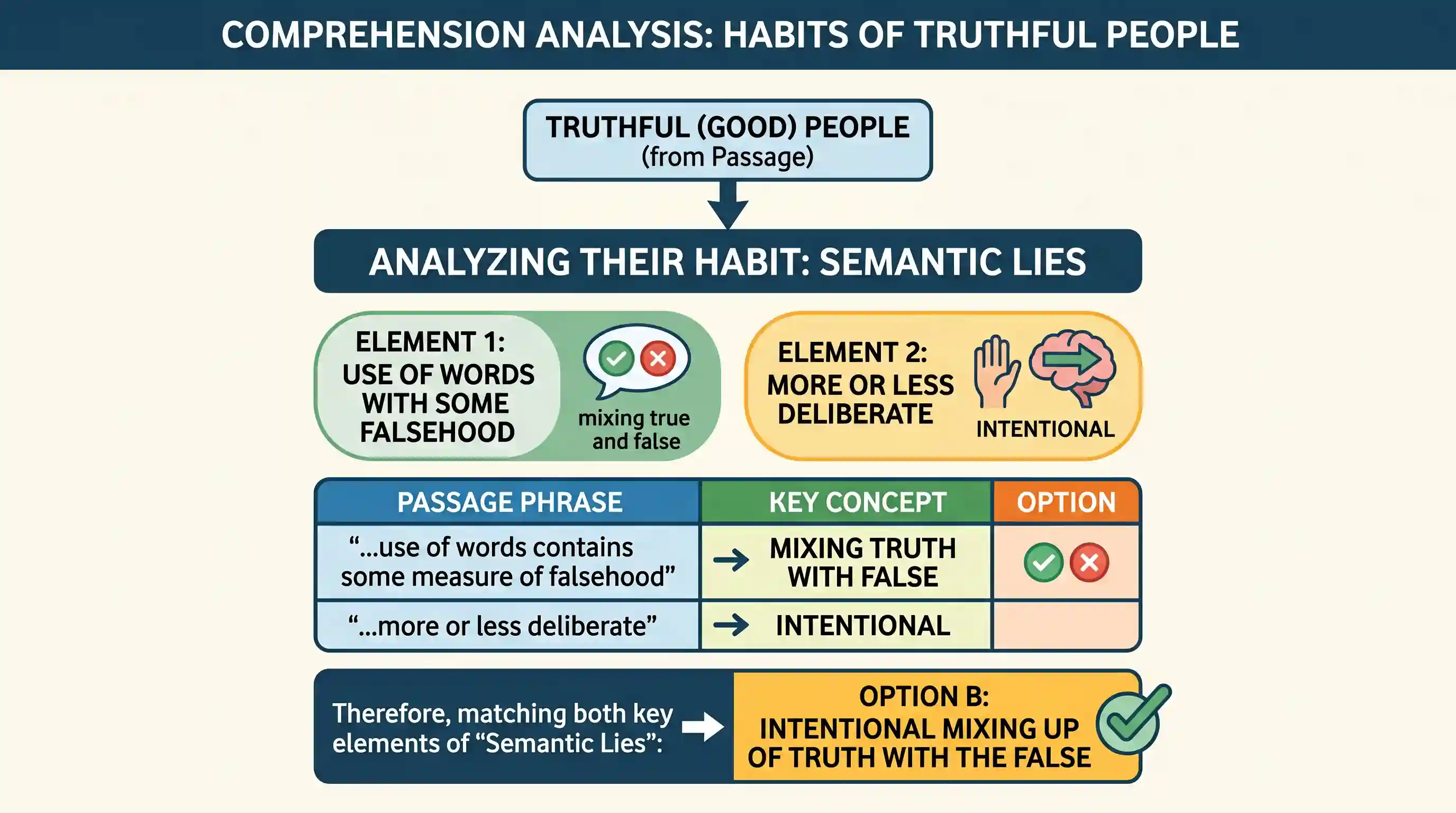
The passage states that "Even the most truthful people probably tell a good many more lies that might be regarded as semantic lies; their use of words contains some measure of falsehood, more or less deliberate."
Let's break down this key sentence:
- "Most truthful people" can be equated with "good people" in the context of truthfulness.
- These people tell "semantic lies."
- Semantic lies involve their "use of words contain[ing] some measure of falsehood." This implies a mixing of truth (since they are truthful people) with falsehood.
- This falsehood is "more or less deliberate," which means it is intentional to some degree.
Now, let's evaluate the options:
A) Mixing up the true and false: This captures the "use of words contains some measure of falsehood" but misses the crucial "more or less deliberate" aspect mentioned in the passage.
B) Intentional mixing up of truth with the false: This option perfectly aligns with the passage. "Intentional" directly corresponds to "more or less deliberate," and "mixing up of truth with the false" describes "use of words contains some measure of falsehood" by truthful people. This is the habit described as common even among the most truthful.
C) Falsification of facts: While a type of falsehood, the passage describes semantic lies as a "measure of falsehood" in the "use of words," which is often more subtle than outright falsification of facts. Also, the passage distinguishes general "deliberate lies" from "semantic lies" told by "truthful people." Truthful people are less likely to engage in outright falsification.
D) Complete concealment of truth: This refers to omission, not necessarily the "use of words contain[ing] some measure of falsehood." Semantic lies are about what is said, not what is left unsaid.
Therefore, option B is the most accurate and complete description of the habit found more often in good/truthful people according to the passage.
Related questions
More UPSC Prelims practice from the same subject and topic.
- Prelims 2021CSATReading Comprehension
India faces a challenging immediate future in energy and climate policy- making. The problems are multiple: sputtering fossil fuel production capabilities; limited access to electricity and modern coo…
- Prelims 2021CSATReading Comprehension
There are reports that some of the antibiotics sold in the market are fed to poultry and other livestock as growth promoters. Overusing these substances can create superbugs, pathogens that are resist…
- Prelims 2021CSATReading Comprehension
Policymakers and media have placed the blame for skyrocketing food prices on a variety of factors, including high fuel prices, bad weather in key food producing countries, and the diversion of land to…
- Prelims 2021CSATReading Comprehension
A central message of modern development economics is the importance of income growth, by which is meant growth in Gross Domestic Product (GDP). In theory, rising GDP creates employment and investment …
- Prelims 2021CSATReading Comprehension
Researchers simulated street lighting on artificial grassland plots containing pea- aphids, sap- sucking insects, at night. These were exposed to two different types of light - a white light similar t…
- Prelims 2021CSATReading Comprehension
Approximately 80 percent of all flowering plant species are pollinated by animals, including birds and mammals, but the main pollinators are insects. Pollination is responsible for providing us with a…