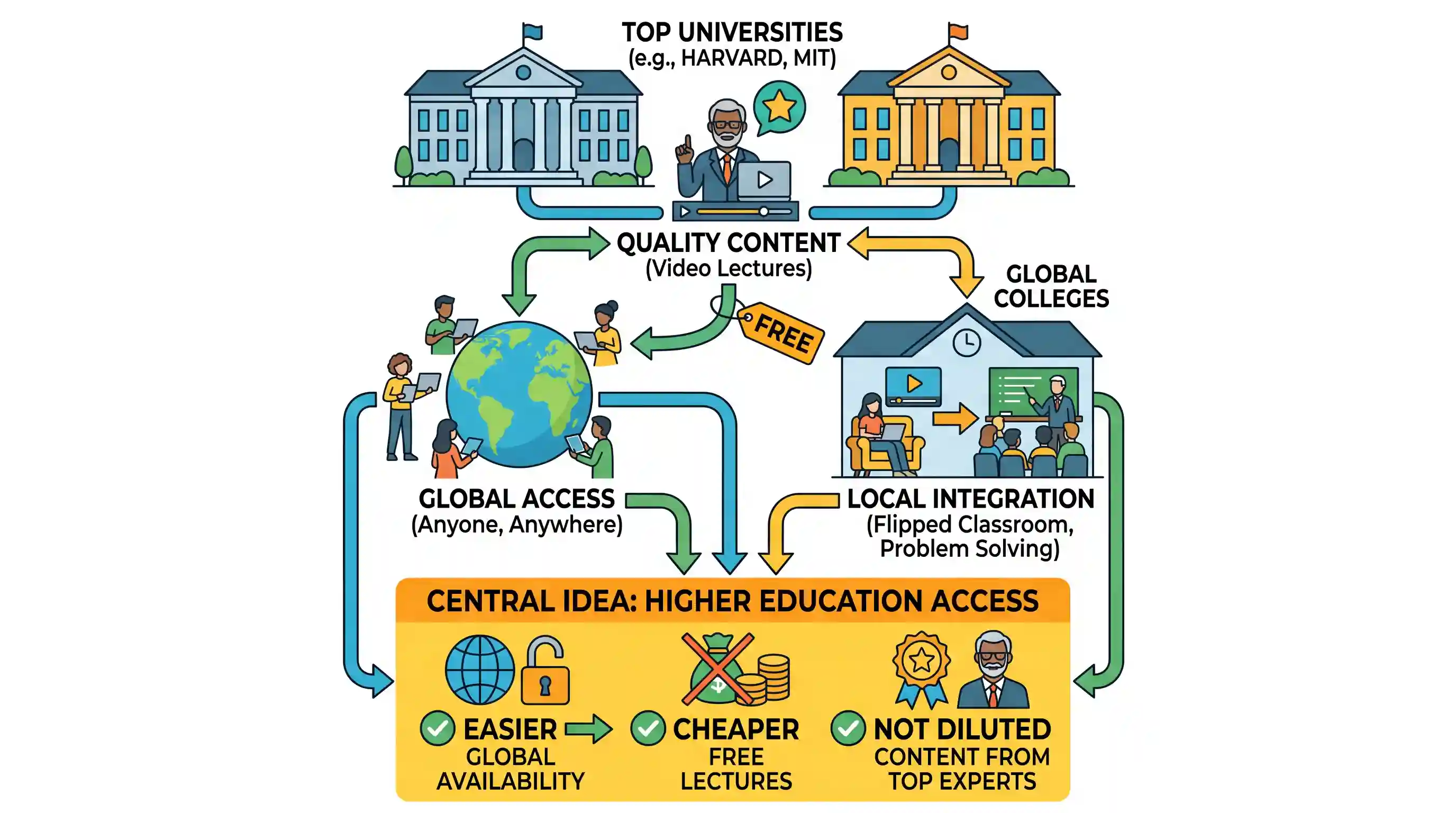
Read the following two passages and answer the items that follow. Your answers to these items should be based on the passages only. The best universities like Harvard and MIT, despite having the luxury of having some truly excellent teachers on their payroll, are increasingly embracing the "flipped classroom" format, where students listen to video lectures at home, and spend class time applying their knowledge, solving problems, discussing examples, etc. Professors guide that discussion and fill in wherever necessary, explaining those bits that seem to be eluding the students and throwing in advanced ideas that happen to be topical. These universities have made their video lectures available free for anyone in the world. They are also encouraging colleges and universities all over the world to integrate these online courses into their own pedagogy, picking the pieces that are appropriate for their needs and building a package around them. Which one of the following statements best reflects the central idea of the passage given above?

- AEfficacy of universities would be better in online mode of conducting classroom tuition as compared, to conventional method
- BAvailability of higher education can be made easier and cheaper without diluting the contentCorrect
- CWe need not invest much in infrastructure related to higher education and yet develop better human and social capital
- DPrivate sector institutions in higher education, as well as coaching institutes, can take advantage of this opportunity and thrive well.
Explanation
The passage describes top universities making their high-quality video lectures available free to anyone globally, and encouraging other institutions to integrate these into their pedagogy.
Let's analyze the options:
A) Efficacy of universities would be better in online mode of conducting classroom tuition as compared, to conventional method. The passage discusses a "flipped classroom" which is a hybrid model (online lectures, in-person class time), not purely online tuition. It doesn't explicitly state that online mode is universally "better" than conventional, but rather describes a specific effective hybrid approach.
B) Availability of higher education can be made easier and cheaper without diluting the content. This aligns perfectly. "Easier" because the content is freely available worldwide and can be integrated by any college. "Cheaper" because the high-quality lecture content is free, potentially reducing costs for students or institutions. "Without diluting the content" because the content comes directly from top-tier universities like Harvard and MIT, ensuring high quality. This option captures the essence of democratizing access to quality education.
C) We need not invest much in infrastructure related to higher education and yet develop better human and social capital. While the model might shift some infrastructure needs, the passage doesn't focus on eliminating or significantly reducing infrastructure investment as its central idea. The "flipped classroom" still requires physical spaces for discussion and application. The primary focus is on content accessibility, not infrastructure reduction.
D) Private sector institutions in higher education, as well as coaching institutes, can take advantage of this opportunity and thrive well. The passage mentions "colleges and universities all over the world" integrating these courses. While private institutions might benefit, the central idea is not about their specific thriving, but rather the broader impact on global education and pedagogy.
Therefore, option B best reflects the central idea by highlighting the increased accessibility and affordability of high-quality higher education content.
Related questions
More UPSC Prelims practice from the same subject and topic.
- Prelims 2021CSATReading Comprehension
India faces a challenging immediate future in energy and climate policy- making. The problems are multiple: sputtering fossil fuel production capabilities; limited access to electricity and modern coo…
- Prelims 2021CSATReading Comprehension
There are reports that some of the antibiotics sold in the market are fed to poultry and other livestock as growth promoters. Overusing these substances can create superbugs, pathogens that are resist…
- Prelims 2021CSATReading Comprehension
Policymakers and media have placed the blame for skyrocketing food prices on a variety of factors, including high fuel prices, bad weather in key food producing countries, and the diversion of land to…
- Prelims 2021CSATReading Comprehension
A central message of modern development economics is the importance of income growth, by which is meant growth in Gross Domestic Product (GDP). In theory, rising GDP creates employment and investment …
- Prelims 2021CSATReading Comprehension
Researchers simulated street lighting on artificial grassland plots containing pea- aphids, sap- sucking insects, at night. These were exposed to two different types of light - a white light similar t…
- Prelims 2021CSATReading Comprehension
Approximately 80 percent of all flowering plant species are pollinated by animals, including birds and mammals, but the main pollinators are insects. Pollination is responsible for providing us with a…