A has some coins. He gives half of the coins and 2 more to B. B gives half of the coins and 2 more to C. C gives half of the coins and 2 more to D. The number of coins D has now, is the smallest two-digit number. How many coins does A have in the beginning?

- A76
- B68
- C60
- D52Correct
Explanation
Here's a step-by-step explanation working backward:
-
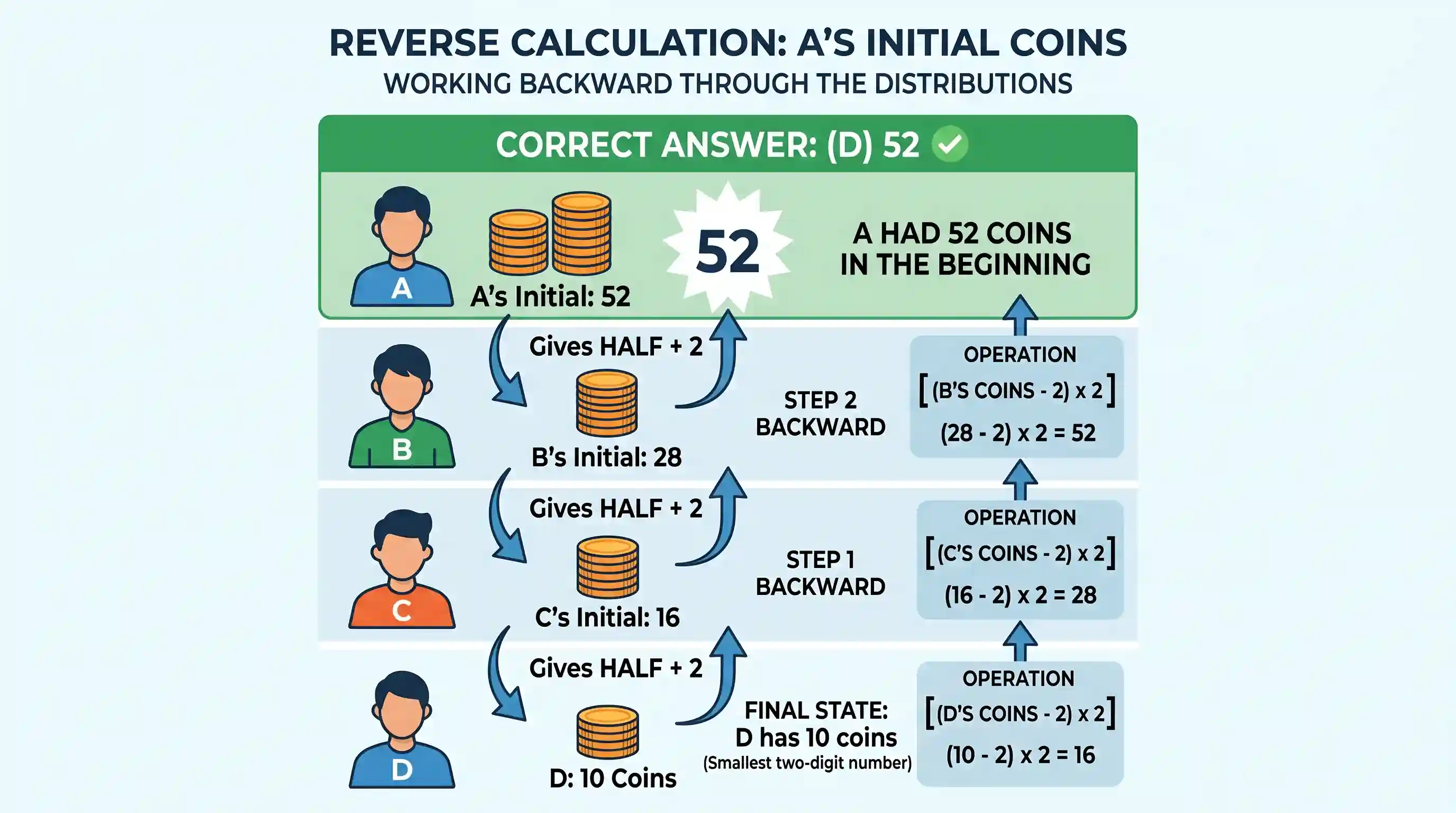
Determine D's coins: The smallest two-digit number is 10. So, D has 10 coins.
-
Calculate C's coins before giving to D: C gave half of his coins and 2 more to D, resulting in D having 10 coins. Let C's coins be 'x'. C gave (x/2) + 2 to D. So, (x/2) + 2 = 10 x/2 = 10 - 2 x/2 = 8 x = 8 * 2 = 16. C had 16 coins before giving to D.
-
Calculate B's coins before giving to C: B gave half of his coins and 2 more to C, resulting in C having 16 coins. Let B's coins be 'y'. B gave (y/2) + 2 to C. So, (y/2) + 2 = 16 y/2 = 16 - 2 y/2 = 14 y = 14 * 2 = 28. B had 28 coins before giving to C.
-
Calculate A's initial coins: A gave half of his coins and 2 more to B, resulting in B having 28 coins. Let A's initial coins be 'z'. A gave (z/2) + 2 to B. So, (z/2) + 2 = 28 z/2 = 28 - 2 z/2 = 26 z = 26 * 2 = 52. A had 52 coins in the beginning.
Therefore, A had 52 coins in the beginning.
The final answer is D) 52.
Related questions
More UPSC Prelims practice from the same subject and topic.
- Prelims 2022CSATQuantitative Aptitude
When 70% of a number xis added to another number y, the sum becomes 165% of the value of y. When 60% of the number xis added to another number z , then the sum becomes 165% of the value of z . Which o…
- Prelims 2022CSATQuantitative Aptitude
An Identity Card has the number ABCDEFG, not necessarily in that order, where each letter represents a distinct digit (1, 2, 4, 5, 7, 8, 9 only). The number is divisible by 9. After deleting the first…
- Prelims 2022CSATQuantitative Aptitude
A bill for ₹1,840 is paid in the denominations of ₹50, ₹20 and ₹10 notes. 50 notes in all are used. Consider the following statements: 1. 25 notes of ₹50 are used and the remaining are in the denomina…
- Prelims 2022CSATQuantitative Aptitude
Which number amongst 2⁴⁰, 3²¹, 4¹⁸ and 8¹² is the smallest?
- Prelims 2022CSATQuantitative Aptitude
The digits 1 to 9 are arranged in three rows in such a way that each row contains three digits, and the number formed in the second row is twice the number formed in the first row; and the number form…
- Prelims 2022CSATQuantitative Aptitude
X and Y run a 3 km race along a circular course of length 300 m. Their speeds are in the ratio 3:2 . If they start together in the same direction, how many times would the first one pass the other (th…