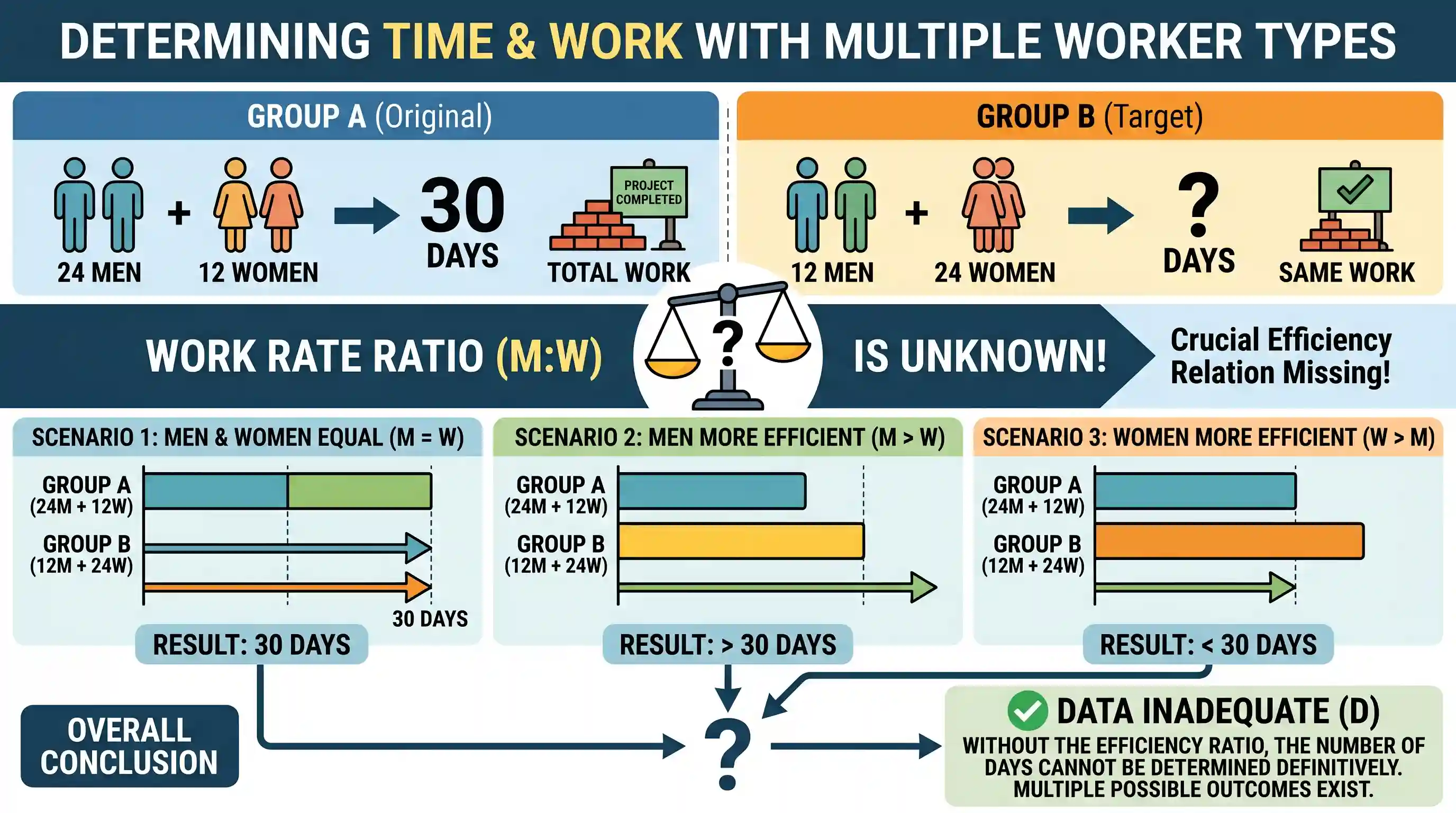
24 men and 12 women can do a piece of work in 30 days. In how many days can 12 men and 24 women do the same piece of work?

- A30 days
- BMore than 30 days
- CLess than 30 days or more than 30 days
- DData is inadequate to draw any conclusionCorrect
Explanation
The problem requires determining the number of days for a different combination of men and women to complete a task. Let M be the work rate of one man per day and W be the work rate of one woman per day.
From the first statement: (24M + 12W) * 30 = Total Work
From the second statement, we need to find the days (D) for: (12M + 24W) * D = Total Work
Equating the two expressions for Total Work: (24M + 12W) * 30 = (12M + 24W) * D
To solve for D, we need to know the relationship between M and W (i.e., the ratio of a man's efficiency to a woman's efficiency). The problem does not provide this information.
Let's consider possible scenarios:
-
If M = W (men and women have equal efficiency): (24M + 12M) * 30 = (12M + 24M) * D (36M) * 30 = (36M) * D D = 30 days.
-
If M > W (men are more efficient than women, e.g., M = 2W): (24(2W) + 12W) * 30 = (12(2W) + 24W) * D (48W + 12W) * 30 = (24W + 24W) * D (60W) * 30 = (48W) * D 1800 = 48D D = 37.5 days (More than 30 days).
-
If W > M (women are more efficient than men, e.g., W = 2M): (24M + 12(2M)) * 30 = (12M + 24(2M)) * D (24M + 24M) * 30 = (12M + 48M) * D (48M) * 30 = (60M) * D 1440 = 60D D = 24 days (Less than 30 days).
Since the number of days depends on the unknown relative efficiencies of men and women, we cannot determine a unique answer.
Analysis of Options: A) 30 days: This is only one possible outcome, not universally true. B) More than 30 days: This is also only one possible outcome. C) Less than 30 days or more than 30 days: While it covers some possibilities, it doesn't account for exactly 30 days and still doesn't provide a definitive answer. D) Data is inadequate to draw any conclusion: This is correct because without the ratio of efficiencies between men and women, a specific number of days cannot be calculated.
Related questions
More UPSC Prelims practice from the same subject and topic.
- Prelims 2022CSATQuantitative Aptitude
An Identity Card has the number ABCDEFG, not necessarily in that order, where each letter represents a distinct digit (1, 2, 4, 5, 7, 8, 9 only). The number is divisible by 9. After deleting the first…
- Prelims 2022CSATQuantitative Aptitude
A bill for ₹1,840 is paid in the denominations of ₹50, ₹20 and ₹10 notes. 50 notes in all are used. Consider the following statements: 1. 25 notes of ₹50 are used and the remaining are in the denomina…
- Prelims 2022CSATQuantitative Aptitude
Which number amongst 2⁴⁰, 3²¹, 4¹⁸ and 8¹² is the smallest?
- Prelims 2022CSATQuantitative Aptitude
The digits 1 to 9 are arranged in three rows in such a way that each row contains three digits, and the number formed in the second row is twice the number formed in the first row; and the number form…
- Prelims 2022CSATQuantitative Aptitude
X and Y run a 3 km race along a circular course of length 300 m. Their speeds are in the ratio 3:2 . If they start together in the same direction, how many times would the first one pass the other (th…
- Prelims 2022CSATQuantitative Aptitude
In a tournament of Chess having 150 entrants, a player is eliminated whenever he loses a match. It is given that no match results in a tie/draw. How many matches are played in the entire tournament?