Consider the following statements in respect of a rectangular sheet of length 20 cm and breadth 8 cm: 1. It is possible to cut the sheet exactly into 4 square sheets. 2. It is possible to cut the sheet into 10 triangular sheets of equal area. Which of the above statements is/are correct?

- A1 only
- B2 only
- CBoth 1 and 2Correct
- DNeither 1 nor 2
Explanation
The problem asks us to evaluate two statements regarding cutting a rectangular sheet of length 20 cm and breadth 8 cm. The total area of the sheet is 20 cm * 8 cm = 160 sq cm.
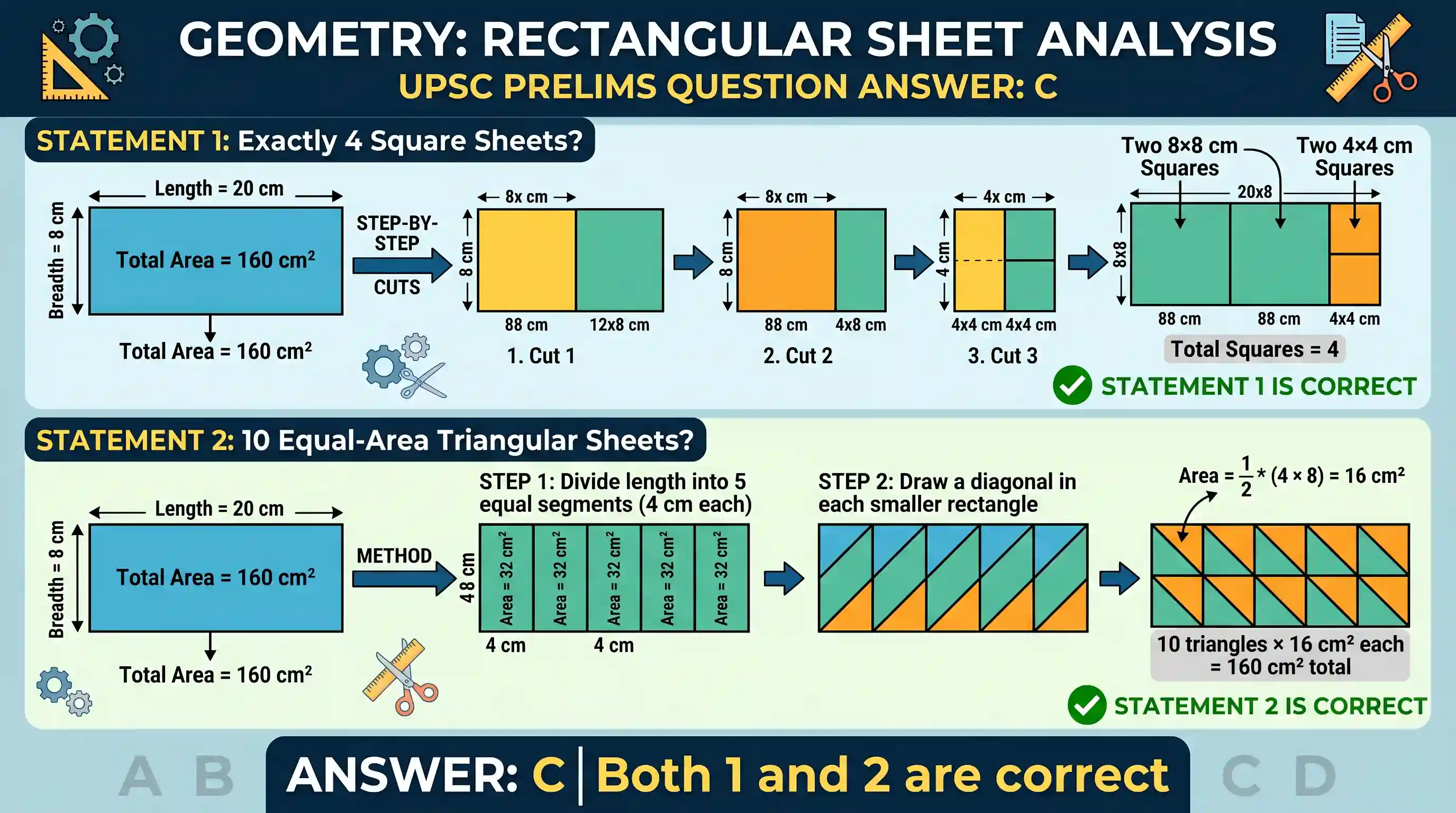
Statement 1: It is possible to cut the sheet exactly into 4 square sheets. Yes, this is possible. We can cut the 20 cm x 8 cm rectangle as follows:
- Cut off an 8 cm x 8 cm square from one end. This leaves a 12 cm x 8 cm rectangle. (1st square)
- From the remaining 12 cm x 8 cm rectangle, cut off another 8 cm x 8 cm square. This leaves a 4 cm x 8 cm rectangle. (2nd square)
- The remaining 4 cm x 8 cm rectangle can be cut into two 4 cm x 4 cm squares. (3rd and 4th squares) Thus, we have successfully cut the sheet into four square sheets: two of size 8 cm x 8 cm and two of size 4 cm x 4 cm. The term "square sheets" does not imply they must all be of the same size. Therefore, Statement 1 is correct.
Statement 2: It is possible to cut the sheet into 10 triangular sheets of equal area. Yes, this is also possible. The total area of the rectangular sheet is 160 sq cm. If it is cut into 10 triangular sheets of equal area, the area of each triangle must be 160 sq cm / 10 = 16 sq cm. We can achieve this by dividing the original rectangle:
- Divide the 20 cm length into 5 equal segments of 4 cm each (20 cm / 5 = 4 cm).
- This effectively divides the original 20 cm x 8 cm rectangle into 5 smaller rectangles, each measuring 4 cm x 8 cm.
- The area of each of these smaller 4 cm x 8 cm rectangles is 4 cm * 8 cm = 32 sq cm.
- Each of these 5 smaller 4 cm x 8 cm rectangles can be cut into two triangles of equal area by drawing a diagonal across it.
- The area of each such triangle would be (1/2) * base * height = (1/2) * 4 cm * 8 cm = 16 sq cm (or (1/2) * 8 cm * 4 cm = 16 sq cm).
- Since we have 5 such rectangles, and each yields 2 triangles, we get a total of 5 * 2 = 10 triangular sheets.
- Each of these 10 triangles has an area of 16 sq cm, and they perfectly cover the original rectangular sheet. Therefore, Statement 2 is correct.
Since both Statement 1 and Statement 2 are correct, the answer is C.
The final answer is $\boxed{C}$
Related questions
More UPSC Prelims practice from the same subject and topic.
- Prelims 2022CSATQuantitative Aptitude
There are eight equidistant points on a circle. How many right-angled triangles can be drawn using these points as vertices and taking the diameter as one side of the triangle?
- Prelims 2022CSATQuantitative Aptitude
An Identity Card has the number ABCDEFG, not necessarily in that order, where each letter represents a distinct digit (1, 2, 4, 5, 7, 8, 9 only). The number is divisible by 9. After deleting the first…
- Prelims 2022CSATQuantitative Aptitude
A bill for ₹1,840 is paid in the denominations of ₹50, ₹20 and ₹10 notes. 50 notes in all are used. Consider the following statements: 1. 25 notes of ₹50 are used and the remaining are in the denomina…
- Prelims 2022CSATQuantitative Aptitude
Which number amongst 2⁴⁰, 3²¹, 4¹⁸ and 8¹² is the smallest?
- Prelims 2022CSATQuantitative Aptitude
The digits 1 to 9 are arranged in three rows in such a way that each row contains three digits, and the number formed in the second row is twice the number formed in the first row; and the number form…
- Prelims 2022CSATQuantitative Aptitude
X and Y run a 3 km race along a circular course of length 300 m. Their speeds are in the ratio 3:2 . If they start together in the same direction, how many times would the first one pass the other (th…