The "Miyawaki method" is well known for the:

- APromotion of commercial farming in arid and semi-arid areas
- BDevelopment of gardens using genetically modified flora
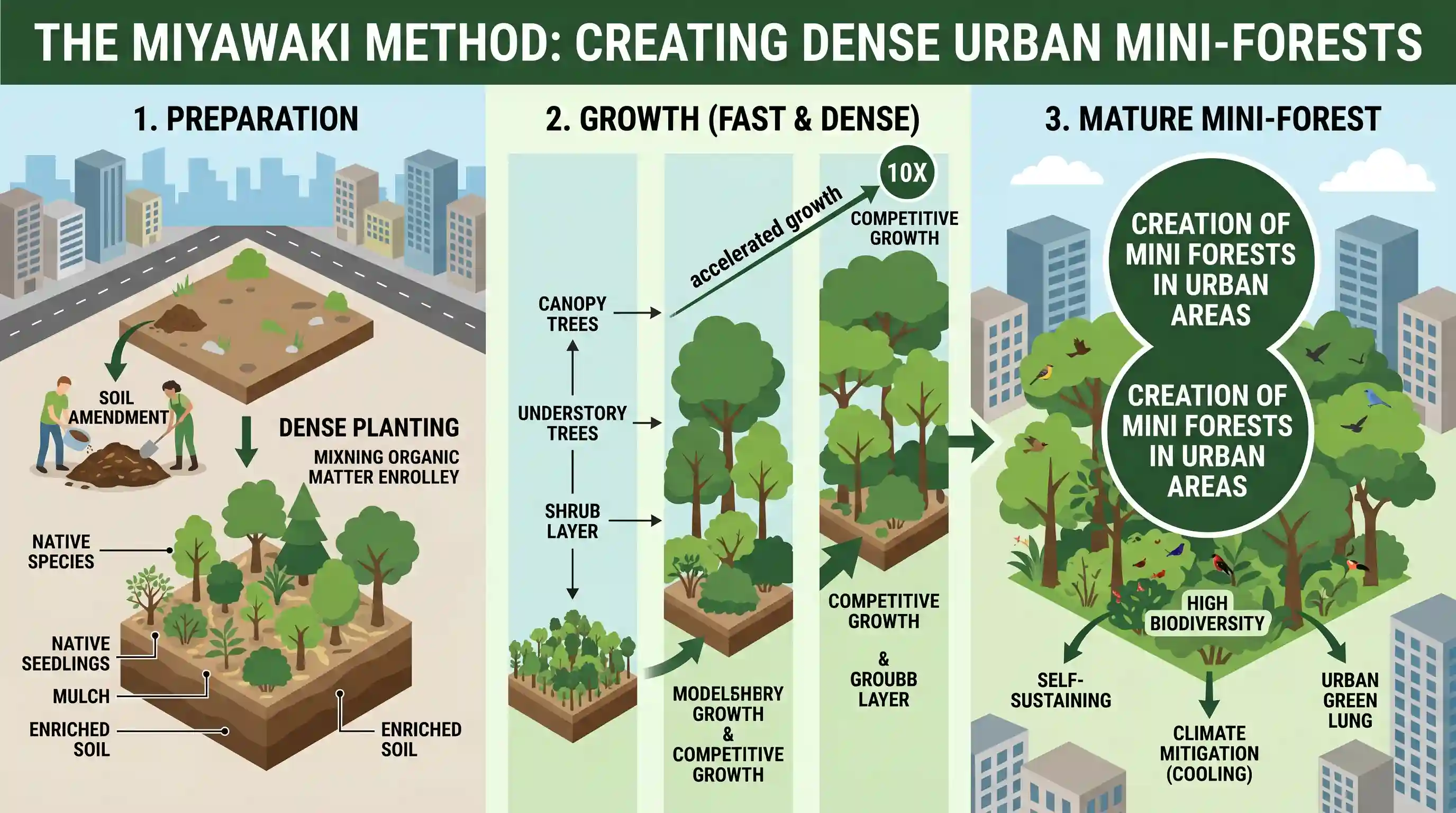
- CCreation of mini forests in urban areasCorrect
- DHarvesting wind energy on coastal areas and on sea surfaces
Explanation
The "Miyawaki method" is an innovative and highly effective technique for afforestation, developed by Japanese botanist Akira Miyawaki. This method involves planting diverse native species in a very dense and specific pattern. By creating a multi-layered forest structure (shrubs, sub-trees, trees, canopy trees) and enriching the soil, the method accelerates forest growth by about 10 times and makes the resulting mini-forests self-sustaining and maintenance-free after a few years. It is particularly well-known for its application in creating dense, biodiverse mini-forests in small urban plots, neglected spaces, or industrial sites, contributing to urban greening and ecological restoration.
Related questions
More UPSC Prelims practice from the same subject and topic.
- Prelims 2022GS1geography
Among the following crops, which one is the most important anthropogenic source of both methane and nitrous oxide?
- Prelims 2022GS1geography
"System of Rice Intensification" of cultivation, in which alternate wetting and drying of rice fields is practised, results in : 1. Reduced seed requirement 2. Reduced methane production 3. Reduced el…
- Prelims 2022GS1geography
"Climate Action Tracker" which monitors the emission reduction pledges of different countries is a :
- Prelims 2022GS1geography
Consider the following statements : 1. "The Climate Group" is an international non-profit organization that drives climate action by building large networks and runs them. 2. The International Energy …
- Prelims 2022GS1geography
"If rainforests and tropical forests are the lungs of the Earth, then surely wetlands function as its kidneys." Which one of the following functions of wetlands best reflects the above statement?
- Prelims 2022GS1geography
In the context of WHO Air Quality Guidelines, consider the following statements: 1. The 24-hour mean of PM2.5 should not exceed 15 µg/m³ and annual mean of PM2.5 should not exceed 5 µg/m³. 2. In a yea…