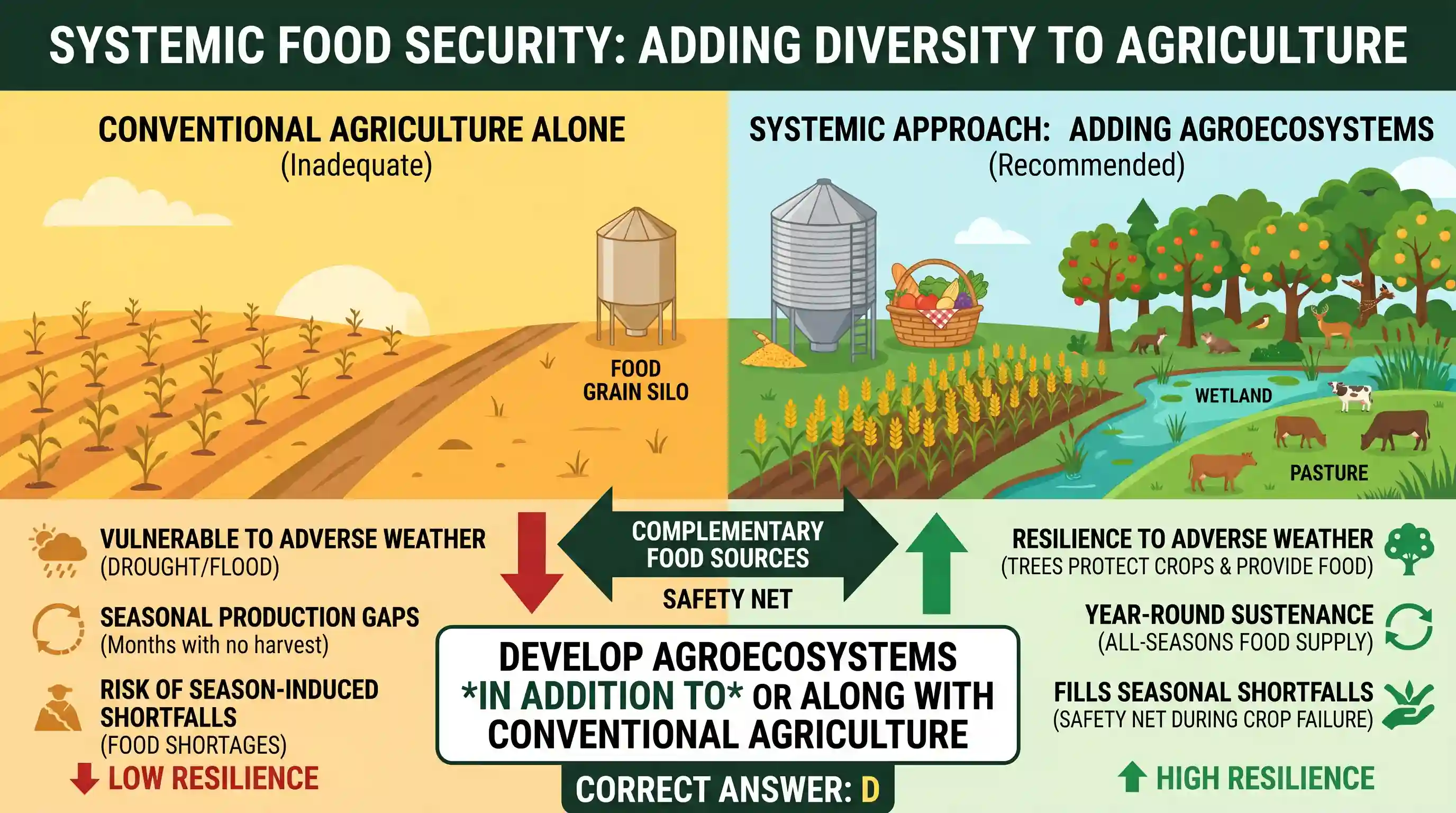
Sourcing food from non- agricultural lands (uncultivated systems such as forests, wetlands, pastures, etc) in addition to agricultural lands enables a systemic approach to food consumption. It allows rural and tribal communities to sustain themselves for the whole year and steer clear of natural disasters and season- induced shortfalls of agricultural food. Since the productivity of trees is often more resilient to adverse weather conditions than annual crops, forest foods often provide a safety net during periods of food shortages caused by crop failure; forest foods also make important contributions during seasonal crop production gaps. Which one of the following statements best reflects the most logical and rational message conveyed by the author of the passage?

- AFood yielding trees should replace other trees in rural and tribal areas and community owned lands.
- BFood security cannot be ensured in India with the present practice of conventional agriculture.
- CWastelands and degraded areas in India should be converted into agroforestry systems to help the poor.
- DAgroecosystems should be developed in addition to or along with conventional agriculture.Correct
Explanation
The passage advocates for sourcing food from non-agricultural lands (forests, wetlands, pastures) in addition to agricultural lands. It highlights the benefits of this approach, such as year-round sustenance, resilience to disasters, and filling seasonal gaps in agricultural food production.
Let's analyze the options:
A) Food yielding trees should replace other trees in rural and tribal areas and community owned lands. This option suggests replacement, which goes against the passage's emphasis on addition and complementarity. The passage does not advocate for replacing existing trees.
B) Food security cannot be ensured in India with the present practice of conventional agriculture. The passage points out the limitations of conventional agriculture in certain situations (disasters, seasonal shortfalls) and suggests supplementary sources. It does not state that food security cannot be ensured by conventional agriculture, but rather that it can be enhanced and made more resilient by adding other sources. This is an overstatement.
C) Wastelands and degraded areas in India should be converted into agroforestry systems to help the poor. While converting wastelands into agroforestry systems might align with the spirit of using non-agricultural lands, the passage's message is broader. It talks about existing uncultivated systems and the general principle of diversification in addition to conventional agriculture, not specifically about converting wastelands. This is a specific application rather than the most logical and rational overarching message.
D) Agroecosystems should be developed in addition to or along with conventional agriculture. This option perfectly captures the core message of the passage. The passage explicitly states "in addition to agricultural lands" and describes the benefits of diverse food sources (which can be broadly termed 'agroecosystems' when managed for food production, encompassing forests, pastures, etc.) complementing conventional agriculture. This approach provides a systemic solution for food consumption and resilience.
Therefore, D is the most accurate reflection of the author's message.
Related questions
More UPSC Prelims practice from the same subject and topic.
- Prelims 2023CSATReading Comprehension
We often hear about conflicts among different States in India over river waters. Of the 20 major river systems, 14 are already water- stressed; 75% of the population lives in water- stressed regions, …
- Prelims 2023CSATReading Comprehension
More than half of Indian women and almost a quarter of Indian men of working age suffer from anaemia. According to studies, they are anywhere from 5 - 15% less productive than they could be, as a resu…
- Prelims 2023CSATReading Comprehension
In India, a majority of farmers are marginal and small, less educated and possess low adaptive capabilities to climate change, perhaps because of credit and other constraints. So, one cannot expect au…
- Prelims 2023CSATReading Comprehension
The emissions humans put into the atmosphere now will affect the climate in the middle of the century and onwards. Technological change, meanwhile, could make a future transition away from fossil fuel…
- Prelims 2023CSATReading Comprehension
Environmental problems cause health problems. Substantial changes in lifestyle can reduce environmental or health problems, but this idea appears almost impossible to adopt. With environmental problem…
- Prelims 2023CSATReading Comprehension
Many people are not eating the right food. For some, it is simply a decision to stick with food they enjoy but which is not too healthy. This is leading to an increase in non- communicable diseases. T…