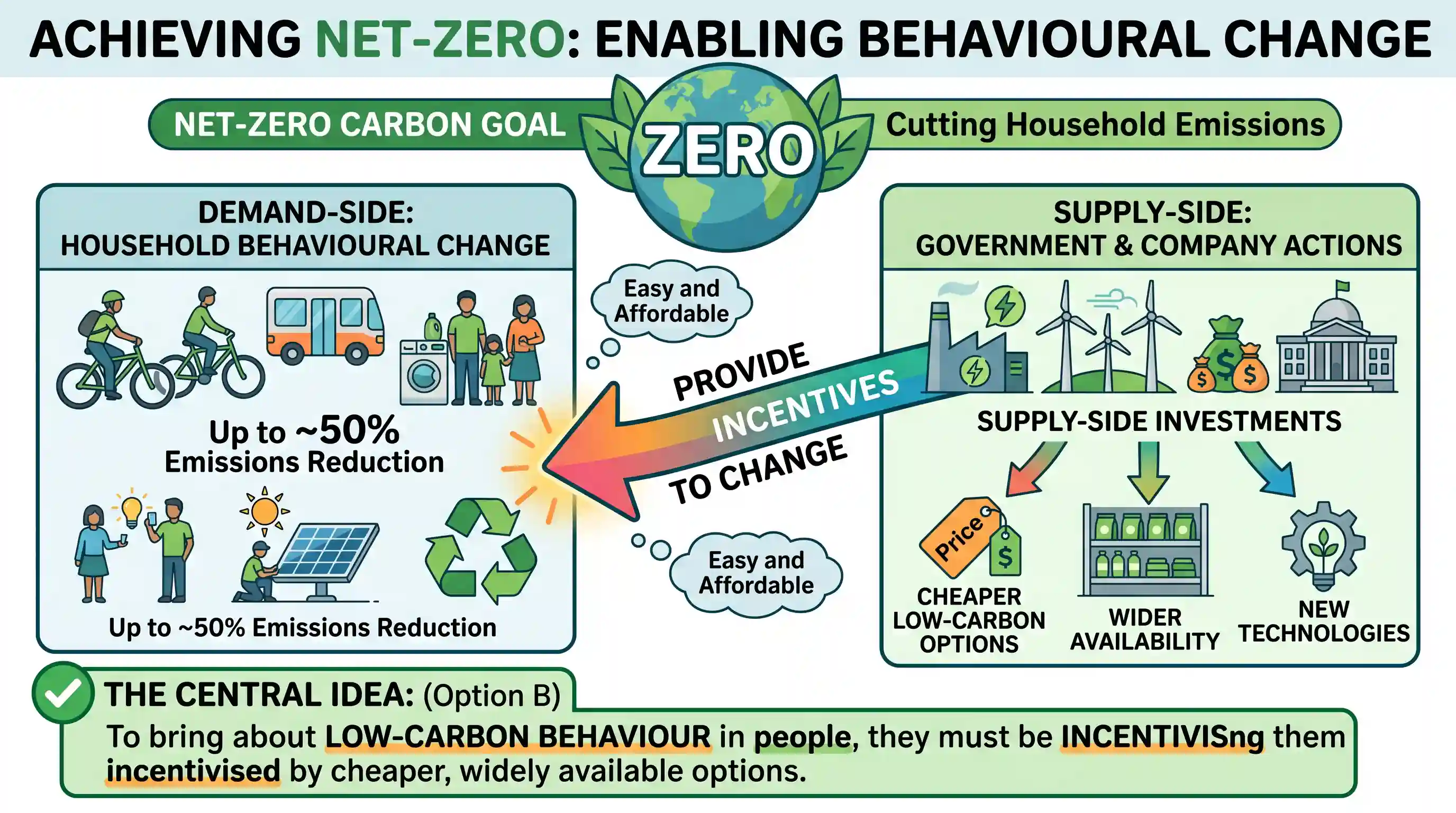
Over the next 30 years, many countries are promising to move to net- zero carbon, implying that household emissions will have to be cut to close to nothing. A leading climate scientist reckons that, at best, half the reduction might be achieved through demand- side measures, such as behavioural changes by individuals and households. And even that would require companies and governments to provide more incentives to change through supply- side investments to make low- carbon options cheaper and more widely available. Which one of the following statements best reflects the central idea conveyed by the passage?

- AMoving to net-zero carbon is possible only by the reduction in household emissions.
- BLow-carbon behaviour in people can be brought about by incentivising them.Correct
- CCheaper goods and services can be made available to people by using low-carbon technologies.
- DManufacturing industries that use low-carbon technologies should be provided with subsidies.
Explanation
The central idea of the passage revolves around how to achieve a significant reduction in household emissions, which is crucial for reaching net-zero carbon.
Let's analyze each option:
A) Moving to net-zero carbon is possible only by the reduction in household emissions. The passage states that household emissions "will have to be cut to close to nothing," implying they are a major component, but it doesn't say it's the only way to achieve net-zero carbon. Other sectors also contribute. The "only" makes this statement too absolute and not fully supported as the central idea.
B) Low-carbon behaviour in people can be brought about by incentivising them. The passage explicitly states that "half the reduction might be achieved through demand-side measures, such as behavioural changes by individuals and households. And even that would require companies and governments to provide more incentives to change through supply-side investments to make low-carbon options cheaper and more widely available." This directly links behavioral changes (low-carbon behavior) to the provision of incentives. This perfectly reflects a core mechanism discussed in the passage.
C) Cheaper goods and services can be made available to people by using low-carbon technologies. The passage mentions making "low-carbon options cheaper and more widely available" as a means to incentivize behavioral change. While this is stated, it's a supporting detail for how incentives work, not the overarching central idea itself. The focus is on the effect of making them cheaper (i.e., incentivizing change), not just the possibility of making them cheaper.
D) Manufacturing industries that use low-carbon technologies should be provided with subsidies. The passage mentions "supply-side investments" to make low-carbon options cheaper. Subsidies could be a form of such investment, but the passage doesn't specifically name "subsidies" or "manufacturing industries." This is a specific policy suggestion that might fall under supply-side investments but is not the central, broader idea conveyed about achieving behavioral change.
Therefore, option B best reflects the central idea because the passage clearly articulates that achieving behavioral changes (low-carbon behavior) in individuals and households requires incentives and the availability of affordable low-carbon options.
Related questions
More UPSC Prelims practice from the same subject and topic.
- Prelims 2025CSATReading Comprehension
Maintaining an ecosystem just to conserve biodiversity will affect its commercial potential as well as the livelihoods dependent on the ecosystem. There is also a conflict between using an ecosystem o…
- Prelims 2025CSATReading Comprehension
Maintaining an ecosystem just to conserve biodiversity will affect its commercial potential as well as the livelihoods dependent on the ecosystem. There is also a conflict between using an ecosystem o…
- Prelims 2025CSATReading Comprehension
]The history of renewable energy suggests there is a steep learning curve, meaning that, as more is produced, costs fall rapidly because of economies of scale and learning by doing. The firms' green i…
- Prelims 2025CSATReading Comprehension
]The history of renewable energy suggests there is a steep learning curve, meaning that, as more is produced, costs fall rapidly because of economies of scale and learning by doing. The firms' green i…
- Prelims 2025CSATReading Comprehension
Each State in India faces a distinctive set of challenges regarding the impact of warming, but also offers its own set of opportunities for reducing emissions depending on its natural resources. For e…
- Prelims 2025CSATReading Comprehension
Each State in India faces a distinctive set of challenges regarding the impact of warming, but also offers its own set of opportunities for reducing emissions depending on its natural resources. For e…