Over the next 30 years, many countries are promising to move to net- zero carbon, implying that household emissions will have to be cut to close to nothing. A leading climate scientist reckons that, at best, half the reduction might be achieved through demand- side measures, such as behavioural changes by individuals and households. And even that would require companies and governments to provide more incentives to change through supply- side investments to make low- carbon options cheaper and more widely available. With reference to the above passage, the following assumptions have been made: I. Supply-side investments in companies can result in low-carbon behaviour in people. II. People are not capable of adapting low-carbon behaviour without the involvement of Government and Companies. Which of the above assumptions is/are valid?

- AI onlyCorrect
- BII only
- CBoth I and II
- DNeither I nor II
Explanation
The passage discusses the challenge of achieving net-zero carbon and the role of demand-side (individual behavior) and supply-side (companies and governments) measures.
Let's analyze each statement:
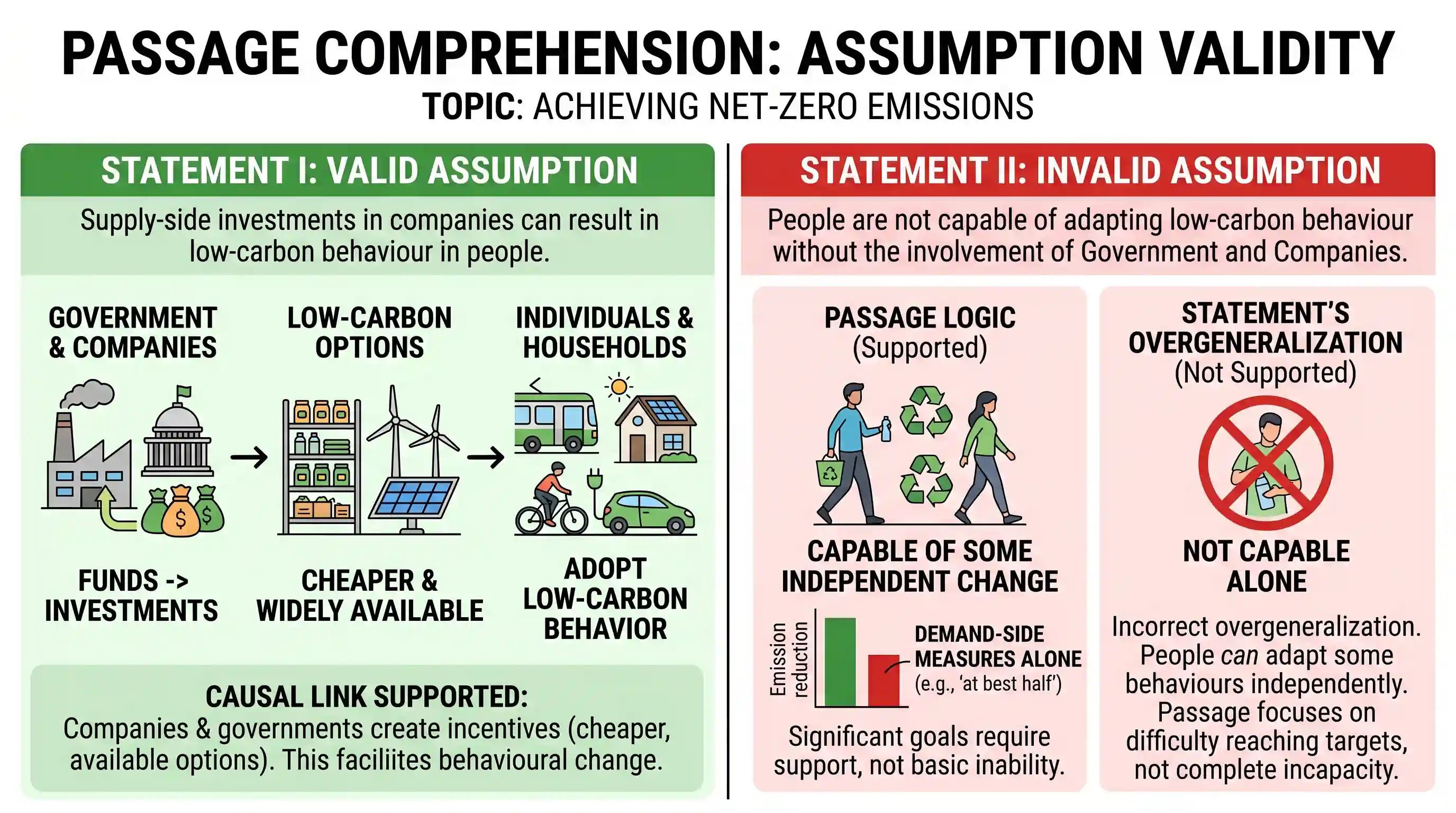
I. Supply-side investments in companies can result in low-carbon behaviour in people. The passage states that "companies and governments to provide more incentives to change through supply-side investments to make low-carbon options cheaper and more widely available." The purpose of making low-carbon options cheaper and more widely available is to facilitate and encourage individuals to adopt them, thereby leading to low-carbon behavior. This directly supports the idea that supply-side investments can influence and result in low-carbon behavior in people. Thus, this is a valid assumption.
II. People are not capable of adapting low-carbon behaviour without the involvement of Government and Companies. The passage says "at best, half the reduction might be achieved through demand-side measures... And even that would require companies and governments to provide more incentives..." This implies that while some individual behavioral change is possible, achieving the desired level of reduction (even half) would require external support. The statement "People are not capable" is very strong and an overgeneralization. The passage does not claim that individuals are utterly incapable of any low-carbon behavior on their own; rather, it suggests that significant, goal-oriented reductions (like the "half reduction" mentioned) necessitate government and company involvement. Individuals can adopt some low-carbon behaviors independently (e.g., walking more, reducing waste), even if not enough to meet large-scale targets. Therefore, this assumption is too strong and not fully supported by the passage.
Based on the analysis, only Statement I is a valid assumption.
The final answer is A
Related questions
More UPSC Prelims practice from the same subject and topic.
- Prelims 2025CSATReading Comprehension
Maintaining an ecosystem just to conserve biodiversity will affect its commercial potential as well as the livelihoods dependent on the ecosystem. There is also a conflict between using an ecosystem o…
- Prelims 2025CSATReading Comprehension
Maintaining an ecosystem just to conserve biodiversity will affect its commercial potential as well as the livelihoods dependent on the ecosystem. There is also a conflict between using an ecosystem o…
- Prelims 2025CSATReading Comprehension
]The history of renewable energy suggests there is a steep learning curve, meaning that, as more is produced, costs fall rapidly because of economies of scale and learning by doing. The firms' green i…
- Prelims 2025CSATReading Comprehension
]The history of renewable energy suggests there is a steep learning curve, meaning that, as more is produced, costs fall rapidly because of economies of scale and learning by doing. The firms' green i…
- Prelims 2025CSATReading Comprehension
Each State in India faces a distinctive set of challenges regarding the impact of warming, but also offers its own set of opportunities for reducing emissions depending on its natural resources. For e…
- Prelims 2025CSATReading Comprehension
Each State in India faces a distinctive set of challenges regarding the impact of warming, but also offers its own set of opportunities for reducing emissions depending on its natural resources. For e…