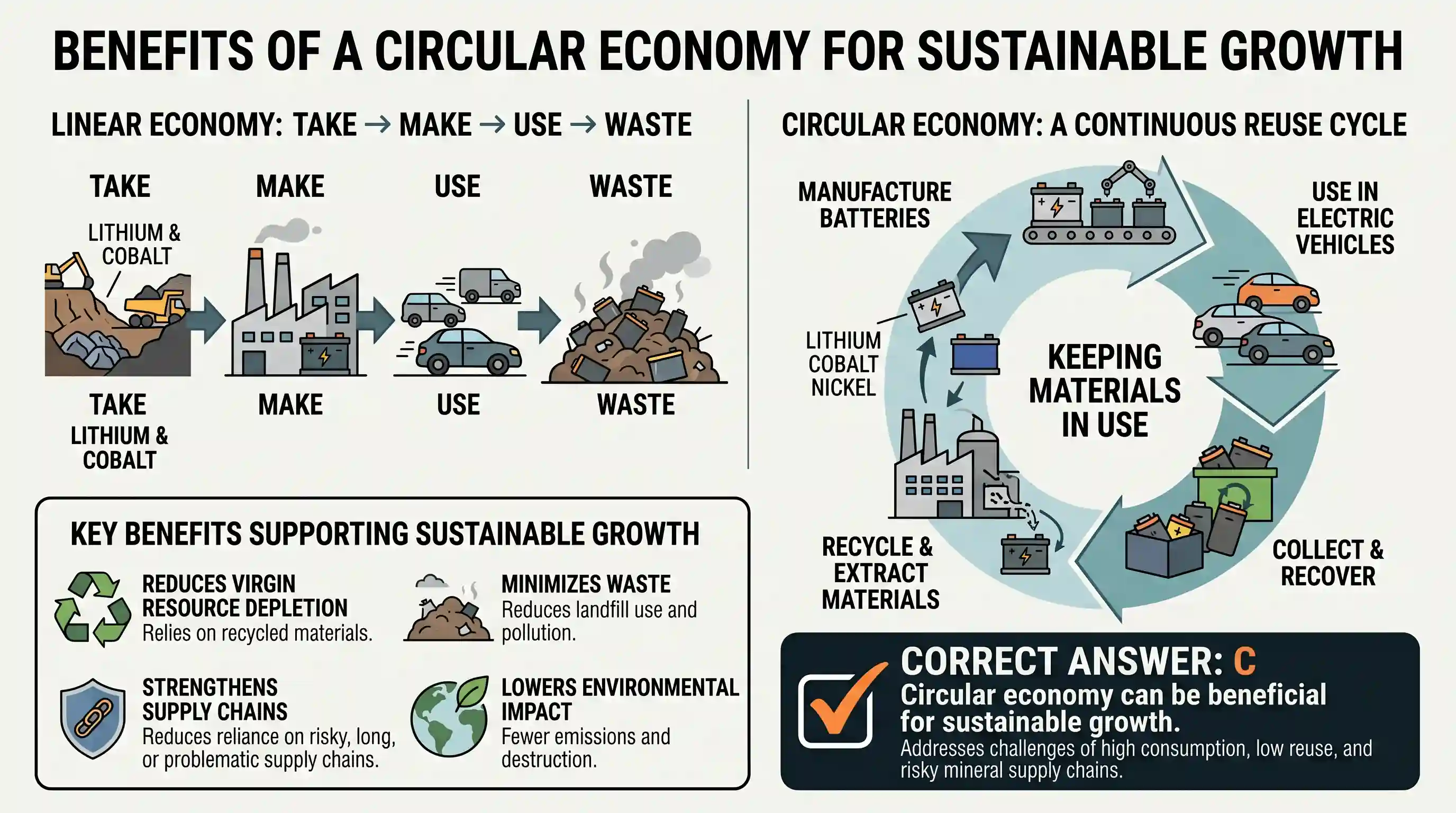
In only 50 years, the world's consumption of raw materials has nearly quadrupled, to more than 100 billion tons. Less than 9% of this is reused. Batteries of old vehicles contain materials such as lithium, cobalt, manganese and nickel that are pricey and can be hard to obtain. Supply chains are long and complicated. Buyers' risks are being aggravated by their suppliers' poor environmental and labour standards. Reusing materials makes sense. Once batteries reach the ends of their lives, they should go back to a factory where their ingredients can be recovered and put into new batteries. Which one of the following statements best reflects the most logical, rational and pragmatic message conveyed by the passage?

- AGreen economy is not possible without reusing critical minerals.
- BEvery sector of economy should adapt the reuse of material resources immediately.
- CCircular economy can be beneficial for sustainable growth.Correct
- DCircular use of material resources is the only option for some industries for their survival.
Explanation
The passage highlights the unsustainable nature of current raw material consumption (quadrupled, low reuse), the value of critical materials in products like batteries, and the problems with existing supply chains. It then proposes a solution: reusing materials, specifically recovering ingredients from old batteries to put into new ones. This entire concept aligns perfectly with the principles of a circular economy, which aims to keep resources in use for as long as possible, extract the maximum value from them whilst in use, then recover and regenerate products and materials at the end of each service life.
Let's analyze the options:
A) Green economy is not possible without reusing critical minerals. This statement is too absolute. While reusing critical minerals is crucial for a green economy, the passage doesn't claim it's "not possible without" it. A green economy encompasses many other aspects beyond critical minerals. The passage focuses on the benefits and necessity of reuse, not an absolute impossibility without it.
B) Every sector of economy should adapt the reuse of material resources immediately. This statement is also too absolute and demanding. "Every sector" is an overgeneralization, and "immediately" is a strong temporal demand not explicitly supported by the passage, which suggests a sensible direction rather than an instant, universal mandate.
C) Circular economy can be beneficial for sustainable growth. This statement accurately reflects the core message. The problems described (high consumption, low reuse, valuable resources, complicated supply chains, environmental/labor risks) all point to the unsustainability of the current linear model. The proposed solution (recovering and reusing materials from batteries) is a prime example of a circular economy practice. Implementing such practices would indeed be "beneficial for sustainable growth" by reducing reliance on virgin materials, mitigating supply chain risks, and lessening environmental impact. This option is broad enough to encompass the passage's implications without being overly prescriptive or absolute.
D) Circular use of material resources is the only option for some industries for their survival. "Only option" is an extreme claim. While the passage emphasizes the importance and sense of reusing materials, it does not state that it is an existential "only option" for the survival of specific industries. It highlights the benefits and logic, not an absolute survival imperative.
Therefore, option C best reflects the most logical, rational, and pragmatic message conveyed by the passage, as it encapsulates the benefits of shifting towards a circular model to address the highlighted challenges and achieve sustainable outcomes.
Related questions
More UPSC Prelims practice from the same subject and topic.
- Prelims 2025CSATReading Comprehension
Maintaining an ecosystem just to conserve biodiversity will affect its commercial potential as well as the livelihoods dependent on the ecosystem. There is also a conflict between using an ecosystem o…
- Prelims 2025CSATReading Comprehension
Maintaining an ecosystem just to conserve biodiversity will affect its commercial potential as well as the livelihoods dependent on the ecosystem. There is also a conflict between using an ecosystem o…
- Prelims 2025CSATReading Comprehension
]The history of renewable energy suggests there is a steep learning curve, meaning that, as more is produced, costs fall rapidly because of economies of scale and learning by doing. The firms' green i…
- Prelims 2025CSATReading Comprehension
]The history of renewable energy suggests there is a steep learning curve, meaning that, as more is produced, costs fall rapidly because of economies of scale and learning by doing. The firms' green i…
- Prelims 2025CSATReading Comprehension
Each State in India faces a distinctive set of challenges regarding the impact of warming, but also offers its own set of opportunities for reducing emissions depending on its natural resources. For e…
- Prelims 2025CSATReading Comprehension
Each State in India faces a distinctive set of challenges regarding the impact of warming, but also offers its own set of opportunities for reducing emissions depending on its natural resources. For e…