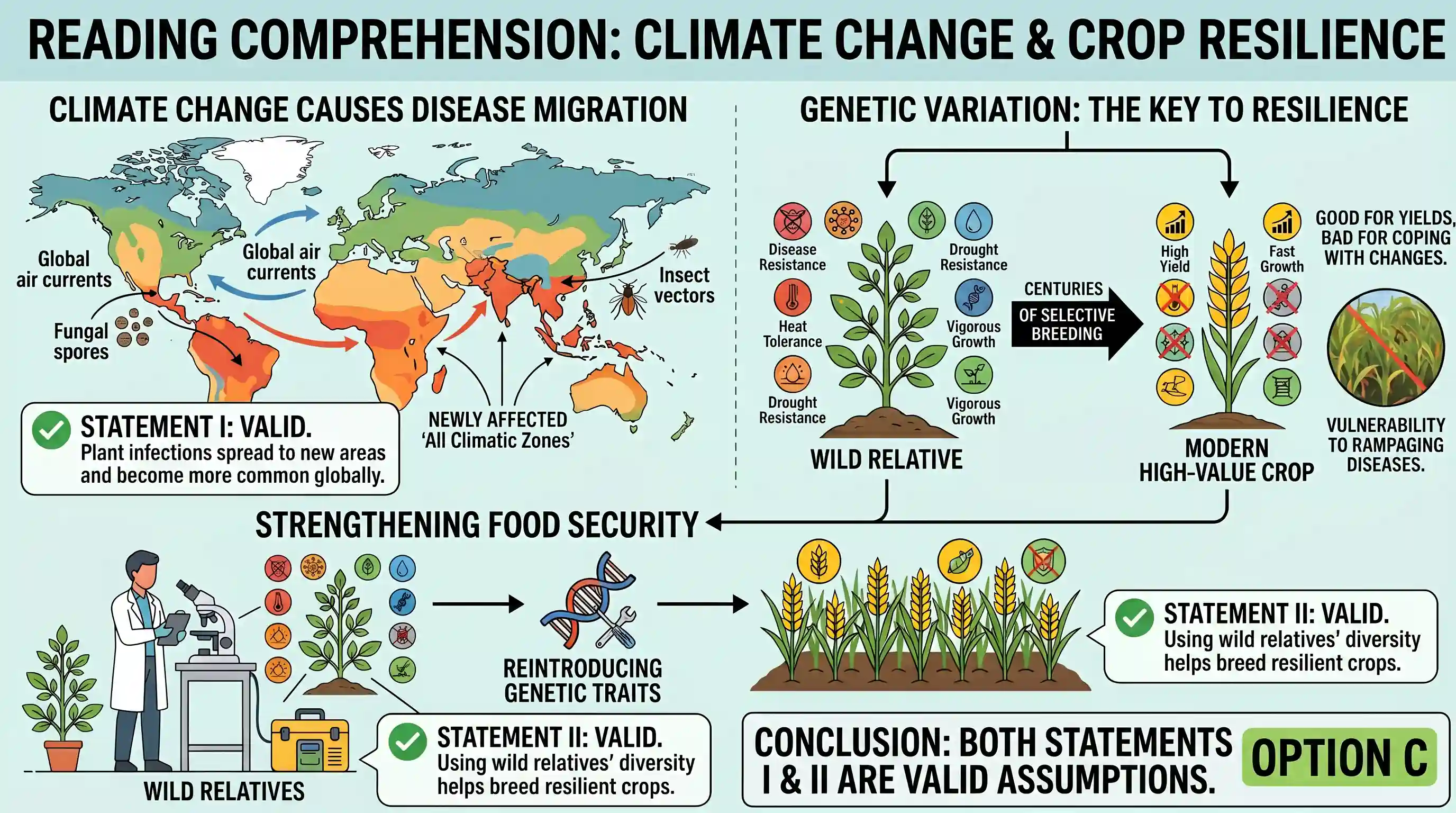
It is hard to predict how changes in the climate and the atmosphere's chemistry will affect the prevalence and virulence of agricultural diseases. But there is a risk that such changes will make some plant infections more common in all climatic zones, perhaps catastrophically so. Part of the problem is that centuries of selective breeding have refined the genomes of most high- value crops. They are spectacular at growing in today's conditions but genetic variations that are not immediately useful to them have been bred out. This is good for yields but bad for coping with changes. A minor disease or even an unknown one could suddenly rampage through a genetically honed crop. With reference to the above passage, the following assumptions have been made : I. Global climate change can result in the migration of several plant diseases to new areas. II. Scientific understanding of the wild relatives of our present crops would enable us to strengthen food security. Which of the above assumptions is/are valid ?

- AI only
- BII only
- CBoth I and IICorrect
- DNeither I nor II
Explanation
The passage states that changes in climate and atmosphere could make plant infections "more common in all climatic zones." This directly supports Statement I, as "more common in all climatic zones" implies diseases spreading or migrating to new areas where they were not previously prevalent.
The passage also notes that centuries of selective breeding have removed genetic variations not immediately useful to high-value crops, making them "bad for coping with changes" and susceptible to new diseases. This implies that genetic diversity is crucial for resilience. Wild relatives of crops are the natural source of such genetic variations. Therefore, understanding these wild relatives would enable us to reintroduce beneficial genetic traits (like disease resistance) into cultivated crops, thereby strengthening food security against new threats. This makes Statement II a valid assumption derived from the problem described in the passage.
Since both statements are valid assumptions, option C is correct.
Related questions
More UPSC Prelims practice from the same subject and topic.
- Prelims 2025CSATReading Comprehension
Maintaining an ecosystem just to conserve biodiversity will affect its commercial potential as well as the livelihoods dependent on the ecosystem. There is also a conflict between using an ecosystem o…
- Prelims 2025CSATReading Comprehension
Maintaining an ecosystem just to conserve biodiversity will affect its commercial potential as well as the livelihoods dependent on the ecosystem. There is also a conflict between using an ecosystem o…
- Prelims 2025CSATReading Comprehension
]The history of renewable energy suggests there is a steep learning curve, meaning that, as more is produced, costs fall rapidly because of economies of scale and learning by doing. The firms' green i…
- Prelims 2025CSATReading Comprehension
]The history of renewable energy suggests there is a steep learning curve, meaning that, as more is produced, costs fall rapidly because of economies of scale and learning by doing. The firms' green i…
- Prelims 2025CSATReading Comprehension
Each State in India faces a distinctive set of challenges regarding the impact of warming, but also offers its own set of opportunities for reducing emissions depending on its natural resources. For e…
- Prelims 2025CSATReading Comprehension
Each State in India faces a distinctive set of challenges regarding the impact of warming, but also offers its own set of opportunities for reducing emissions depending on its natural resources. For e…