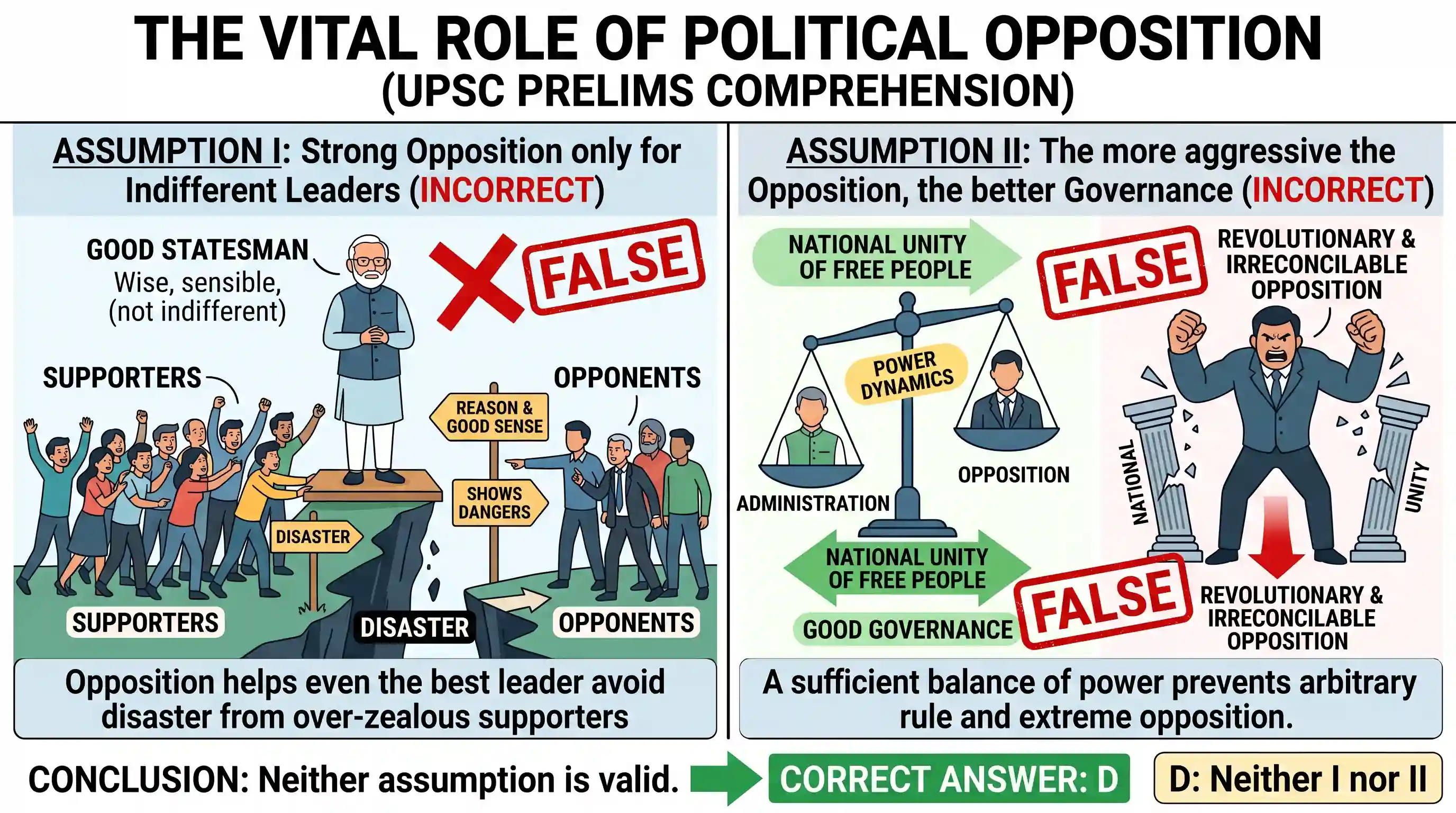
"A good statesman, like any other sensible human being, learns more from his opponents than from his fervent supporters. For his supporters will push him to disaster unless his opponents show him where the dangers are. So if he is wise he will often pray to be delivered from his friends, because they will ruin him. But, though it hurts, he ought also to pray never to be left without opponents; for they keep him on the path of reason and good sense. The national unity of free people depends upon a sufficiently even balance of political power to make it impracticable for the administration to be arbitrary and for opposition to be revolutionary and irreconcilable." With reference to the above passage, the following assumptions have been made : I. In a democracy, a strong opposition is required only if the Head of Government is indifferent. II. The more aggressive the opposition, the better is the governance in a democracy. Which of the above assumptions is/are valid ?

- AI only
- BII only
- CBoth I and II
- DNeither I nor IICorrect
Explanation
The passage emphasizes the crucial role of opponents (opposition) in a democracy, not just as a check on a bad leader, but as an essential element for any statesman to stay on the path of reason and good sense, and to prevent the administration from becoming arbitrary.
Let's analyze each assumption:
I. In a democracy, a strong opposition is required only if the Head of Government is indifferent. This assumption is incorrect. The passage states that a good statesman learns from opponents and that opponents keep him on the path of reason and good sense. It implies that even a wise and sensible leader benefits from opposition to avoid being pushed to disaster by supporters. The passage does not limit the need for a strong opposition to cases where the Head of Government is "indifferent"; rather, it presents it as a fundamental requirement for good governance regardless of the leader's disposition. The word "only if" makes this statement too restrictive and invalid.
II. The more aggressive the opposition, the better is the governance in a democracy. This assumption is incorrect. While the passage highlights the importance of opponents, the last sentence explicitly states that national unity depends on a balance of political power to make it impracticable "for opposition to be revolutionary and irreconcilable." This implies that there is a limit to how aggressive an opposition should be. An overly aggressive, revolutionary, or irreconcilable opposition is presented as detrimental to national unity, not as leading to better governance. Therefore, "the more aggressive... the better" is an oversimplification and contradicts the passage's nuance about balanced power.
Since neither assumption is valid according to the passage, D is the correct answer.
Related questions
More UPSC Prelims practice from the same subject and topic.
- Prelims 2025CSATReading Comprehension
Maintaining an ecosystem just to conserve biodiversity will affect its commercial potential as well as the livelihoods dependent on the ecosystem. There is also a conflict between using an ecosystem o…
- Prelims 2025CSATReading Comprehension
Maintaining an ecosystem just to conserve biodiversity will affect its commercial potential as well as the livelihoods dependent on the ecosystem. There is also a conflict between using an ecosystem o…
- Prelims 2025CSATReading Comprehension
]The history of renewable energy suggests there is a steep learning curve, meaning that, as more is produced, costs fall rapidly because of economies of scale and learning by doing. The firms' green i…
- Prelims 2025CSATReading Comprehension
]The history of renewable energy suggests there is a steep learning curve, meaning that, as more is produced, costs fall rapidly because of economies of scale and learning by doing. The firms' green i…
- Prelims 2025CSATReading Comprehension
Each State in India faces a distinctive set of challenges regarding the impact of warming, but also offers its own set of opportunities for reducing emissions depending on its natural resources. For e…
- Prelims 2025CSATReading Comprehension
Each State in India faces a distinctive set of challenges regarding the impact of warming, but also offers its own set of opportunities for reducing emissions depending on its natural resources. For e…