An explosion takes place at a certain distance from an army camp. As soon as the sensor in the camp receives the sound of the explosion, a drone starts flying towards the spot of explosion. The drone clicks a picture from the spot and the camp receives it at the same time. Immediately another drone starts flying to the spot and it also sends a picture as soon as it reaches the spot. The two pictures were received at 5:02 PM and 5:05 PM, respectively. If the speed of the drones is 30 m/s, at what time did the explosion take place? Assume that the speed of sound is 300 m/s.

- A4:59:00 PM
- B4:59:02 PM
- C4:58:42 PMCorrect
- D4:56:32 PM
Explanation
Correct Answer: Option C (4:58:42 PM)
This question tests the concepts of Time, Speed, and Distance (TSD), a core quantitative component of the UPSC Civil Services Aptitude Test (CSAT) Paper-II.
Let the distance from the camp to the explosion be D meters, and let the explosion occur at time T.
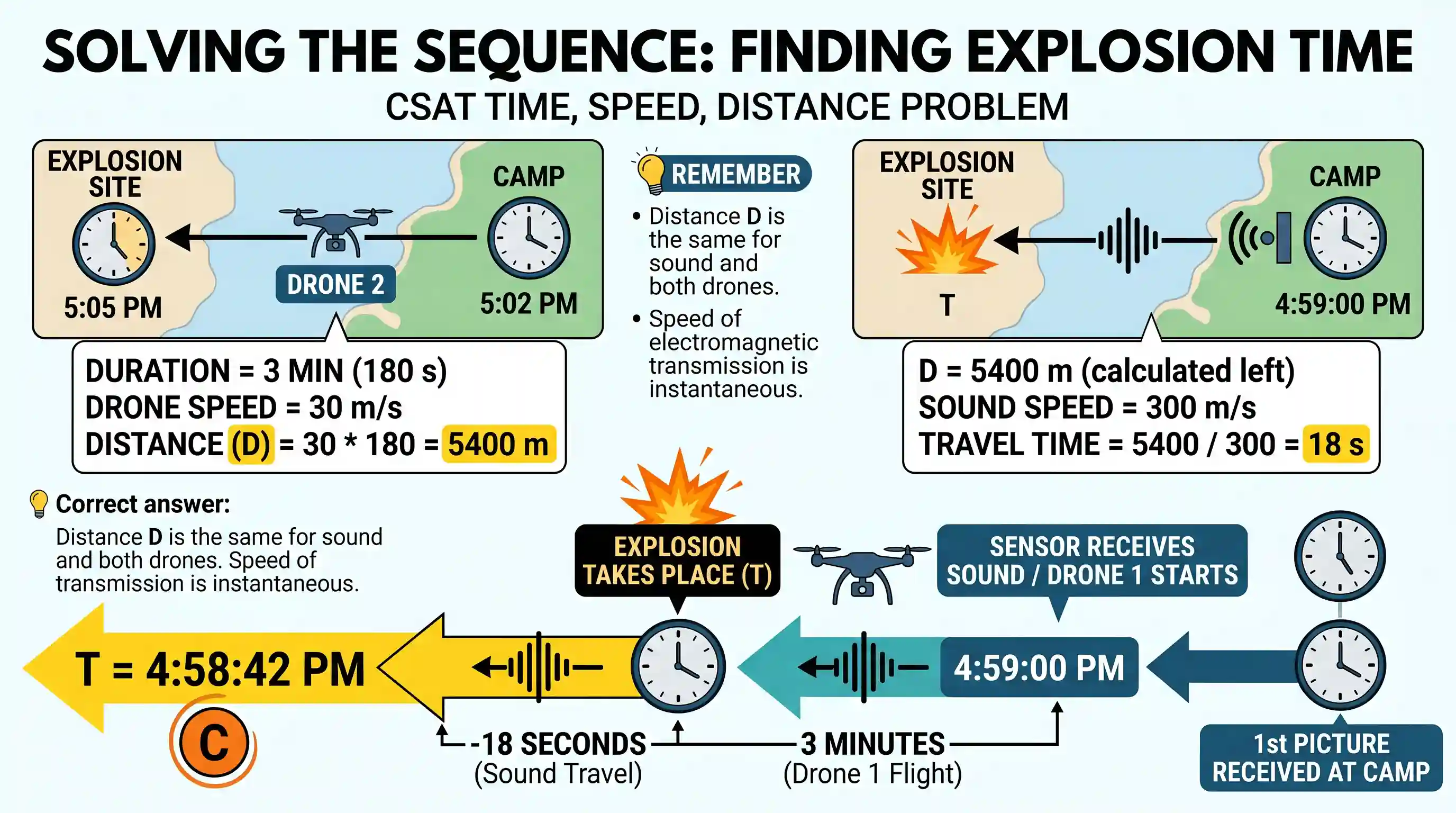
- Second Drone's Journey: The second drone departs exactly at 5:02 PM when the first picture is received. It reaches the spot at 5:05 PM, meaning its travel time is exactly 3 minutes (180 seconds). Using the standard physical formula Distance = Speed × Time, we determine D = 30 m/s × 180 s = 5400 meters.
- Sound's Journey: The acoustic wave of the explosion travels 5400 meters to the army camp. The time taken by the sound is Time = 5400 m / 300 m/s = 18 seconds.
- First Drone's Journey: The camp's sensors pick up the sound at T + 18 seconds. The first drone then takes 180 seconds (3 minutes) to travel the 5400 meters, taking and transmitting a picture at 5:02:00 PM. (Because electromagnetic radio waves transmit pictures at the speed of light, this transmission time is practically instantaneous and negligible).
- Calculating T: Therefore, the timeline is T + 18 seconds + 3 minutes = 5:02:00 PM. Subtracting 3 minutes and 18 seconds from 5:02:00 PM yields the exact time of the explosion: 4:58:42 PM.
Why the other options are incorrect:
- Option A (4:59:00 PM): Incorrect because it subtracts only the drone's 3-minute travel time from 5:02 PM, failing to account for the 18-second acoustic travel time.
- Option B (4:59:02 PM): Incorrect due to an arithmetic error in subtracting the sound travel time.
- Option D (4:56:32 PM): Incorrect as it wrongly subtracts both drones' travel times (6 minutes) from the first picture's timestamp rather than establishing a proper chronological sequence.
Takeaway: In sequential TSD questions involving multiple moving parts, chart the timeline step-by-step. Always isolate the unknown distance by analyzing the most complete time interval (in this case, the second drone's journey).
Related questions
More UPSC Prelims practice from the same subject and topic.
- Prelims 2026GS1other
Which of the following statements with regard to the Grand Slam Tennis Tournaments is/are correct ? 1. The tournaments have a shared governance structure establishing the partnership among the four Gr…
- Prelims 2026GS1other
Ms. X is a mid-level civil service official working in the urban development department of a major city. Recently, she was involved in approving a contract for a public infrastructure project — a new …
- Prelims 2026GS1other
Which one of the following pairs is not correctly matched? (Indian Army Corps) : (Headquarters)
- Prelims 2026CSATother
For ⅓ < x < y < 2, which of the following statements is/are always correct? I. x + 1/x < y + 1/y II. √(1 + y²)/y < √(1 + x²)/x Select the answer using the code given below.
- Prelims 2026CSATother
What is the minimum number of times one needs to measure to get 298 litres of water from a tank, if the measuring cylinders have capacities 1 litre, 6 litres, 25 litres and 100 litres?
- Prelims 2026CSATother
There are four types of weights, namely 1 kg, 2 kg, 5 kg and 10 kg. What is the maximum number of different ways one can measure 20 kg, if at least eight but not more than eleven weights of 1 kg are t…