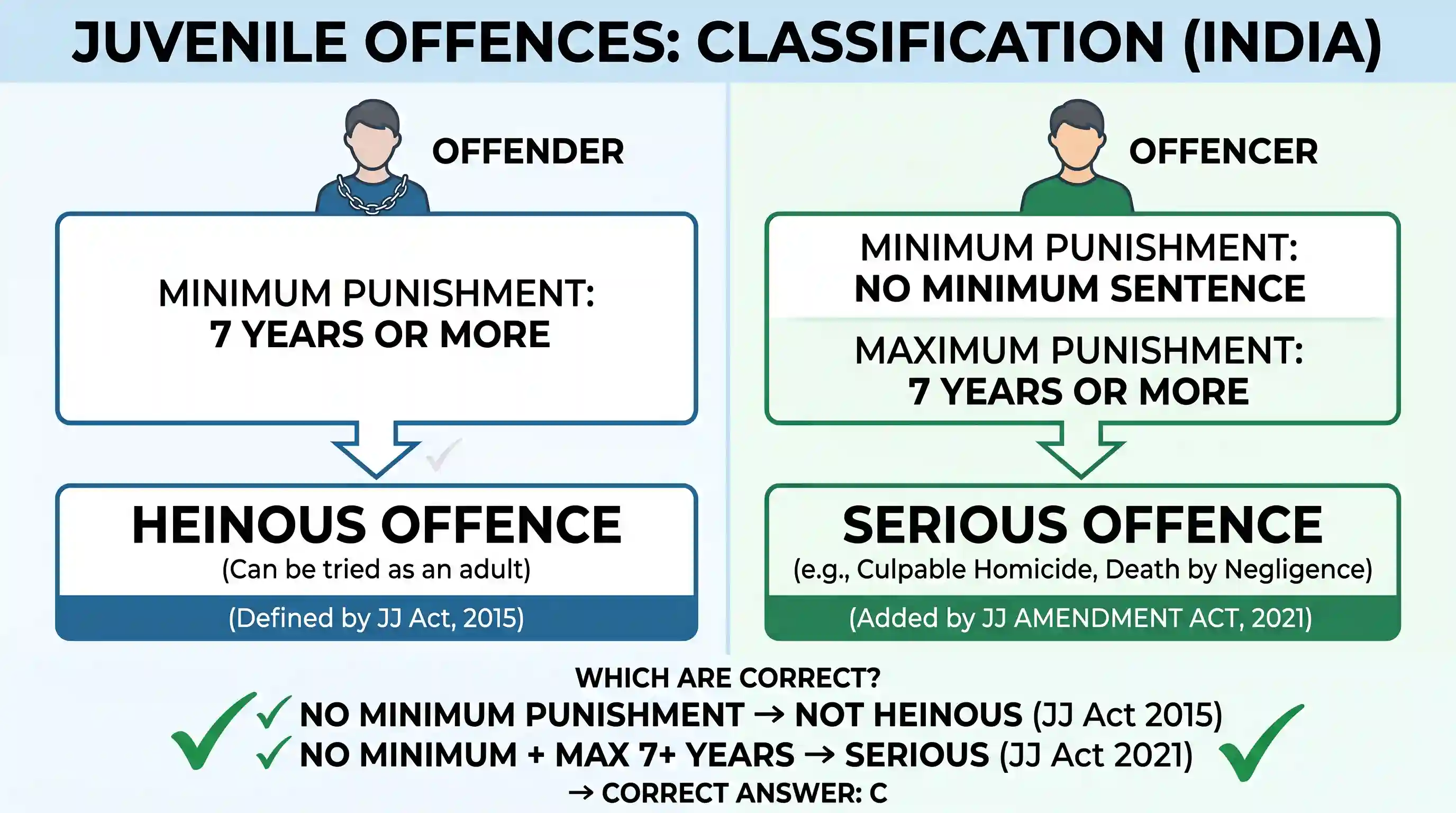
Passage: The Juvenile Justice (Care and Protection of Children) Act, or the JJ Act, 2015 allows for the possibility for trying adolescents above 16 as adults if they are accused of committing a heinous offence. A heinous offence is one with a minimum punishment of seven years. Offences such as culpable homicide and causing death by negligence, which are common in drunken driving cases, are not heinous offences because they do not have a prescribed minimum punishment. The JJ Act, amended in 2021, now categorises an offence that has no minimum sentence, but has a maximum sentence of seven years or more as a serious offence which nonetheless, in the opinion of activists, does not merit the transfer of a case to the adult criminal justice system. Question: Which of the following statements is/are correct? 1. If an offence has no minimum prescribed punishment, it cannot be considered heinous as per the JJ Act, 2015. 2. As per the JJ Act, 2021, an offence for which there is a provision for a maximum sentence of seven years or more, but no minimum sentence, is to be considered a serious offence. Select the answer using the code given below.

- A1 only
- B2 only
- CBoth 1 and 2Correct
- DNeither 1 nor 2
Explanation
The correct answer is C) Both 1 and 2.
Statement 1 is correct. Under Section 2(33) of the Juvenile Justice (Care and Protection of Children) Act, 2015, a "heinous offence" is strictly defined as an offence for which the minimum punishment under the Indian Penal Code (IPC) or any other law is imprisonment for seven years or more. Therefore, if a crime has a maximum sentence of seven years or more but lacks a prescribed minimum sentence (such as culpable homicide not amounting to murder), it cannot be legally categorized as a heinous offence. The Supreme Court notably highlighted this legislative gap in the landmark Shilpa Mittal v. State of NCT of Delhi (2020) judgment.
Statement 2 is correct. To rectify the aforementioned loophole, the Parliament passed the Juvenile Justice (Care and Protection of Children) Amendment Act, 2021. The amendment expanded the definition of "serious offences" under the Act. It established that any offence carrying a maximum sentence of more than seven years of imprisonment, but having no minimum sentence prescribed (or a minimum sentence of less than seven years), will now be treated as a "serious offence."
Why the other options are wrong:
- Option A is incorrect because it dismisses the validity of Statement 2, which correctly reflects the 2021 amendment.
- Option B is incorrect because Statement 1 is also completely true; an offence cannot be "heinous" without a prescribed minimum of seven years.
- Option D is incorrect because both statements are factually sound representations of the law.
Concluding Takeaway: To easily differentiate the categories under the JJ Act: Heinous strictly requires a minimum sentence of 7 years. If a crime has a maximum of 7+ years but no prescribed minimum, the 2021 amendment automatically categorizes it as Serious.
Related questions
More UPSC Prelims practice from the same subject and topic.
- Prelims 2026GS1polity
Mr. X, a senior officer, was overseeing a critical vaccination programme during a pandemic. He found that a private service provider responsible for vaccine distribution was compromising on quality to…
- Prelims 2026GS1polity
In a multi-ethnic district where both economic competition and historical grievances frequently led to community tensions, a flashpoint has arisen with a Government decision to allocate land for a was…
- Prelims 2026GS1polity
'X' was addressing a seminar on the meaning of the term 'law' as provided under Article 13, Part III of the Constitution of India. 'X' explained that the meaning of the term 'law' in the Constitution …
- Prelims 2026GS1polity
Consider the following statements with reference to the Constitution of India : 1. There is no Article in the Constitution of India that specifies that the Constitution of India will be officially cal…
- Prelims 2026GS1polity
Which of the following statements with regard to the persons with disabilities in India is/are correct ? 1. The Rights of Persons with Disabilities Act, an Act passed by the Parliament of India in 201…
- Prelims 2026GS1polity
Consider the following statements about the provisions pertaining to the Scheduled Castes and the Scheduled Tribes in India : 1. Provisions regarding the administration of the Tribal Areas in the Stat…