A person saves 10% of his salary every month. If his salary increases by 12% and the expenditure increases by 10%, then what will be the change in his saving per month?

- A20% increase
- B30% increaseCorrect
- C03% decrease
- D02% decrease
Explanation
This question tests Basic Numeracy (Percentages), formally evaluated under the UPSC Civil Services Aptitude Test (CSAT) Paper-II framework, which tests candidates at a Class X mathematical standard.
Why Option B is correct: Applying standard percentage principles, we assume a baseline value of 100 to simplify the calculations:
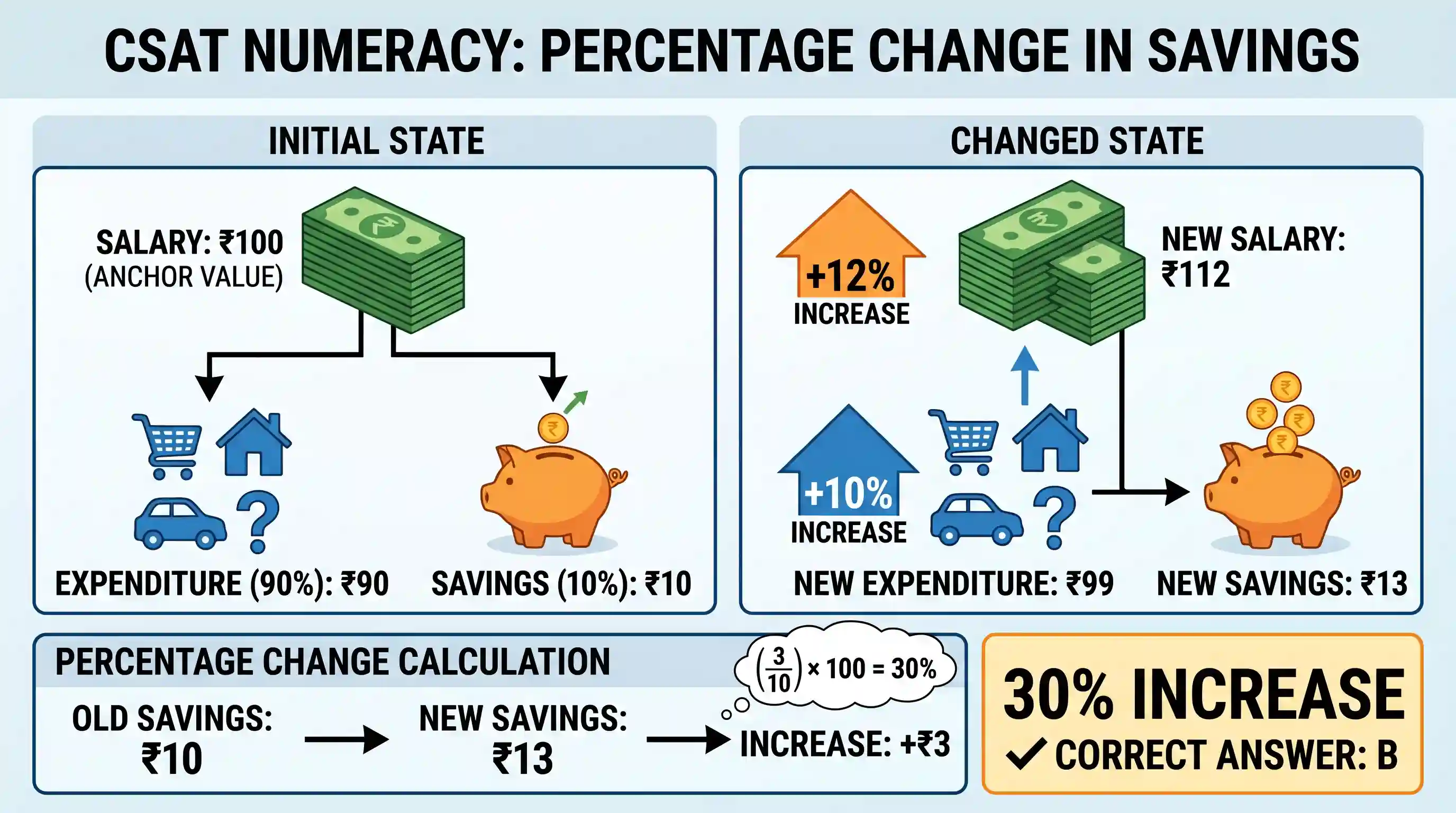
- Initial State: Let the person's initial monthly salary be ₹100. Since he saves 10%, his initial saving is ₹10. Therefore, his initial expenditure is ₹100 - ₹10 = ₹90.
- Changed State: The salary increases by 12%, making the new salary ₹112. The expenditure increases by 10%. A 10% increase on the initial expenditure of ₹90 is ₹9, resulting in a new expenditure of ₹90 + ₹9 = ₹99.
- Final Calculation: The new saving equals the new salary minus the new expenditure (₹112 - ₹99 = ₹13). The absolute increase in saving is ₹13 - ₹10 = ₹3. Applying the standard formula for percentage change—
[(New Value - Old Value) / Old Value] × 100—we get(3 / 10) × 100 = 30%. Thus, the saving increases by 30%, making Option B the correct answer.
Why the other options are incorrect:
- Option A (20% increase): Incorrect due to arbitrarily combining the percentages (e.g., averaging 12% and 10%) instead of applying them to the actual base values.
- Option C (03% decrease): Incorrect because it confuses the absolute numerical increase (3) with a percentage decrease, acting as a mathematical distractor.
- Option D (02% decrease): Incorrect as it mistakenly subtracts the percentage rates directly (10% expenditure - 12% salary = -2%), violating the mathematical rule that percentages on different bases cannot be directly added or subtracted.
Concluding Takeaway: Rule of Thumb: For percentage changes linking Income, Expenditure, and Savings, always anchor the initial salary at 100. Compute the independent absolute values for each component before calculating the final percentage change.
Related questions
More UPSC Prelims practice from the same subject and topic.
- Prelims 2026GS1other
Which of the following statements with regard to the Grand Slam Tennis Tournaments is/are correct ? 1. The tournaments have a shared governance structure establishing the partnership among the four Gr…
- Prelims 2026GS1other
Ms. X is a mid-level civil service official working in the urban development department of a major city. Recently, she was involved in approving a contract for a public infrastructure project — a new …
- Prelims 2026GS1other
Which one of the following pairs is not correctly matched? (Indian Army Corps) : (Headquarters)
- Prelims 2026CSATother
For ⅓ < x < y < 2, which of the following statements is/are always correct? I. x + 1/x < y + 1/y II. √(1 + y²)/y < √(1 + x²)/x Select the answer using the code given below.
- Prelims 2026CSATother
What is the minimum number of times one needs to measure to get 298 litres of water from a tank, if the measuring cylinders have capacities 1 litre, 6 litres, 25 litres and 100 litres?
- Prelims 2026CSATother
There are four types of weights, namely 1 kg, 2 kg, 5 kg and 10 kg. What is the maximum number of different ways one can measure 20 kg, if at least eight but not more than eleven weights of 1 kg are t…