P has a son and a daughter. S is the mother of T. S is R's spouse. Q and R are children of P. Then how is Q related to S?

- AQ is a sister of S
- BQ is a daughter of S
- CQ is the mother of S
- DQ is a sister of the husband of SCorrect
Explanation
The correct answer is D) Q is a sister of the husband of S.
Step-by-Step Logical Deduction:
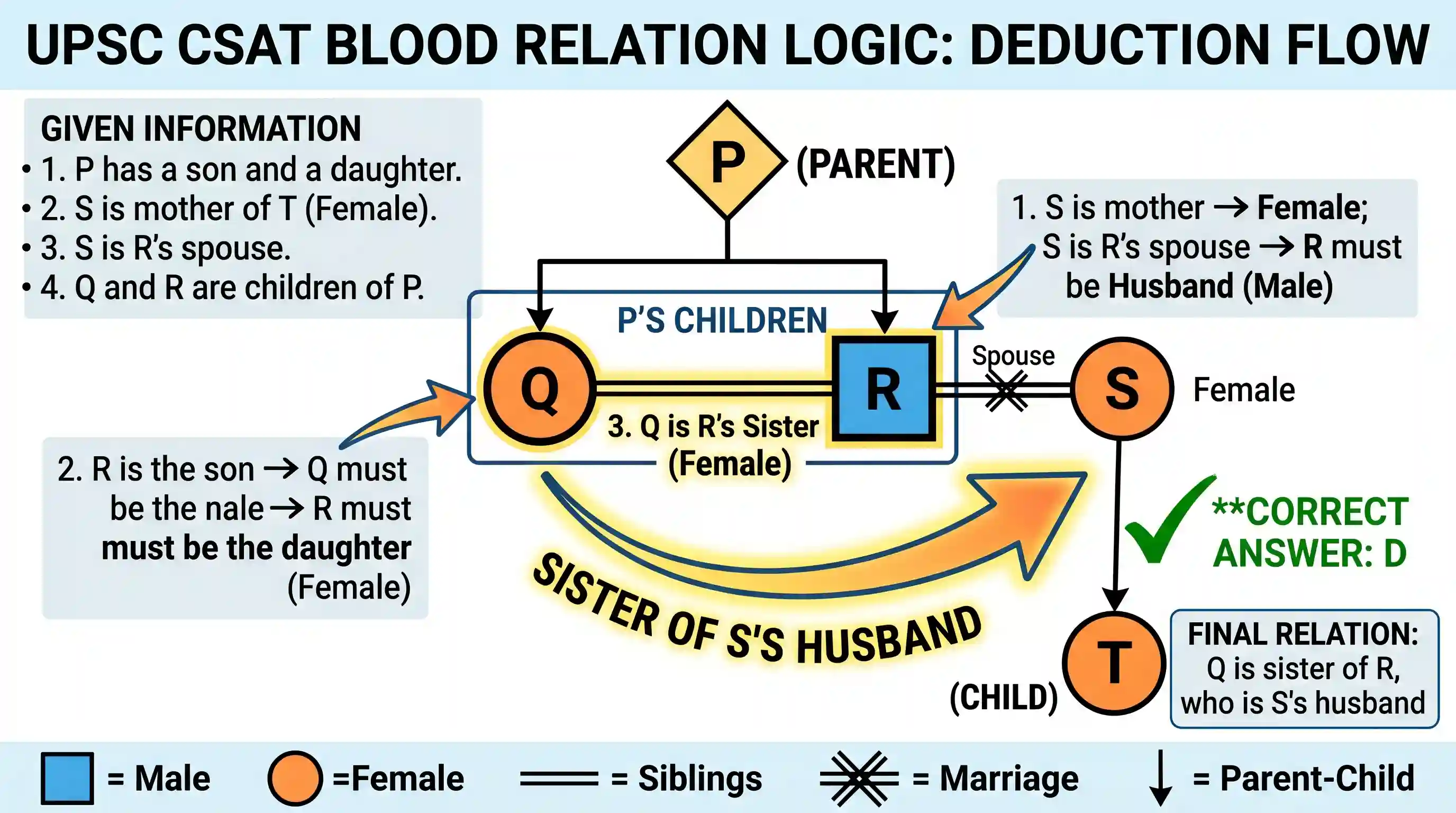
- Identify P's children: The premise states that P has exactly one son and one daughter. We are also told that Q and R are the children of P.
- Determine genders through marriage: We know that S is the mother of T, which establishes that S is female. The problem states that S is R's spouse. Since S is a female (wife), her spouse R must be logically identified as male (husband).
- Assign genders to Q and R: Because R is male, he is the son of P. Since P has exactly one son and one daughter, and R is the son, Q must inherently be the daughter of P. Thus, Q is female and is the sister of R.
- Establish the final relationship: S is married to R (S is the wife, R is the husband). Q is the sister of R. Therefore, Q is the sister of S's husband.
Why the other options are incorrect:
- A) Q is a sister of S: Incorrect. Q and S do not share parents; Q is the sister of R (S's husband), making them sisters-in-law.
- B) Q is a daughter of S: Incorrect. Q is from the same generation as S and R; Q is the daughter of P, not the daughter of S.
- C) Q is the mother of S: Incorrect. Q is in the same generation as S, and S's parentage is not defined in the premises.
Concluding Takeaway: When tackling Blood Relation puzzles in the UPSC Civil Services Aptitude Test (CSAT Paper II, a component introduced in 2011 to evaluate logical reasoning and analytical ability), quickly sketch a family tree using standard demographic symbols (e.g., squares for males, circles for females). Always deduce the gender of unspecified individuals by examining their spouse or sibling constraints!
Related questions
More UPSC Prelims practice from the same subject and topic.
- Prelims 2026GS1other
Which of the following statements with regard to the Grand Slam Tennis Tournaments is/are correct ? 1. The tournaments have a shared governance structure establishing the partnership among the four Gr…
- Prelims 2026GS1other
Ms. X is a mid-level civil service official working in the urban development department of a major city. Recently, she was involved in approving a contract for a public infrastructure project — a new …
- Prelims 2026GS1other
Which one of the following pairs is not correctly matched? (Indian Army Corps) : (Headquarters)
- Prelims 2026CSATother
For ⅓ < x < y < 2, which of the following statements is/are always correct? I. x + 1/x < y + 1/y II. √(1 + y²)/y < √(1 + x²)/x Select the answer using the code given below.
- Prelims 2026CSATother
What is the minimum number of times one needs to measure to get 298 litres of water from a tank, if the measuring cylinders have capacities 1 litre, 6 litres, 25 litres and 100 litres?
- Prelims 2026CSATother
There are four types of weights, namely 1 kg, 2 kg, 5 kg and 10 kg. What is the maximum number of different ways one can measure 20 kg, if at least eight but not more than eleven weights of 1 kg are t…