Which of the following statements about a Zero First Information Report (Zero FIR) under the Bharatiya Nagarik Suraksha Sanhita (BNSS), 2023 is/are correct ? 1. A Zero FIR can be lodged at a police station, even though the place of commission of a cognizable/non-cognizable offence is outside the territorial jurisdiction of that police station. 2. The Officer-in-Charge of the police station where a Zero FIR has been lodged may, with the permission of the competent authority, initiate a preliminary enquiry. 3. Under Zero FIR, it is obligatory for the informant to furnish information electronically. Select the answer using the code given below :

- A1, 2 and 3
- B2 and 3 only
- C1 only
- D2 onlyCorrect
Explanation
The Bharatiya Nagarik Suraksha Sanhita (BNSS), 2023, which replaces the colonial-era Code of Criminal Procedure (CrPC), introduces significant procedural reforms to the First Information Report (FIR) mechanism under Section 173.
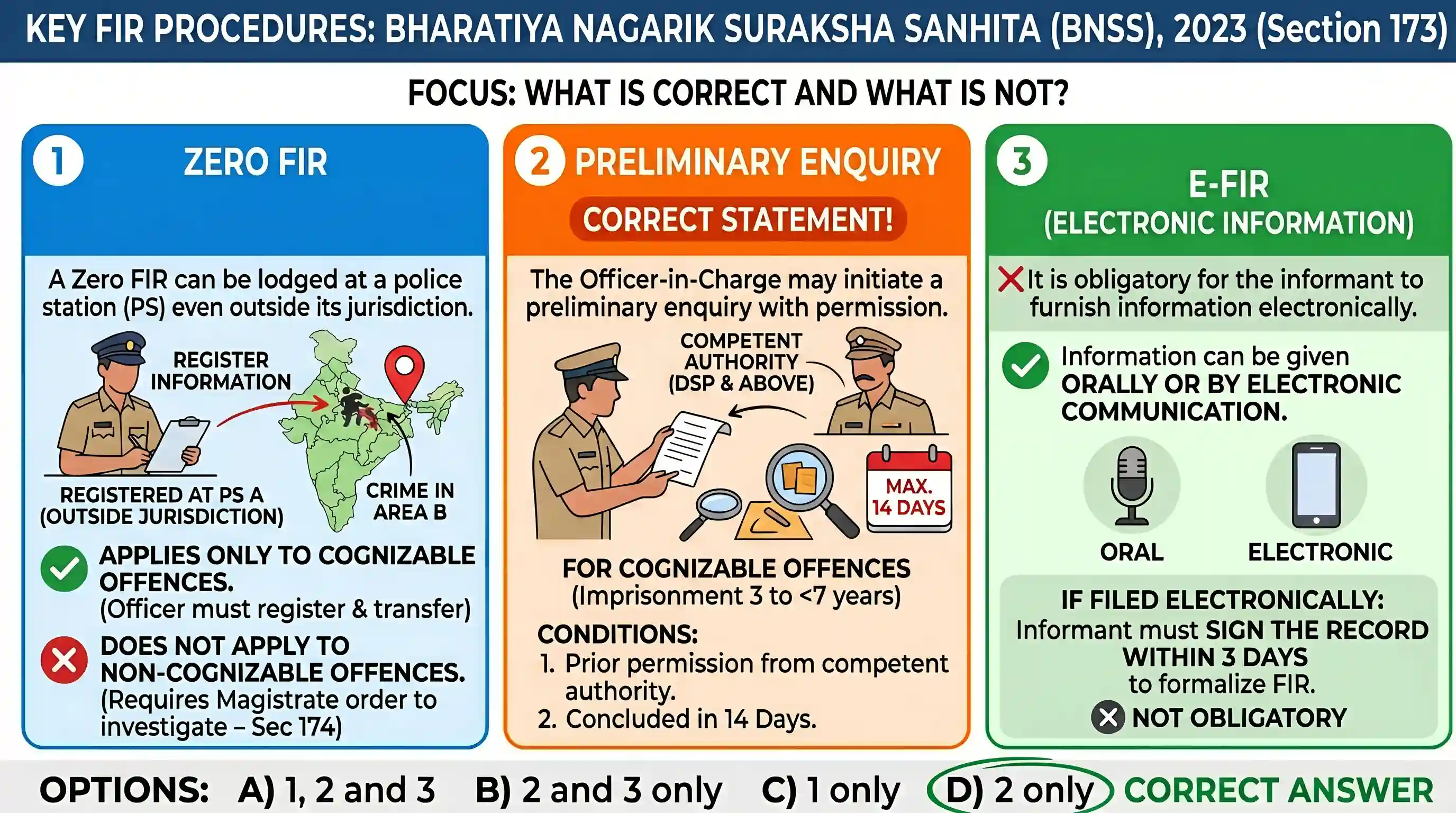
Statement 1 is incorrect: The provision for a Zero FIR applies exclusively to cognizable offences, not non-cognizable offences. Under Section 173(1) of the BNSS, if the police receive information about a cognizable offence, they must register it irrespective of the territorial jurisdiction where the crime occurred. This is registered without a serial number (hence 'Zero FIR') and transferred to the appropriate jurisdiction. Non-cognizable offences, governed by Section 174 of the BNSS, do not fall under the Zero FIR framework as police require a Magistrate's authorization to investigate them.
Statement 2 is correct: Section 173(3) of the BNSS introduces a statutory provision for preliminary enquiries. For cognizable offences punishable with imprisonment of 3 to less than 7 years, the Officer-in-Charge may conduct a preliminary enquiry to ascertain if a prima facie case exists. However, this requires prior permission from a competent authority (an officer not below the rank of Deputy Superintendent of Police) and must be concluded within 14 days.
Statement 3 is incorrect: It is not obligatory to furnish information electronically. Section 173(1) of the BNSS expressly permits information to be given "orally or by electronic communication". While the BNSS officially integrates the 'e-FIR', traditional oral or written submissions remain entirely valid. If filed electronically, the informant must sign the record within three days for it to be formally registered.
Takeaway: BNSS 2023 codifies Zero FIRs and e-FIRs solely for cognizable offences, while introducing a 14-day preliminary enquiry filter for offences with 3–7 year punishments to prevent arbitrary arrests.
Related questions
More UPSC Prelims practice from the same subject and topic.
- Prelims 2026GS1polity
Mr. X, a senior officer, was overseeing a critical vaccination programme during a pandemic. He found that a private service provider responsible for vaccine distribution was compromising on quality to…
- Prelims 2026GS1polity
In a multi-ethnic district where both economic competition and historical grievances frequently led to community tensions, a flashpoint has arisen with a Government decision to allocate land for a was…
- Prelims 2026GS1polity
'X' was addressing a seminar on the meaning of the term 'law' as provided under Article 13, Part III of the Constitution of India. 'X' explained that the meaning of the term 'law' in the Constitution …
- Prelims 2026GS1polity
Consider the following statements with reference to the Constitution of India : 1. There is no Article in the Constitution of India that specifies that the Constitution of India will be officially cal…
- Prelims 2026GS1polity
Which of the following statements with regard to the persons with disabilities in India is/are correct ? 1. The Rights of Persons with Disabilities Act, an Act passed by the Parliament of India in 201…
- Prelims 2026GS1polity
Consider the following statements about the provisions pertaining to the Scheduled Castes and the Scheduled Tribes in India : 1. Provisions regarding the administration of the Tribal Areas in the Stat…